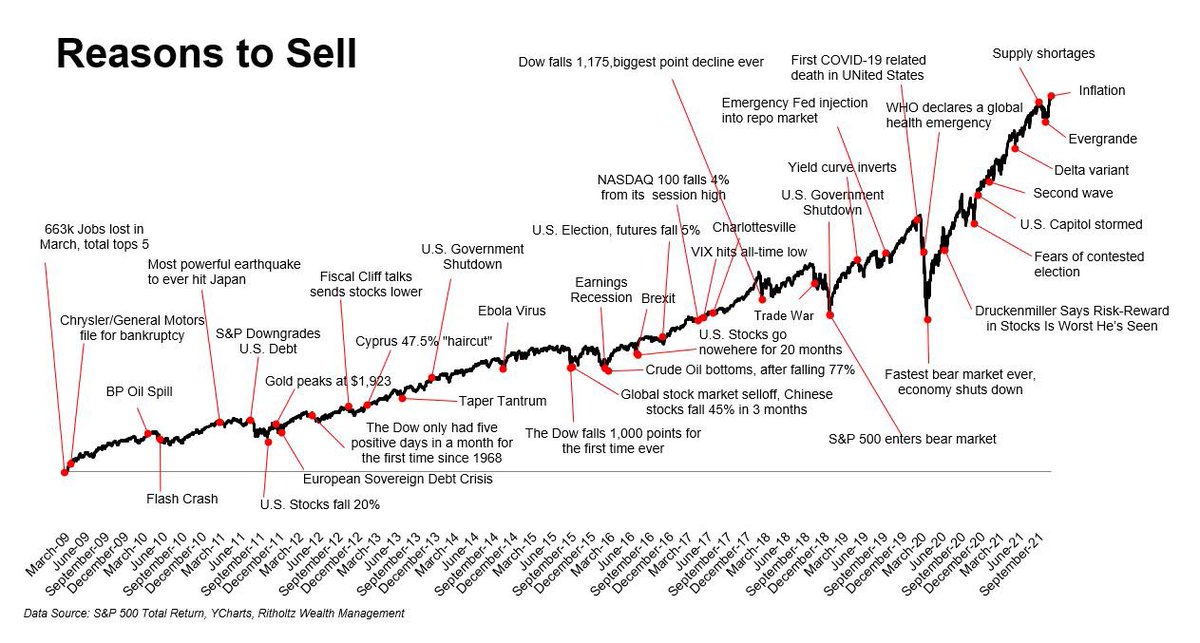
Charlie Munger said: “If all you ever did was buy high-quality stocks on the 200-week moving average, you would beat the S&P 500 by a large margin over time. The problem is, few human beings have that kind of discipline."
Instead of cutting spending and reducing deficits, Washington is considering using nearly $1 trillion from the Treasury General Account to suppress bond yields.
Step 1: Create the problem
Step 2: Refuse to fix the problem
Step 3: Manipulate the market to hide the problem
Railroads were once 63% of the entire US stock market.
Not 63% of transport stocks. 63% of everything listed.
The history of concentration, in order:
– Tulips, 1637. A single bulb traded for the price of an Amsterdam canal house.
– South Sea Company, 1720. Shares went from about £128 in January to above £1,000 by summer, then back near £150 by December.
– US railroads, 1840s. 63% of US market cap.
– Utilities, telecom and industrials, 1929. 36%.
– Nifty Fifty, 1972. 40%.
– Japan, 1989. 44% of global equity.
– Dot com, 2000. 41%.
– AI Big 10, today. About 40%.
Every one of them was built on something real. Railroads did compress a continent. The internet did rewire commerce. Being right about the technology was never the thing that protected you.
The tulip story is also less clean than the legend. Modern research found the economic damage was modest and the ruin was mostly literary.
The bubble was never in the idea. It was in how many people decided to own the same idea at the same time.
As an Indian if you are investing in US Markets via Indian Funds be careful.
You pay basically a 20% premium.
Something that should be 100, costs you 120.
Even when the underlying asset goes up, you can still lose money. Because of this artificial premium.
You are basically betting that other Indian investors will keep overpaying at the same approx premium rates that you are paying today.
Solution: if you wish to own QQQ/US Index, just buy directly. Open a US Brokerage account with any app you like. And, invest.
Honestly, no one is coaching you on such topics. And, you are losing crazy wealth due to all these middle agents.
ex-CEO of Goldman Sachs just explained how he spotted the 2008 crisis from a movie theater on his BlackBerry
"something moved 6% that was only supposed to move 4 basis points - I said excuse me I have to go to the bathroom - and started making calls"
"I don't care what you think is going to happen - I only want to know what could possibly happen - even with low probability - and what we're doing about it"
"we were very good contingency planners - when that remote contingency happens you get off the block so quickly people think you anticipated the gun - we just heard it and acted quicker"
bookmark & watch the full conversation ↓
So, now the minimum tariff plan starts at ₹349/- from ₹299/-
TRAI should consider a plan under ₹99/- for folks who use basic facilities like voice calls.
Millions of poor people will benefit from it, who never use data.
The bond market situation is crazy.
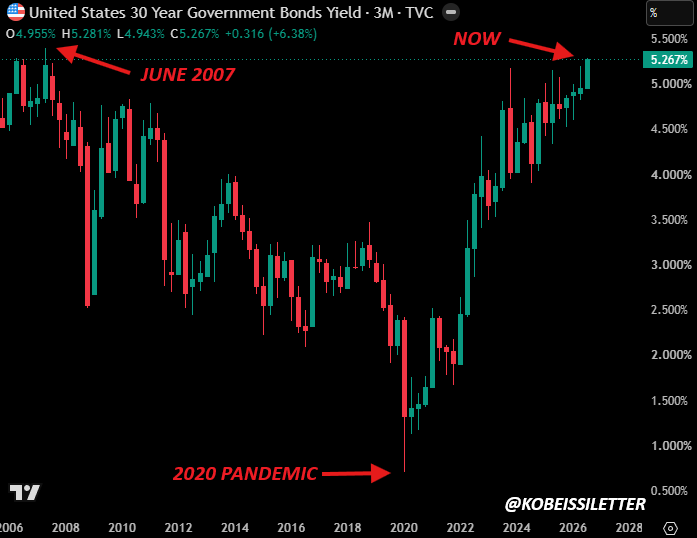
While everyone focuses on AI, US borrowing rates just hit the highest level since June 2007.
Credit card "serious delinquencies" are at the highest since 2010 and mortgage rates could near 8%.
What's happening? Let us explain.
(a thread)
The bond market is out of control.
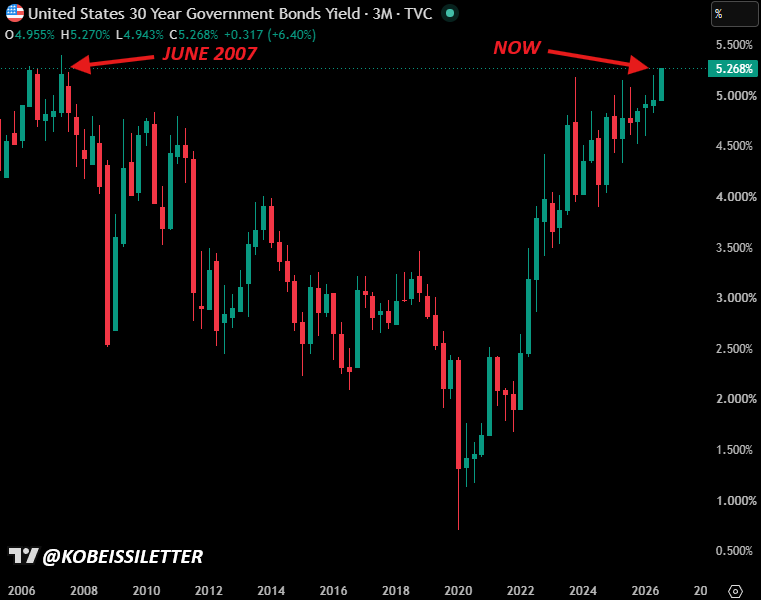
The US 30Y Note Yield is now up to 5.27%, its highest level since June 2007.
This officially marks a +450 basis point rally since the low seen in 2020.
At the current pace, we are on track to see US 30Y mortgage rates exceed 7.50% by year-end.
And to top it all off, Fed Chair Warsh is now adamant that the market should operate independently, without Fed guidance.
Even without rate hikes or Fed guidance, the market is sending rates higher; operating exactly how Fed Chair Warsh wants it to operate.
The bond market will soon be the most talked about component of global capital markets.
This simply is not sustainable.
Absolutely incredible.
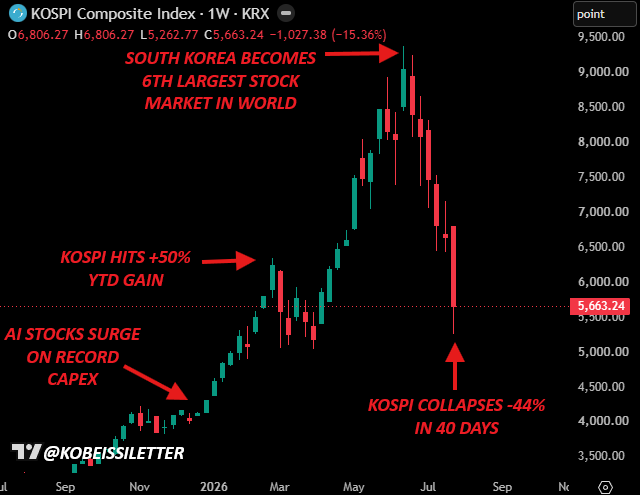
In an unprecedented move, South Korea's stock market just collapsed -44% in 40 days, erasing -$2 trillion in market cap.
Now, South Korea's finance ministry has announced plans to "stabilize" the market.
What is happening? Let us explain.
(a thread)
Alice Schroeder on Warren Buffett's famous 1999 speech at Sun Valley.
"He made a lot of jokes, kidded around, and wasn't personal about it, but he talked to a roomful of people — many of whom had internet start-up companies, a number of which are no longer with us — and he told them that the valuations of the internet stocks at the time were not credible and that investors were likely to be very disappointed."
"He was ridiculed for this. People in the room were snickering. One person told me that in the ladies room at the break, women were making fun of him. The Silicon Valley wives were [saying], 'Oh, he's just such a has-been."
(Microsoft Research || 2008)
Persi Diaconis, Stanford mathematician and former professional magician:
"I spent fifty years proving one thing: almost nothing is as random as it looks. The 50.75% that built Renaissance wasn't luck. It was a tiny crack in the randomness, found and repeated a million times."
this free lecture holds the exact idea the thread above is built on. and the man giving it isn't a trader. he's a stanford professor and former professional magician who spent his career on one question: where does real randomness end, and where does a hidden edge begin.
here is his life's finding. a coin, a shuffle, a market, all look random, yet each hides a faint, measurable bias. on its own that bias is nothing, indistinguishable from luck. repeat it enough times and it stops being luck and becomes a law. that faint crack, found and repeated, is the whole distance between a 50.75% win rate and a hundred billion dollars.
none of this is new or hidden. diaconis has taught it for decades, the math runs back to 1713, and the lecture is free. i mapped the full system in my article, expected value, kelly, and this. same point the thread makes: the edge was sitting in plain sight.
here is the part the gurus skip. a faint edge only pays if you survive long enough to reach it, and that takes correct sizing and the patience to trust it through thousands of losing-looking trades. most quit while it still looks like randomness. the math is free. the nerve to hold it is the edge.