@dyingempires This is George Vertue’s map from 1738 and has been shown to be inaccurate. David Flintham discusses the work of @MillsWhipp to uncover the true alignment of the lines of communication - the contemporary name for London’s civil war defences - at https://t.co/ZXYSKug5vi
@battleftrust@HistoricEngland Good to see the Wars of the Roses Memorial database mentioned in this piece. Hopefully it will lead to further submissions.
Our Research and Threats coordinator recorded a podcast with Dr Ismini Pells on the British Civil Wars memorial project earlier in the year for @world_turned. This has just been released and can be heard at https://t.co/V7rMvQEzgD
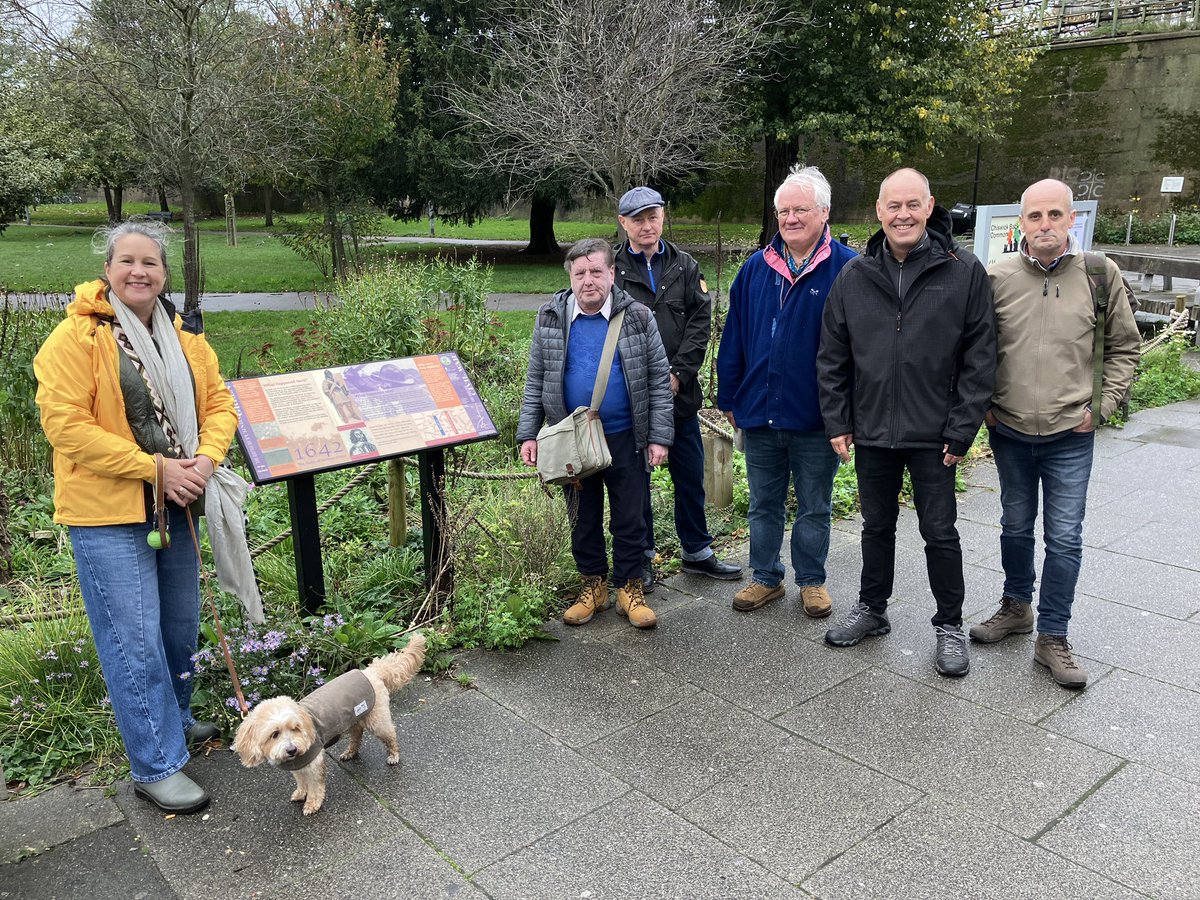
Enjoyable afternoon leading a small but engaged group around Turnham Green (1642) this afternoon for @battleftrust. Thanks to @CharlesCordell for support and leading Brentford (1642) walk in the morning.
@historytwit1 John Tincey & Keith Roberts Edgehill 1642 published by Osprey, Peter Young’s book of the same title - out of print but should be available on Abebooks, and Chris Scott, Alan Turton & Eric Gruber von Arni’s Edgehill have useful elements and are worth a read.
@Prof_Murdoch @battleftrust@SSNEdatabase @EnglishCivilWar @MuseumCromwell @A_J_Lind But Lindsey stormed off the lead a regiment. Ruthven no doubt fought and, as you say, the King noted Edgehill as one of his successes in his elevation to Lord Brentford. But army level command and control arrangements for the royalists at Edgehill are a little opaque.
@Prof_Murdoch @battleftrust@SSNEdatabase @EnglishCivilWar @MuseumCromwell @A_J_Lind Letter patent at Edgcote on 22 Oct 1642 (Black, Letters Patent 1642-46, p.347) makes Ruthven Marshal General (ie responsible for the army’s deployment). Technically Lindsey was still Lt Gen on the day of the battle as Ruthven only appointed to the role after the battle.
@Prof_Murdoch @battleftrust@SSNEdatabase @EnglishCivilWar @MuseumCromwell @A_J_Lind More interesting question is why Ruthven is selected as, initially, marshal of the field and then Lieutenant General. Who is encouraging the King to dump Lindsey and appoint Ruthven? Suspect it’s Rupert, with Astley and Aston seeing the way the wind is blowing.
@Prof_Murdoch @battleftrust@SSNEdatabase @EnglishCivilWar @MuseumCromwell @A_J_Lind Rupert’s commission has him responding to orders and instructions only from the King - no one else in his chain of command. So in Rupert’s mind (and possibly the rest of the army’s) Ruthven not seen as Rupert’s superior officer?
@Prof_Murdoch @battleftrust@SSNEdatabase @EnglishCivilWar @MuseumCromwell @A_J_Lind System slightly different in Germany than in the Swedish Discipline (SD). In Germany the system is three squadrons in arrow head formation, probably due to a lack of of NCOs to operate what is a complex deployment. In SD the formation is a diamond formation of four squadrons.
@Prof_Murdoch @battleftrust@SSNEdatabase @EnglishCivilWar @MuseumCromwell @A_J_Lind I have always thought R pushed use of the Swedish system and everyone went along with it because he had the King’s ear and they wanted employment.
@Prof_Murdoch @battleftrust@SSNEdatabase @EnglishCivilWar @MuseumCromwell @A_J_Lind Ruthven, Astley and Aston had all fought with the Swede’s, but no one seems to have said ‘we didn’t do it like that and stopped using the system in 1634’.
@emswifthook @Prof_Murdoch convincingly argues that the allied commanders didn’t flee. See https://t.co/R13FKHUSDb. Rupert’s performance was poor, but not helped by James King’s antipathy toward him dating back to the battle of Vlotho in 1638.