Python skills that actually get paid 💰
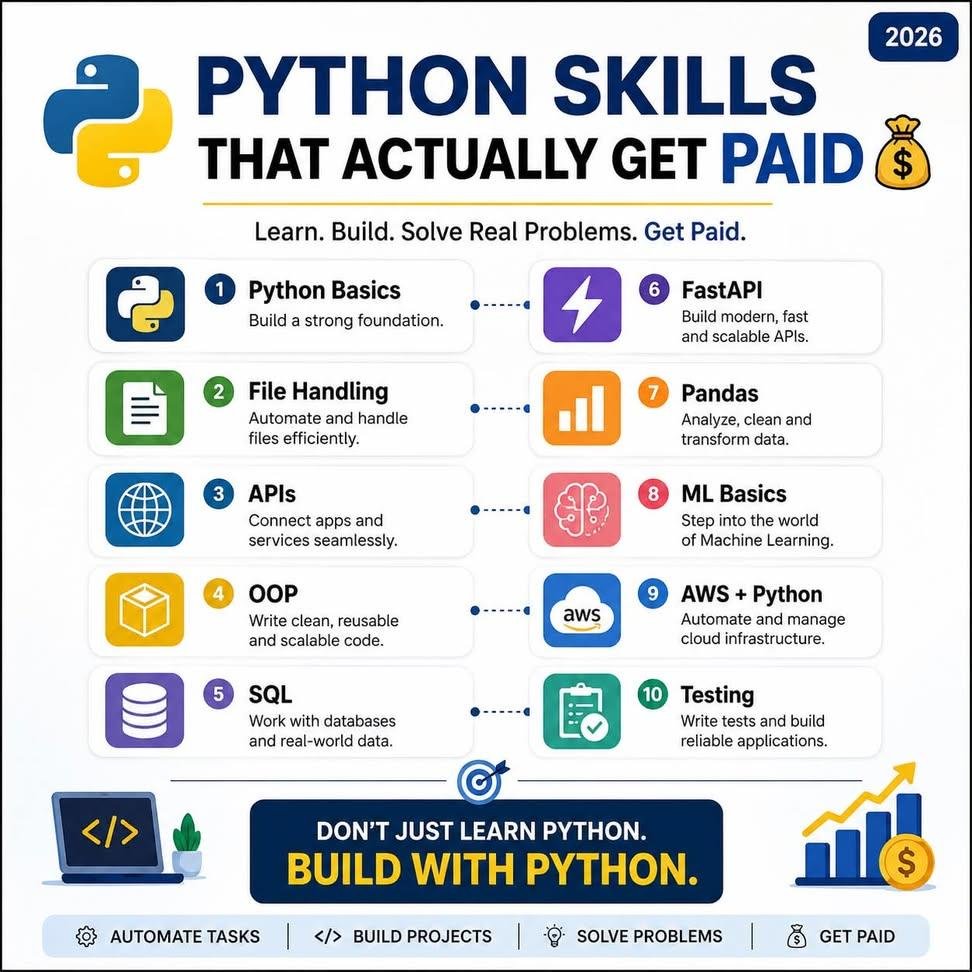
• 🐍 Python Basics → start here
• 📁 File Handling → automate boring work
• 🌐 APIs → connect real apps
• 🧠 OOP → write cleaner code
• 🗄️ SQL → work with data
• ⚡ FastAPI → build backends
• 📊 Pandas → analyze data
• 🤖 ML Basics → enter AI
• ☁️ AWS + Python → cloud automation
• 🧪 Testing → write reliable code
Python alone won’t get you hired.
Building real projects with Python is what creates opportunities.
Fix your architectural debt with these 7 foundational system design principles:
1️⃣ DRY: Stop duplicating logic.
2️⃣ KISS: Stop over-engineering code.
3️⃣ YAGNI: Drop premature features.
4️⃣ Law of Demeter: Limit object knowledge.
5️⃣ Separation of Concerns: Isolate system responsibilities.
6️⃣ Coupling & Cohesion: Build independent components.
7️⃣ Object Composition: Assemble reusable parts.
Which One you're struggle with the most?
Learn More 👇
https://t.co/zmwhYlGFkr
#SystemDesign #Interview #Coding #Examadda
Most people want to become AI Engineers
Very few know what to learn next
That's why I'm giving away one of the best Agentic AI Engineer Roadmaps for FREE to the first 4500 people only
Inside you'll learn
✅ Python Fundamentals
✅ LLM Fundamentals
✅ LangChain LangGraph CrewAI AutoGen
✅ LCEL Runnables & Workflows
✅ Memory Systems
✅ Tool Integrations
✅ RAG Systems
✅ Multi Agent Systems
✅ Real World AI Projects
✅ Interview Questions & Answers
72 Hours Only
How to get
Follow me (so I can DM you)
Like + RT
Comment "ROADMAP"
Once the limit is reached I'll stop sending it.
Don't waste 2 years learning to build LLMs like Claude & ChatGPT.
Stanford just dropped a 2 hour course on how to build LLMs from scratch.
• 00:00 - LLM tokenization
• 25:44 - how LLMs decode user prompts
• 35:40 - training pipeline of LLMs
• 1:16:47 - LLM architecture from scratch
Anthropic pays $750,000/year to engineers who understand this exact knowledge of LLMs.
Bookmark this & give 2 hours today, no matter what. Then read the article below.
Docker vs Kubernetes
𝗗𝗼𝗰𝗸𝗲𝗿 is a containerization platform that solves the “it works on my machine” problem.
It builds images, runs containers, and primarily runs them on a single host. Applications are packaged with everything they need and run as lightweight, isolated containers. The focus is on running software consistently with simple primitives like images and containers.
𝗞𝘂𝗯𝗲𝗿𝗻𝗲𝘁𝗲𝘀 is a cluster orchestration system.
It manages containers across multiple machines using a control plane that schedules and maintains containerized workloads. It works with Pods and reconciles actual state to desired state. The focus is on operating software at scale with capabilities like self-healing, autoscaling, and rolling updates.
Kubernetes doesn’t create containers. It orchestrates them. Docker runs containers. Kubernetes keeps them running.
What else would you add?
➕ Follow me ( @NikkiSiapno ) to improve at system design.
🚨40 most asked DSA questions to clear your next interview
> Arrays and Strings:
1. Find the maximum sum subarray.
2. Find all substrings that are palindromes.
3. Implement the "two sum" problem.
4. Implement Kadane's algorithm for maximum subarray sum.
5. Find the missing number in an array of integers.
6. Merge two sorted arrays into one sorted array.
7. Check if a string is a palindrome.
8. Find the first non-repeating character in a string.
9. Write a program to remove duplicates from a sorted array.
> Linked List:
10. Reverse a linked list.
11. Detect a cycle in a linked list.
12. Find the middle of a linked list.
13. Merge two sorted linked lists.
14. Implement a stack using linked list.
15. Find the intersection point of two linked lists.
> Stack & Queue:
16. Implement a stack using an array.
17. Implement a stack that supports push, pop, top, and retrieving the minimum element.
18. Implement a circular queue.
19. Design a max stack that supports push, pop, top, retrieve maximum element.
20. Design a queue using stacks.
> Trees and Binary Search Trees:
21. Find the height of a binary tree.
22. Find the lowest common ancestor of two nodes in a binary tree.
23. Validate if a binary tree is a valid binary search tree.
24. Serialize and deserialize a binary tree.
25. Implement an inorder traversal of a binary tree.
26. Find the diameter of a binary tree.
27. Convert a binary tree to its mirror tree.
> Graphs:
28. Implement depth-first search (DFS).
29. Implement breadth-first search (BFS).
30. Find the shortest path between two nodes in an unweighted graph.
31. Detect a cycle in an undirected graph using DFS.
32. Check if a graph is bipartite.
33. Find the number of connected components in an undirected graph.
34. Find bridges in a graph.
> Sorting & Searching:
35. Implement (bubble, insertion, selection, merge) sort.
36. Implement quicksort.
37. Implement binary search.
38. Implement interpolation search.
39. Find the kth smallest element in an array.
40. Given an array of integers, count the number of inversions it has. An inversion occurs when two elements in the array are out of order.
Want to become a backend developer? learn these concepts
-System Design (scalability, microservices)
-APIs (REST, GraphQL, gRPC)
-Database Systems (SQL, NoSQL)
-Distributed Systems (consistency, replication)
-Caching (Redis, Memcached)
-Security (OAuth2, JWT, encryption)
-DevOps (CI/CD, Docker, Kubernetes)
-Performance Optimization (profiling, load balancing)
-Cloud Services (AWS, GCP, Azure)
-Monitoring (Prometheus, Grafana)
Pick up a language..
Stop jumping from one language to the other
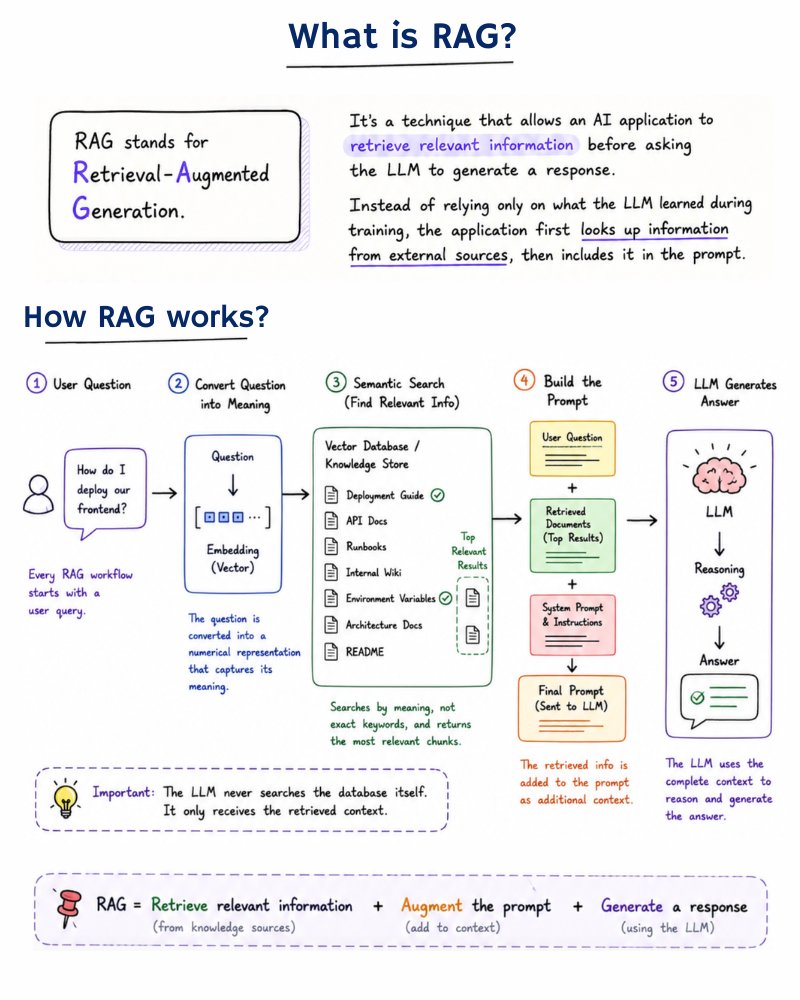
What is RAG ? ✨
RAG stands for Retrieval-Augmented Generation.
It's a technique that allows an AI application to retrieve relevant information before asking the LLM to generate a response.
Instead of relying only on what the LLM learned during training, the application first looks up information from external sources, then includes it in the prompt.
How RAG works? ✨
1. You ask a question.
2. The application searches a knowledge source.
It might retrieve :
→ Company documentation
→ PDFs
→ Wikis
→ Database records
→ Knowledge bases
→ Vector databases
The retrieved information is added to the prompt as additional context.
The LLM generates a response using that information.
Isn't that just context? ✨
Not exactly.
Context is everything the LLM receives before generating a response.
RAG is one technique the application uses to retrieve relevant information and turn it into context.
The LLM doesn't know whether that information came from you or was retrieved automatically.
It simply receives the final context and generates the response.
A simple way to remember it :
📝 Context = Everything the LLM sees.
📚 RAG = One way the application builds that context.
As AI applications continue to evolve, RAG has become one of the core building blocks for working with company knowledge, documentation, and constantly changing data.
That's why you'll find it in many modern AI products, including ChatGPT, Claude Code, Cursor, and Bug0.
_____________________
Thanks for reading till the end!🙌
In tomorrow's post, I will explore more about RAG.
How to Get a Job as an AI Developer in 6 Months:
🚀 Month 1
🧠 Learn Python basics
📊 Understand math essentials
📚 Learn how models work at a high level
⚙️ Month 2
📘 Learn NumPy, Pandas, Matplotlib
🤖 Start with Machine Learning
🔍 Build 3 ML mini-projects
🛠️ Month 3
🧠 Learn PyTorch or TensorFlow
📸 Build a small neural network
🎧 Try 1 NLP project + 1 Computer Vision project
🧪 Understand losses, activations, overfitting
🧠 Month 4
⚡ Learn LLM basics
🛠️ Use OpenAI/Anthropic
🔗 Build RAG apps, chatbots, agents, and tools
🧩 Learn vector databases
🌍 Month 5
🌐 Launch 3 real projects
🚀 Deploy on Vercel, Render, or AWS
⚡ Create a polished GitHub + portfolio
💼 Month 6
📄 Build an AI-specific resume
💬 Join AI dev communities & hackathons
📨 Apply to 2–5 AI/ML roles daily
🧠 Prep for interviews
@NarayanaRaoCK1@siddaramaiah ನಿಮ್ಮನೆ issues ನೀವು solve ಮಾಡಿಕೊಳ್ಳಿ,
He's national level leader his Job is to concentrate delhi,
So you are agreeing no hope on BJP !!