How do you help your child become a champion?
Chill out!
Here are 9 lessons that I wish every parent knew when it came to supporting their child’s athletic and academic pursuits: https://t.co/eLKXjqoBp8
@zbitter@Brady_H Agree it can be both and certainly would be in the context of the long runway (years) high volume athlete. But that's not the majority. Our data (@Athletica_AI) support a focus on training consistency and volume.
2:42 Boston case study:
https://t.co/ft3Qu0lw8h
Nouvel exploit d'Armand Duplantis... Cette fois il est parvenu à franchi un mur de 5,50 mètres composé de 3000 produits de l’enseigne Lidl dans le cadre d'une opération commerciale à Stockholm.
Dans le détail : Largeur de 12 mètres et profondeur de 30 centimètres.
Vidéo Lidl.
My updated metabolic map is less focused on substrate utilization and thresholds and more focused on metabolic stability. I believe the shift is subtle but important.
Instead of only asking:
“What fuel is being used?”
The model also asks:
“How stable is the metabolic system under stress?”
In this framework, lactate becomes the central proxy to understand the balance, drift, or overload of the metabolic system.
Approximate translation and comparison with different models:
• Zone 1 = low metabolic stress
Clearly below LT1/VT1
• Zone 2 = metabolic equilibrium
Near LT1/VT1, where lactate production and clearance remain tightly matched and the system operates at its highest sustainable balance
• Zones 3–4 = metabolic drift
The system progressively moves away from optimal mitochondrial matching capacity, even if lactate may still achieve a “steady state”…CP/MLSS/VT2/LT2/V4…
• Zone 5+ = metabolic overload
Above CP/MLSS/VT2/LT2/V4, where no true steady state is physiologically achievable
The key conceptual distinction:
A lactate steady state is not the same as optimal metabolic equilibrium.
The metabolic equilibrium ceiling is near LT1/VT1 and Zone 2.
The steady-state ceiling is CP/MLSS/VT2/LT2/V4.
Performance is ultimately defined by how long the body can preserve metabolic equilibrium.
Secretary Sayers and I had a great time visiting Athens and Ride Wisconsin Gravel.
Outdoor recreation is a $12 billion industry in our state so it was great to get outside and see what gravel biking is all about during National Travel and Tourism Week.
"En los últimos 20 años, París ha experimentado una importante transformación física, cambiando las arterias automovilísticas por carriles bici, añadiendo espacios verdes y eliminando 50.000 plazas de aparcamiento: La contaminación ha disminuido un 55%" https://t.co/ttR2iQ2HGI
Interval training is not about accumulating fatigue.
It is about accumulating time at a target physiological intensity.
That does not make it the same as resistance training, but it does make both of them dose response problems. In resistance training, we dose mechanical tension and total work. In interval training, we dose cumulative exposure to the intensity that sends the adaptation signal we want.
Coates et al. describe a “central tenet of interval training” as accumulating more work at a higher intensity than continuous exercise would allow. They define HIIT in the performance context primarily within the “severe intensity domain,” and they explain that the intermittent structure allows “greater time to be accumulated” at the desired work rate.
So when people arbitrarily chop up work and rest without understanding the physiology, they are not necessarily progressing the session. They may be changing the metabolic demand and prescribing a different workout altogether.
Good interval training is not random suffering.
It is precise dosing.
Source: Coates et al., 2023.
The Municipal Police of Madrid has published the video of Paco's training exercises, the hero dog who saves and performs cardiac massage (CPR) on the officer who fainted (as a simulation),
and it's winning hearts worldwide. ❤️ https://t.co/bRcAgJYMmc
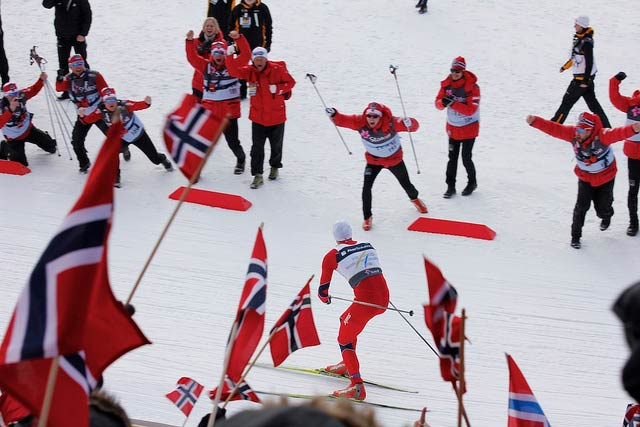
Norway consistently wins the most medals at the Winter Olympic Games, with a population of just 5.6 million people.
A big part of their success is how they treat youth sports—and it’s the opposite of what we do in the US. Here’s what we can learn from Norway:
1. Scorekeeping:
In the US: Youth sports tend to be hyper competitive even at early ages. Leagues almost always keep score.
In Norway: Scorekeeping isn’t even allowed until age 13.
Removing winners and losers keeps the focus on the process not outcomes. It keeps kids engaged longer because it minimizes pressure (and tears) and maximizes fun, learning, and growth. The goal isn’t to win a third grade championship. It’s to love sport and keep playing.
2. Trophies:
In the US: If you give everyone a trophy, you’re creating snowflakes who will never gain a competitive edge.
In Norway: Whenever trophies are awarded, they are handed out to everyone.
If getting a trophy makes young kids feel good, we should give them trophies. Maybe they’ll come back and play again next year!!
As for the creation of snowflakes with no competitive edge—Norway’s athletes are tough as nails and all they do is win.
3. Prioritizing Fun:
In the US: Far too often, the goal is to win.
In Norway: The national philosophy is “joy of sport.”
Youth sports in the US are driven by adults, ego, and money. Youth sports in Norway are driven by fun.
Only half of kids in the US participate in sports. The number one reason they drop out: because they aren’t having fun anymore. In Norway, 93% of kids participate in youth sports. Fun is the foremost goal.
4. Playing Multiple Sports:
In the US: There’s pressure to specialize early and play your best sport year round.
In Norway: Try as many sports as you can before specializing as late as college.
Norway encourages kids to try all types of sport. This reduces injury and burnout and increases all-around athleticism. It also helps promotes match quality, or finding the sport you are best suited for as your body develops, which is impossible if you commit to a single sport too early.
5. Affordability
In the US: There is increasingly a pay-to-play model with high fees for leagues, equipment, and travel. This excludes many kids from playing.
In Norway: It’s a national priority to keep youth sports affordable and therefore accessible for all.
Kids aren’t priced out, which creates opportunities for everyone to participate (and develop into athletes), regardless of their parents’ income level.
We could learn a lot from Norway:
In the US, 70% of kids drop out of youth sports by age 13. This not only diminishes an elite-athlete pipeline, but it also destroys an opportunity for healthy habits and all the character lessons kids can learn from sport.
In Norway, lifelong participation in sport is the norm. The goal isn’t to have the best 9U team. It’s to develop the best athletes. Those are two very different things. And Norway has the gold medals to prove it.
It's astonishing to witness the improvement in public education--reading, math, attendance, grad rates--in Alabama, Louisiana and Mississippi. But we're busy fighting culture wars rather than scaling up what these three states have done. Please do read: https://t.co/h20UCdCP2w
It's winter in Wisconsin! 🥶
If you or somebody you know needs help staying warm, call 211 Wisconsin or download the 211 Wisconsin app to get connected to services and find a warming shelter near you. ⬇️
https://t.co/x6J5Yh8DgV