When you treat things more like they really are, you tend to get better results. Former grad student Samuel Smith's preprint shows the NAO may be better treated (and 2-days-better predicted) as a poleward propagating pattern, not a pulse. https://t.co/AyuYzbNzit
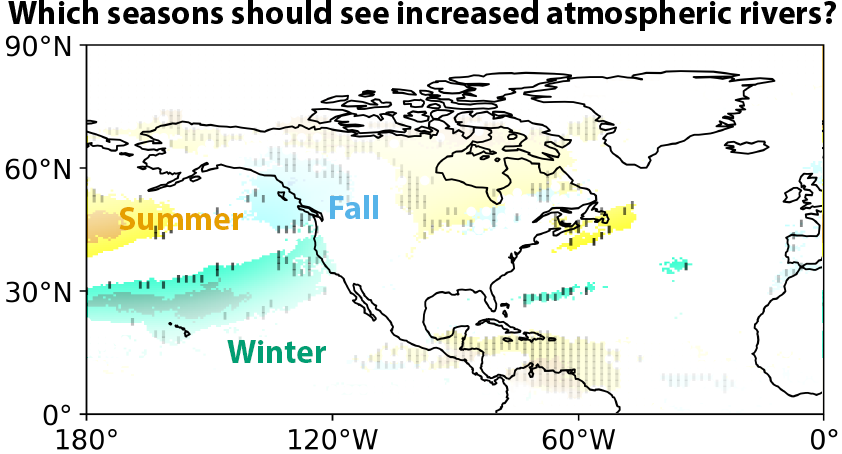
IU’s Diya Kamnani shows where different atmospheric river detection methods agree, ultimately helping planners and decision makers better prepare for high impact weather changes as climate warms. https://t.co/0vwFwj6wRs
Dr. James Ryan - recently graduated from IU - helped cue us in on the conditions that lead to cold air outbreaks here in the midwest. We're positioned just right to receive cold air spilling down the east side of west coast ridges. Great work, James!
Earth and Atmospheric Sciences professor Paul Staten uses a keyboard to demonstrate the range of light waves and how they relate to heat. #Ed4EnvChange
☁️ Spend a minute with your head in the clouds with this timelapse of clouds building and spilling over the Towers of the Virgin. ☁️
Video by Ben Gibson
#FindYourPark#EncuentraTuParque
It is always interesting to play with a 2D Navier Stokes solver, plunge a #WUI microscale profile inside, including a porous tree, and see what happens. The created vorticity patterns are pretty mesmerizing #WindTunnel









![pwstaten's tweet photo. "Come together, right now*, over [pizza]." @IU_EAS @WeatherClub_IU *7pm Wed https://t.co/hRd1CCn7GC](https://pbs.twimg.com/media/EEHzA6tVUAQw6vp.png)


