🔥 Jeremy Clarkson had a fiery clash with BBC’s Victoria Derbyshire at the farmers’ protest against Reeves’ inheritance tax raid on family farms.
Victoria went straight for the gotcha:
“So it’s not about you, it’s not about your farm and the fact you bought a farm to avoid inheritance tax?”
Clarkson, visibly stunned:
“Classic BBC there, classic. The ‘fact’ that I bought a farm to avoid inheritance tax? The ‘fact’?”
Victoria doubled down: “You told The Sunday Times in 2021 that’s why you bought it?”
Clarkson, laughing in disbelief:
“These people… BBC. Let’s start from the beginning. I wanted to shoot. That’s even worse to the BBC. Which comes with the benefit of not having to pay inheritance tax.”
He pointed out the tax isn’t even an issue for him personally as he can simply put the farm in a trust, but he’s standing with ordinary family farms that will be hammered.
After sparring over the real numbers affected, Clarkson urged the government to U-turn.
Victoria: “And get the money from where?”
Clarkson: “Walk into any of the offices around here and if you don’t understand what somebody’s job is, fire them.” 😂
Classic Clarkson.
My first introduction to probability theory came from Bertsekas textbook. After I later absorbed the measure theoretic formalism of the subject, I still find myself occasionally revisiting the book for practical computation techniques. Later, when I worked as a quant researcher in finance, I learned the theory of model predictive control from his book “Dynamic programming and stochastic controls”. The idea of open loop feedback control motives me to write the paper https://t.co/VFLfVaCO1k where we formulate multi-step time series forecasting as a model predictive control problem.
These days, the RL in the LLM context feels more like contextual bandit with policy gradient methods. For example, the usual notation in this context is pi(x|y). There is also rich control theoretic formulation of RL with known dynamics or joint estimation of the dynamics that I have learned from Bertsekas textbook.
Both books are still on my desk side bookshelf. I often find Bertsekas is able to design a notation system that’s optimized for understanding and calculation. He introduces many meaningful intermediate abstractions that end up being more tractable objects to reason about. Rest in peace, Professor Bertsekas!
Imagine a 19-year-old scrolling TikTok. She watches a creator list five "signs you have undiagnosed anxiety." She recognizes three in herself. By the end of the week, she's describing herself as anxious to her friends. A month later, she's avoiding situations she used to handle fine.
What went wrong?
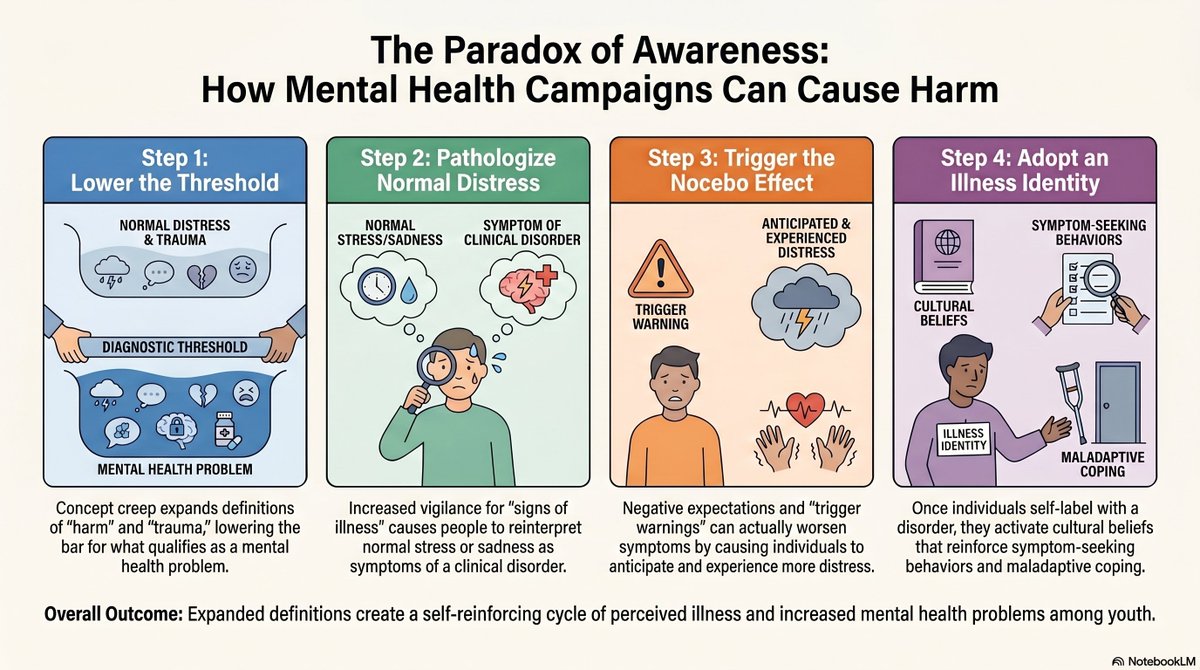
In a new paper by my PhD student Dasha Sandra, titled "Why mental health awareness can harm: Converging explanations for a societal problem", we argue that well-meaning mental health awareness can backfire, and we identify how. Four separate literatures (concept creep, nocebo effects, prevalence inflation, and illness self-labeling) have been circling the same problem from different angles. We show they converge on three mechanisms:
1.Awareness lowers the threshold for what counts as a disorder.
2. It trains people to scan their inner lives for symptoms and reinterpret normal distress as pathology.
3. Once someone adopts an illness identity, they behave in ways that confirm and deepen it.
The evidence is wide. Learning that loneliness is harmful makes solitude feel worse. Learning that stress is harmful worsens well-being and performance. Awareness videos about fake conditions like "wind turbine syndrome" produce real headaches. Trigger warnings raise anticipatory anxiety without reducing distress.
This does not mean awareness should stop. It means awareness can have unintended consequences, including manufacturing the suffering it tries to prevent. Inoculating people against these mechanisms works, and we already have evidence it does.
Link to paper: https://t.co/ucoGyhEuAj
Dear Charles, since you are talking about double standards, let me remind you that Turkey invaded Cyprus in 1974, and still occupies European territory, 🇨🇾🇪🇺
Δηλαδή ο Γκιγιέρμο Όγιος θα μπορεί να λέει ότι κοουτσάρισε τον Μέσι και στα πρώτα και στα τελευταία βήματα του στο ποδόσφαιρο και ενδιάμεσα προπόνησε τον Γιώργο Κολτσίδα, τον Κώστα Νεμπεγλέρα, τον Γιώργο Σαϊτιώτη, τον Γιάννη Λαζανά και τον Γιώργο Ανατολάκη.
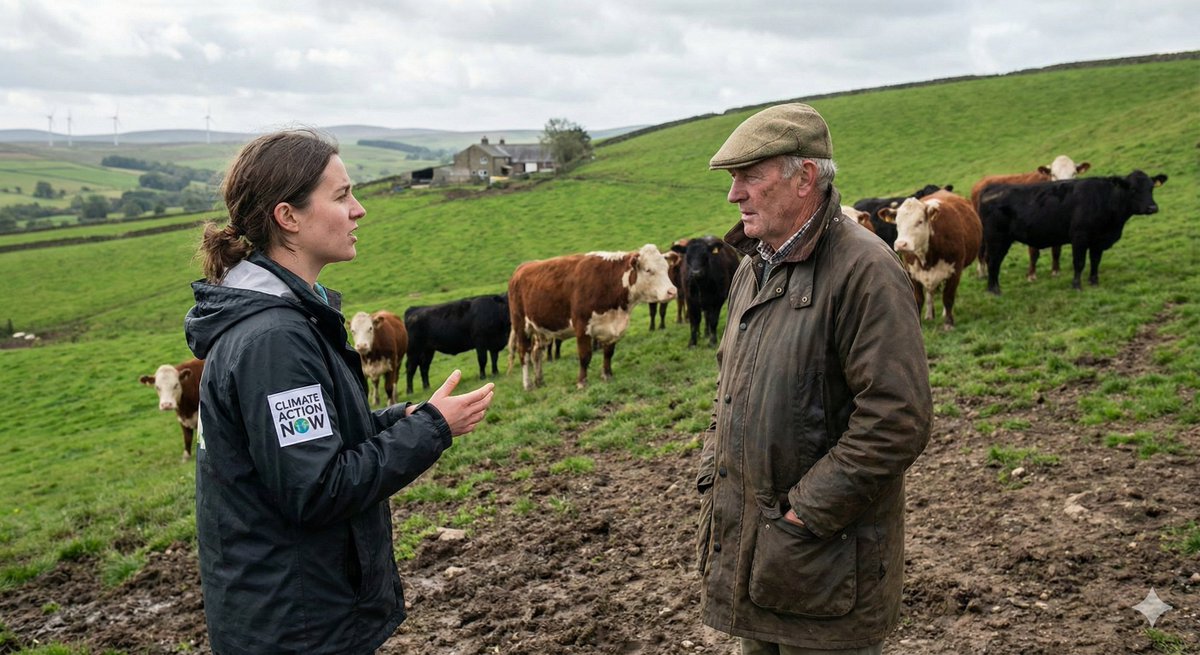
Activist: "Cattle farming is incredibly wasteful."
Farmer: "Is it? List the inputs."
Activist: "What?"
Farmer: "For my farm. What goes in?"
Activist: "Feed, water, land..."
Farmer: "Rain, grass that grows for free, and land that won't grow anything else. Where's the waste?"
Activist: "But the resources..."
Farmer: "Are solar energy and rainfall. Both happen whether there's a cow here or not."
Activist: "You're oversimplifying."
Farmer: "I'm being accurate. Sunlight hits grass. Grass grows. Cow eats grass. Cow becomes beef. Which step wastes resources?"
Activist: "The land could grow crops."
Farmer: "This land? 30-degree slope, clay soil, 45 inches of rain? Show me the crop."
Μαθαίνω ότι η @COSMOTE απέσυρε την ετήσια χορηγία προς την παγκόσμια πρωταθλήτρια σκακιού Σταυρούλα Τσολακίδου. Φταίνε και τα ΜΜΕ. Φταίνε και οι δημοσιογράφοι. Και δεν ακούω δικαιολογίες τύπου «δεν πουλάει το θέμα» γιατί αν δεν μπορείτε να αναδείξετε στο κοινό ως παγκόσμια πρωταθλήτρια σκακιού την Τσολακίδου, που είναι η χαρά της ζωής προσωποποιημένη, το πρόβλημα μάλλον το έχετε εσείς και όχι ο κόσμος. Δείξτε μου αν υπάρχει αφιέρωμα ή podcast με την Τσολακίδου που πήγε άπατο, γιατί δεν προκάλεσε το ενδιαφέρον του κοινού, να το συζητήσουμε.