7 fauteuils roulants en 39 ans de paraplégie.
J’avais 3 ans pour le premier.
C’était un fauteuil de taille adulte, de ceux qui sont entièrement remboursés par la sécurité sociale, vous savez ceux que l’on trouve dans les hôpitaux.
OTAUTUNE PRÉSENTE SON CALENDRIER DE L’AVANT
Le mois de Noël démarre, et pour l’occasion Otautune vous propose, à la manière d’un Calendrier de l’avant, un projet musical (mixtape, EP’s, albums) à écouter ou à réécouter, chaque jour jusqu’au 25 décembre.
(Les projets sont choisis en fonction d’à quel point ils nous font penser à Noël, au mois de décembre ou encore à l’hiver, que ce soit implicitement ou explicitement.)
Incroyable mais vrai, il est possible d'avoir des tests lisibles et maintenables.
J'ai même fait un guide gratuit pour t'aider à y arriver.
C'est fou !
https://t.co/9BKI279bum
Everyone knows electrons, but probably few know the One Electron Theory, a weird idea according to which every electron in the universe is actually one 10¹⁰⁵ years old particle that continually travels backward and forward through time, possibly 10⁸⁰ times.
The theory was first thought up by John Archibald Wheeler, a theoretical physicist who worked on the hydrogen bomb at Los Alamos and later taught at Princeton. He is largely known for reviving interest in general relativity in the 1940s and 1950s.
One of the biggest reasons that this thought experiment was proposed by Wheeler is that each and every electron looks exactly the same. They all have the same mass and the same electric charge.
Proposing that the entire universe contains just one electron may not seem all that absurd, when we consider that the only change would be to the idea of what an electron is. In practicality, everything would still function the same.
According to the theory, in the same way as an electron can be bounced around in space when hit with light, the electron might also be able to bounce backward in time. The consequence of this is that electrons moving backwards in time are positrons, the antimatter component of electrons. So, not only are all electrons the same electron, but all positrons are also the same electron moving backward.
It is estimated that there are roughly 10⁸⁰ atoms in the universe. If we ignore the fact that many atoms have more than one electron, we can simplify the number of electrons in the universe as around 10⁸⁰.
Although electrons are treated as stable for theoretical purposes, the experimental lower bound for the electron's mean lifetime is often given as 6.6×10²⁸ years. Using this, we can get an idea of how this theory actually plays out.
The theory and these numbers imply that the one electron in existence has traveled through the universe 10⁸⁰ times, each time taking 460 septillion years. We can double these numbers for each time that the electron had to go back through time, which equates to the one electron in the One Electron Theory being 10¹⁰⁵ years old.
👋
Tu commences cette semaine de travail et tu vas retrouver des tests automatisés très lents qui cassent en permanence ?
Et t’es pas super emballé(e) à cette idée ?
Cette formation sur l’amélioration des tests automatisés est pour toi !
https://t.co/IL8dUBo5ro
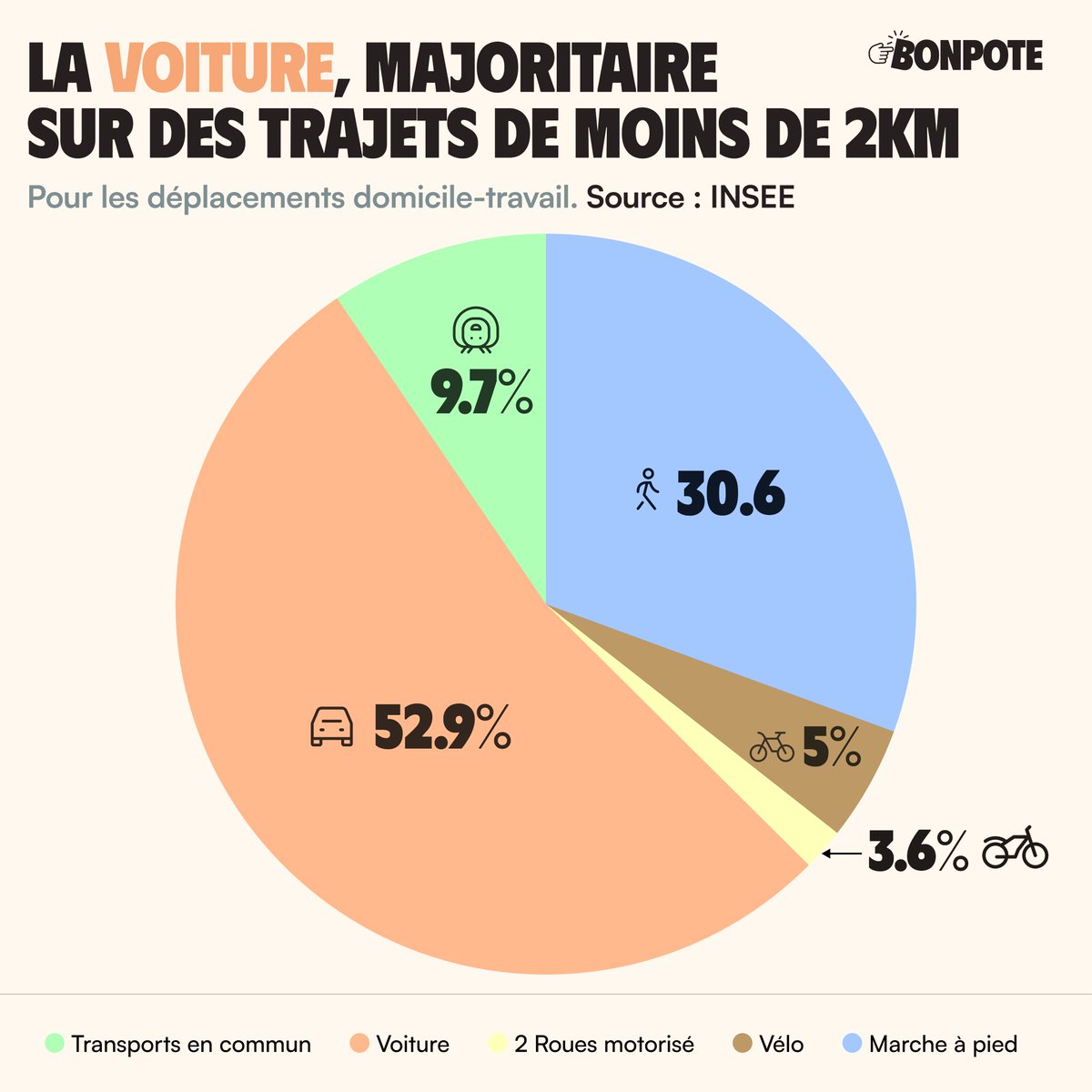
La voiture est majoritaire pour les déplacements domicile-travail, même pour un trajet de moins de 2km.
Si nous étions un peu sérieux dans la transition écologique, voilà ce qui devrait être systématiquement rappelé dans les débats, par chaque politique et journaliste.
NYCTHÉMÈRE – premier album – 10 titres - 45min - 0 featuring – disponible en CD & Double Vinyle – Édition personnalisée pour toute commande passée entre le 29 mars et le 29 avril - PRIX LIBRE – La parole est à vous…
https://t.co/08c5yjI8RI
Réchauffement, perte de biodiversité, déforestation... Sommes-nous condamnés ?
Contre le fatalisme, une chercheuse d'Oxford révèle des raisons d'être optimistes, avançant que nous pourrions être, au contraire, la 1ère génération à laisser la planète en meilleur état. #Thread🧵⬇️
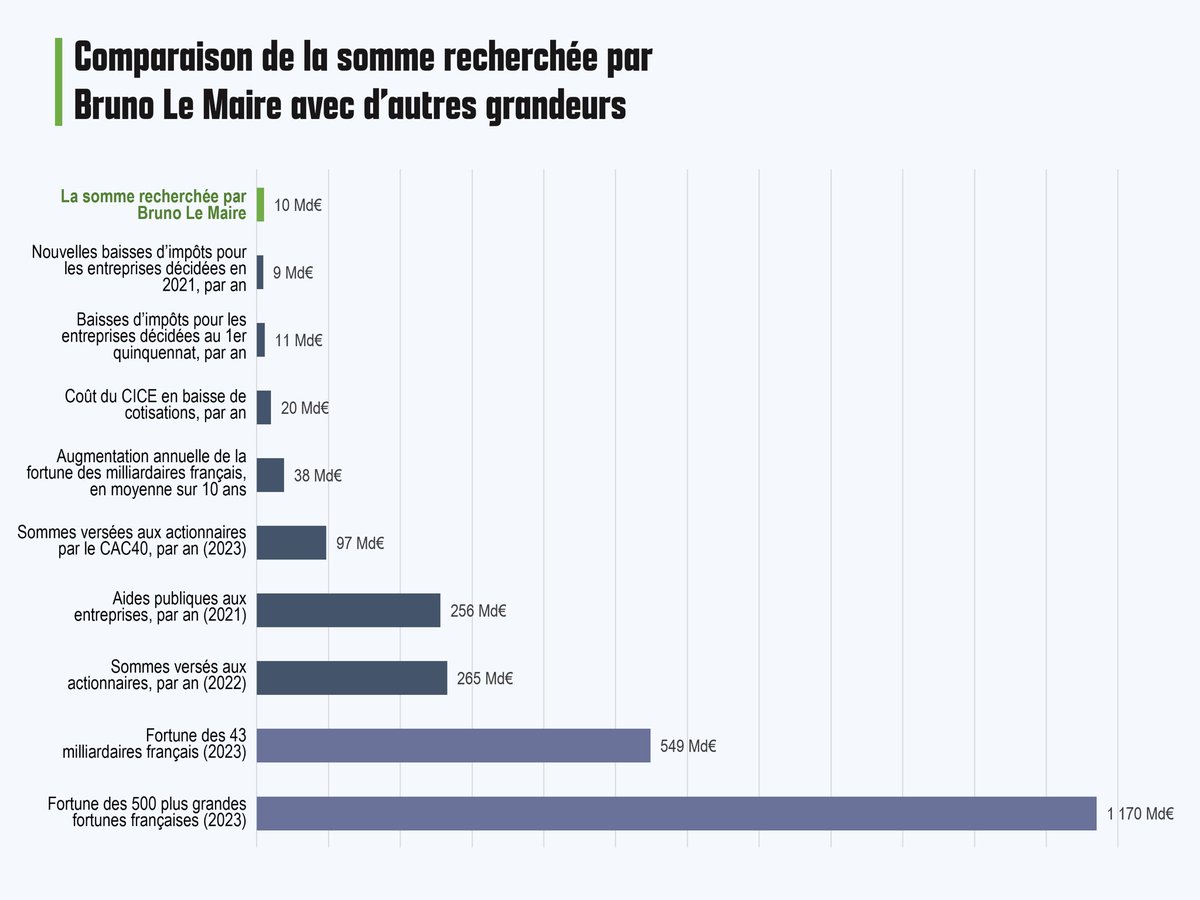
Bruno Le Maire est en difficulté, il cherche 10 Md€.
Pour ne pas qu’il soit dans l’obligation de démolir les services publics (contre sa volonté bien sûr), on a cherché d’autres sources d’économie/financement ⤵️
I see some vocal objections: "Sora is not learning physics, it's just manipulating pixels in 2D".
I respectfully disagree with this reductionist view. It's similar to saying "GPT-4 doesn't learn coding, it's just sampling strings". Well, what transformers do is just manipulating a sequence of integers (token IDs). What neural networks do is just manipulating floating numbers. That's not the right argument.
Sora's soft physics simulation is an *emergent property* as you scale up text2video training massively.
- GPT-4 must learn some form of syntax, semantics, and data structures internally in order to generate executable Python code. GPT-4 does not store Python syntax trees explicitly.
- Very similarly, Sora must learn some *implicit* forms of text-to-3D, 3D transformations, ray-traced rendering, and physical rules in order to model the video pixels as accurately as possible. It has to learn concepts of a game engine to satisfy the objective.
- If we don't consider interactions, UE5 is a (very sophisticated) process that generates video pixels. Sora is also a process that generates video pixels, but based on end-to-end transformers. They are on the same level of abstraction.
- The difference is that UE5 is hand-crafted and precise, but Sora is purely learned through data and "intuitive".
Will Sora replace game engine devs? Absolutely not. Its emergent physics understanding is fragile and far from perfect. It still heavily hallucinates things that are incompatible with our physical common sense. It does not yet have a good grasp of object interactions - see the uncanny mistake in the video below.
Sora is the GPT-3 moment. Back in 2020, GPT-3 was a pretty bad model that required heavy prompt engineering and babysitting. But it was the first compelling demonstration of in-context learning as an emergent property.
Don't fixate on the imperfections of GPT-3. Think about extrapolations to GPT-4 in the near future.
Remember, when the fresh snow flies in your city, it reveals how much we’ve over-designed our streets for cars making them faster & more dangerous, and how much space we could reclaim for people and public life. We call them #sneckdowns. HT @fietsprofessor