The role of frailty and comorbidities in severe infections and the risk of dementia: a prospective, multicohort, observational study
https://t.co/oXUUXMy1Lg
The role of noninfectious comorbidities in the association between severe infections and risk of dementia in Finland: A nationwide registry study https://t.co/MR6AobaRbg
A study finds that eating disorder patients with type 1 diabetes receive hospital treatment for their eating disorder less often than those eating disorder patients who do not have diabetes. https://t.co/fZB8fkvKZo
Proud of PhD student Leon Hirvelä from our department, whose paper about broad eating disorder symptoms and alcohol problems was published on Friday. https://t.co/j15k7iFhCj
Predicting long-term risk of #dementia for cognitively healthy individuals is challenging. Error rates are very high even with the risk scores currently used in research and health care.
@Gill_Livingston@epiAgeing@PyrySipila
https://t.co/BHE27vyGq1
#OriginalResearch: In this multicohort study, hospital-treated infections associated w/ significant increase in short-term risk and modest long-term risk of major CVD events. @MikaKivimaki @nellimarikki@PyrySipila #AHAJournals https://t.co/51JSJkS6l4
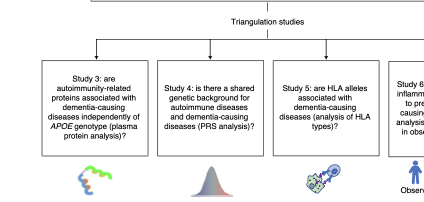
This massive study combined evidence for the link between autoimmune diseases and dementia using 6 different big-data approaches.
The work was lead by @jlindbohm and @ninajmars with contributions from @pyrysipila, @heikorunz, @Gill_Livingston, Ramnik Xavier and many others
Observational evidence suggests:
–#Obesity decreases disease-free years much more than longevity.
–The proportion of #multimorbidity by age 75 in people with healthy weight was reached already by age 55 in those with obesity.
#multicohort#UKBiobank
https://t.co/lhimCjy91f
What causes dementia? 2 studies using retrospective cohort data find that risk of developing #dementia increases after having a serious #infection. What does this mean for #LongCovid?
@TheLancetInfDis https://t.co/4qAtCAeTPh
@LancetLongevity https://t.co/LUN7IktlTQ
If anti-amyloid drugs do not prevent clinical dementia, what are the alternatives? This paper identifies 15 new protein targets for #dementia drug development.
#Whitehall study #ARIC study
@jlindbohm@gill_livingston @gottesman_lab
https://t.co/qCXbrB3e7J
New research Article: Hospital-treated infectious diseases and the risk of #dementia: a large, multicohort, observational study with a replication cohort 🇫🇮🇬🇧 https://t.co/AfNMjGVgY3
Multicohort study links #infections to #dementia risk:
- stronger effects on vascular dementia than Alzheimer’s
- attributable to general inflammation rather than any specific pathogen
- systemic infections sufficient to affect the brain.
@UK_Biobank
https://t.co/udAaOr7YUf
Amyloid and tau have dominated pathophysiological models of dementia aetiology.
This preprint identifies 15 novel proteins associated with cognitive decline and dementia.
@Whitehall2study#ARIC@JLindbohm @gottesman_lab @epiAgeing@Gill_Livingston
https://t.co/yqDtxwyqrb
For comparison, mild traumatic brain injury with loss of consciousness is also associated with a ~2-fold increase in the risk of dementia diagnosis
https://t.co/hio335GZBi
NEW multicohort study: #BingeDrinking a long-term #dementia risk factor even if a person usually drinks moderately.
Alcohol-induced loss of consciousness linked to a 2-fold increased dementia risk among both moderate and heavy drinkers.
https://t.co/omh0yLO35m
Risk factors, such as hypertension, obesity and physical inactivity are targets of #dementia prevention. New research suggests that many inflammatory diseases (gastritis, duodenitis, erysipelas) may be equally strong long-term predictors of dementia. https://t.co/WmVgqp2dh3