#LEGALALERT
A joint tenant may sue alone for trespass, also see enforceability of a gentleman's agreement and trespass where scope of authority is exceeded...
In Baku Raphael Obudra v Attorney General, Constitutional Petition No. 13 of 2020, Constitutional Court of Uganda (4 December 2025), among other findings, the CC found that a candidate cannot claim that he automatically qualified for judicial appointment on the sole basis that he fulfilled Article 143 qualifications, as qualifications and requirements for appointment go beyond those under Article 143 of the Constitution.
The Court further found that Parliament acted outside its Article 41(2) mandate when it exempted records of court proceedings before the conclusion of a case from the access requirements of Article 41 of the Constitution. It noted that Parliament acted outside that mandate when it listed records of court proceedings before the conclusion of a case among information that is exempt from the access requirements, and therefore found section 1(2)(b) of the Access to Information Act, 2005 inconsistent with the Constitution.
The Court also found sections 27 of the Access to Information Act and 17 of the Judicial Service Act exceptions (confidentiality) falling within the Article 41 constitutional exceptions, specifically in reference to interference with the right to the privacy of any other person. Section 17 of the Judicial Service Act empowers the Chairperson of the Judicial Service Commission (JSC) to consent in writing to what information a party should access. It applies to officers of the JSC, requiring them not to produce or disclose the types of communications that are outlined in subsections (a) to (c) of the section without the written consent of the Chairperson of the JSC.
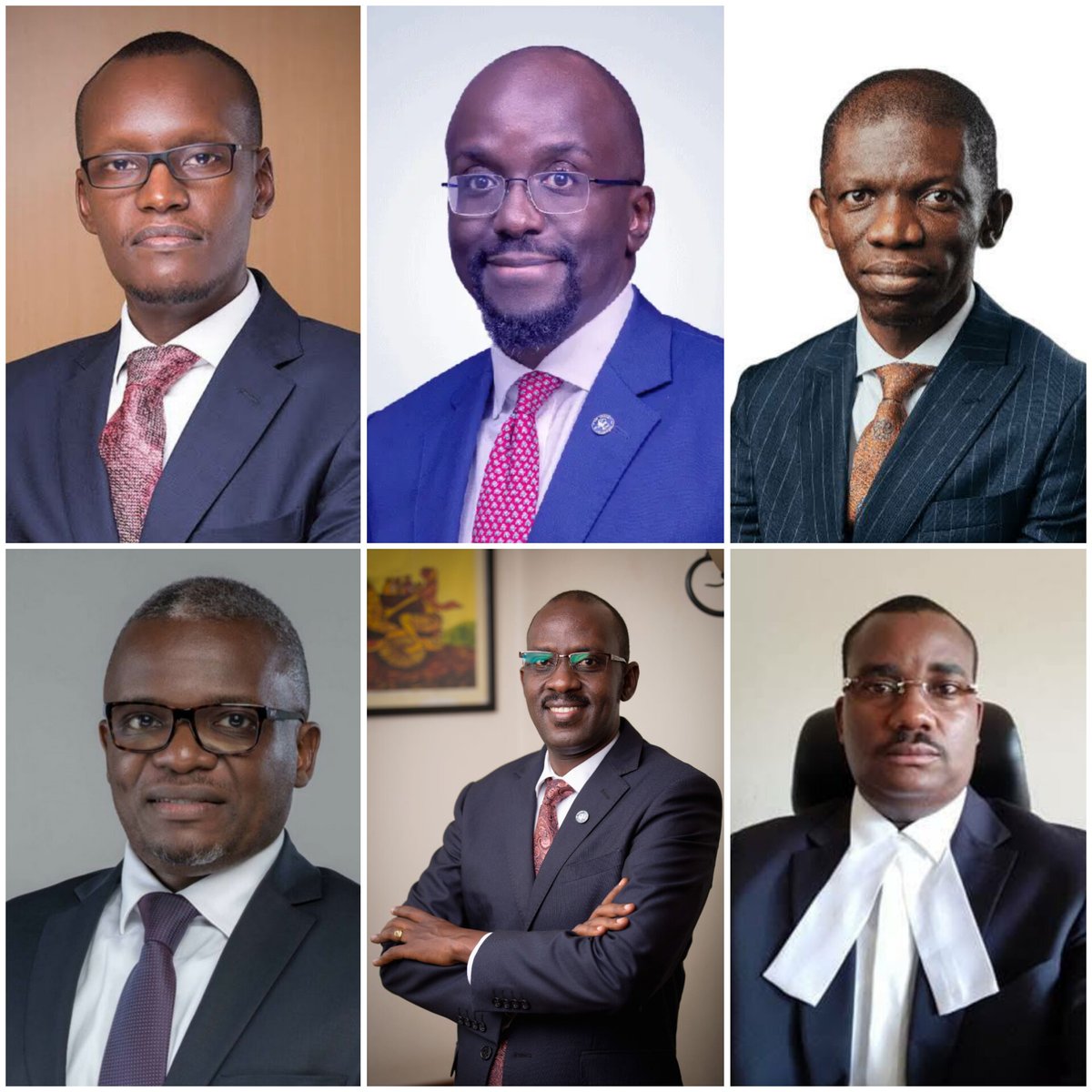
The judgment was delivered by Hon. Margaret Tibulya, JCC, with Hon. Justices Luswata, Kihika, Kazibwe, and Dr. Mugenyi, JJCC, concurring.
Among other issues, the Court dealt with the suggestion that a candidate’s being shortlisted means that he qualifies to be appointed in terms of Article 143 of the Constitution and noted that the qualifications and requirements for appointment go beyond those under Article 143 of the Constitution. It noted that being qualified for appointment and being appointed are two different things, and Article 143 should not be the basis for the claim that a qualified person must automatically be forwarded to the appointing authority without more. Rather, Article 143 leaves room for the Judicial Service Commission (JSC) to probe candidates on other criteria with a view to further determining their suitability for judicial appointment.
Hon. Margaret Tibulya, JCC, noted that the argument that removal of the petitioner’s name from the shortlist (which resulted in his not being interviewed and in his name not being forwarded to the President for consideration of his appointment) represented a breach of the JSC’s duty to advise the President in the performance of his function of appointing judicial officers is premised on a misunderstanding of the JSC’s role in the appointment process. She stated that the JSC is obligated to probe candidates about their Regulation 11(1) of the JSC regulations values as well. By so doing, the JSC neither obstructed the President from considering the petitioner’s appointment as a Justice of Appeal nor hijacked his role in the appointment process, and hence the JSC did not abdicate its function under Article 147(1)(a) as alleged.
This judgment dealt with several other aspects. Read it below: https://t.co/Bt0I2Io20n
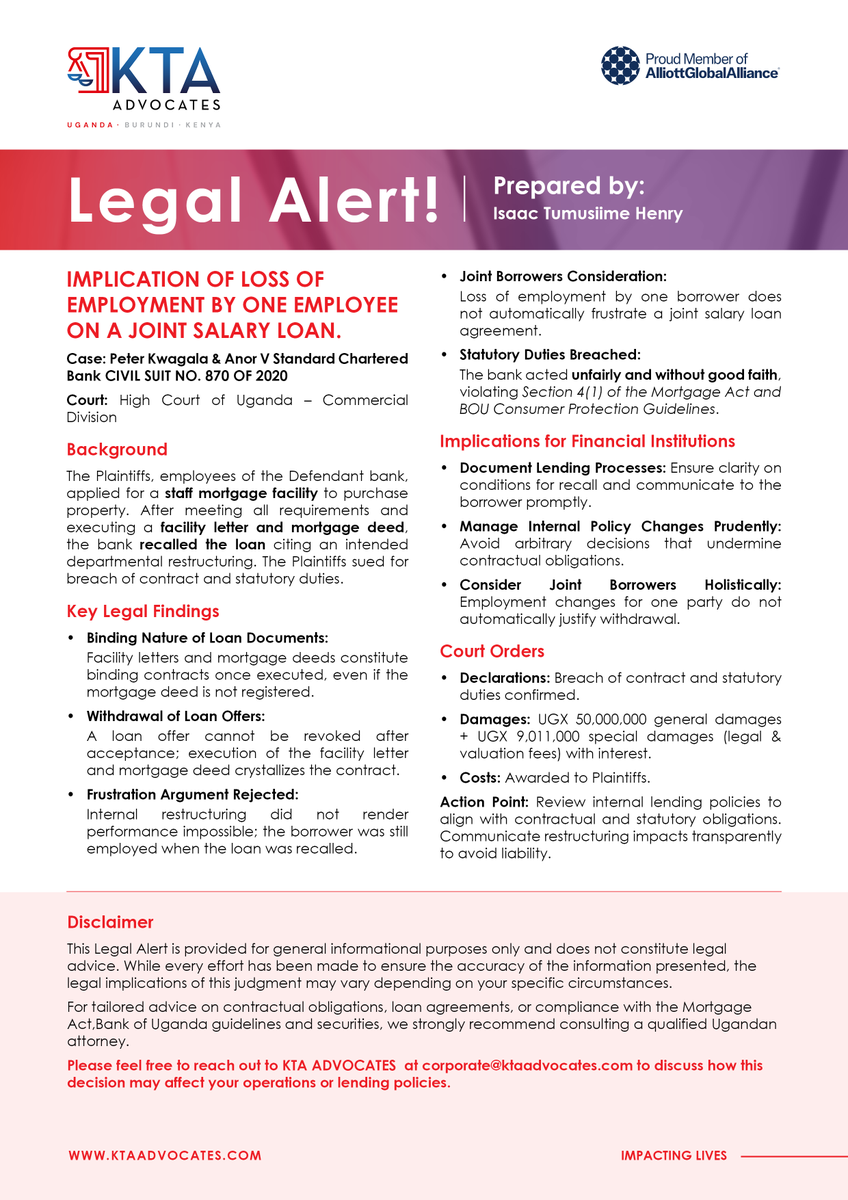
What you need to know about joint salary loans.
The High Court clarifies obligations in joint salary loans.
More details are in our alert below.
Prepared by: @Tumusiimeisaach
#hotoffthebench
🚨NEW RULING ALERT: Firstborns Just Lost the Automatic Right to Family Land. Court Says "Title Is Not Everything"
For decades, many Kenyan families have lived under a silent assumption: the firstborn’s name on the title deed means the land is theirs. The Court of Appeal’s decision in Muthandi v Muthandi (2025) just smashed that belief wide open. Two brothers, one title, twelve acres in Ndeiya, and a family history stretching back to the colonial emergency years. One brother insisted he was the absolute owner. The other swore the land was family property registered in the firstborn’s name only because their father was in detention in the 1950s and women couldn’t be registered. That’s the kind of generational Kenyan story everyone thinks can only happen to “other families.”
Here’s the bombshell: the Court held that the firstborn was NOT the true owner at all. Instead, he was just a trustee for the whole family. The judges dug into history, occupation patterns, and the logic of land allocation during colonial demarcation. They leaned on the Supreme Court’s principles in Isack M’LIntari Kiebia and reaffirmed that a customary trust can override even a clean, legitimate title deed. You can be holding the title, proudly laminated, and still not own the land in the way you think. The Court basically told Kenyans: if your family acquired land during adjudication under unusual circumstances, your title is not the final chapter. The story behind it matters just as much.
This judgment carries massive implications for families across Kenya. It reinforces that customary trusts remain powerful, silent legal realities that survive fresh titles, decades of occupation, foreign travel, and even “I paid for everything” claims. If your parents settled the whole family on land, if the firstborn was registered during emergency rule, if siblings grew up there, or if historical context points to collective benefit, then the land is not “yours alone,” even with a title. Before families rush to evict relatives, subdivide, or sell, they must confront this truth: the law still protects unwritten family interests, and courts won’t hesitate to declare a trust where history demands it. @Thuranira_1@NelsonHavi@KensonMutethia@joshuamalidzo@georgediano@DavisThuranira@MutandaLaw
Mt Kenya The Standard Tosin #FailedProtests #RiggyEarWax #SpotifyWrapped Leeds Somalis Mange Apashwa
Every law firm owner must know and admit that they are entrepreneurs in the business of law. As much as you are working IN your business as principal, don’t forget to also work ON your business.
I’m currently reading ‘The Business of Law’ and I find it a fascinating read. Lawyers in some countries seem to me to not be scared of sharing tips and knowledge they have found useful with even templates just to help others grow. We should imbibe that culture with more intentionality.
This book was sold under the American Bar Association publishing arm and has chapters dedicated to all types of practices be you a sole practitioner, a practitioner working from home or an even joining a family law practice.
I’m curious. Do we have any book published by the Nigerian Bar Association geared towards helping lawyers and practitioners navigate the business of law? Please point me in that direction, if we do, as I would like to include it in my readings towards 2026 goal setting for my firm.
🙏🏽
Court of Appeal Upholds Sale of Estate Land by Beneficiaries Before Grant of Administration
The court reaffirmed that a purchaser who pays a deposit or part payment for land immediately acquires an equitable interest in the property. The vendor becomes a trustee holding the property for the purchaser, even before completion and registration.
Read more
https://t.co/qZ6cGcy3Vg
Secure your inheritance. Ensure your parents have made Wills & strong ones. Meaning 2 independent witnesses, ideally a doctor's certificate & registered. We can help you do this at @thefynprint assist. Fill the form here. https://t.co/GBIThquYoG
Introducing Airtel Communication as a Service, an all in one Business Communication platform that allows you to send promos, track campaigns, and manage payments all in one place. Watch the video to see how it works, then book your free demo today here.