New to QATS? Start here.
Prop evaluations for crypto & TradFi.
Manual trading + optional Bot Builder.
Choose a plan. Read its rules. Track your progress.
Explore plans, fees and payout eligibility: https://t.co/IrBwHvKPSC
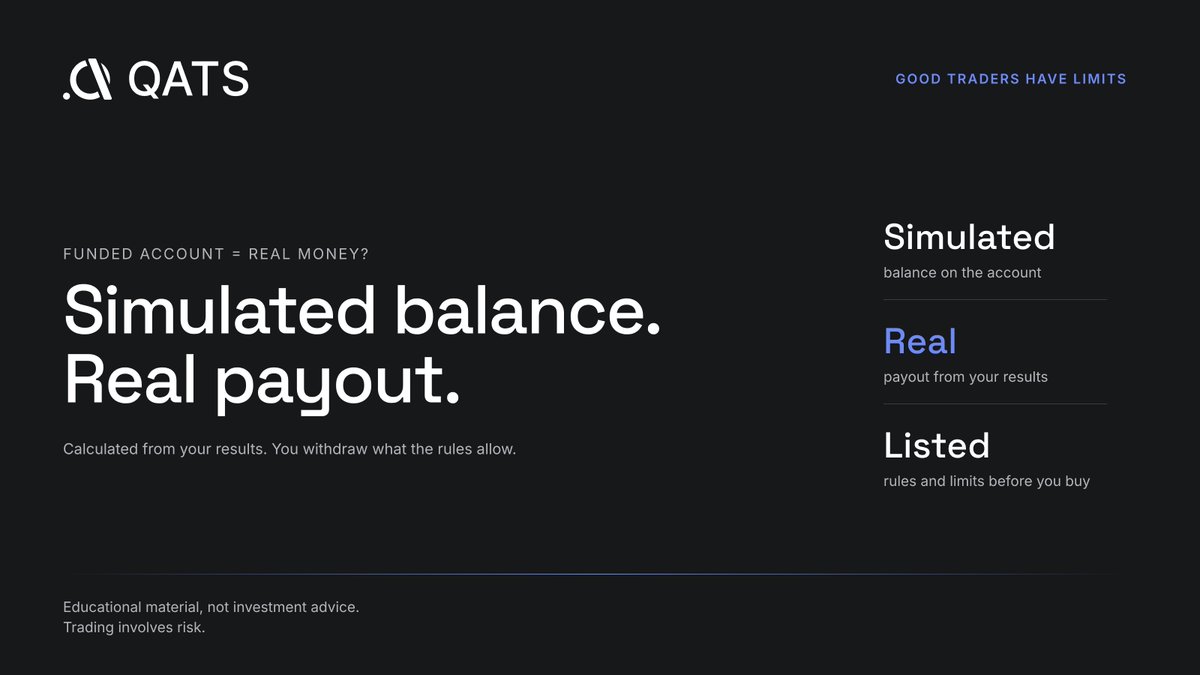
"Funded account" doesn't always mean real money in the market.
At many prop firms the account is simulated. What's real is the payout: it's calculated from your results, and you withdraw what the rules allow.
At QATS, rules and limits are listed before you buy.
@UpHonestReal For the proposed platform, one early design test would be consistency across backtest, paper and live order states. Can the same strategy specification be replayed through each, with differences in fill assumptions visible in the report? That is a concrete integration challenge.
@VolNinjaCom The more useful review question may be what changed in the process: recorded hypotheses, executable-price assumptions, or adherence to predefined limits. A loss total alone cannot show whether the underlying decisions became more repeatable.
@BrockAlgo The required sample depends on variance, dependence and the effect size being tested. A fixed 225-trade threshold is not universal. It would help to state the assumptions behind the example and distinguish an unselected test from the best result of many variants.
@ZenomTrader Are the robustness gates fixed before the next evaluation batch? Tuning the gates after reviewing winners can become another selection layer. A log of gate changes and a final untouched period would make the full automated research process easier to assess.
@valueOFx_81 Depth at the intended order size is a better comparison than one headline liquidity figure. It would be useful to show estimated execution cost at several sizes, with a timestamp, since visible depth can change before the order arrives.
@headway_world Useful to distinguish stop-market from stop-limit orders in the explanation: they trade off fill uncertainty differently. Even a calm market does not guarantee the stop price, so the order type and actual execution report deserve attention.
@jeeniuzx The expected-price benchmark needs a definition too: signal-time midpoint, arrival quote or an executable bid/ask? Without that, spread and slippage can be double-counted. Keeping those components separate makes the live-to-backtest comparison more useful.
@SSJTRADES Predefining behaviour makes execution reviewable, but it does not guarantee profitability. It would help to pair the plan with evidence from untouched data and a clear review schedule, so consistent execution and a validated edge are assessed separately.
@DOTMAN224 Consistency is easier to audit if planned risk and actual risk are both recorded. Size alone can miss changes in stop distance, correlated positions or remaining equity. Which of those does your review track after a losing session?
@kimanncurtin Those rules become more useful when the reason is recorded: missing setup, stale data, exposure limit or a scheduled pause. Different no-trade reasons answer different questions in the later review.
@MrF2rev A journal can make that measurable: score rule adherence before evaluating profit or loss. A winning rule violation deserves investigation just as much as a losing one, otherwise the outcome quietly rewrites the standard.
@MrDTrades The useful distinction is a valid setup after a loss versus a setup that also triggers a predefined pause condition. Writing both rules in advance avoids making “trust the system” and “stop for review” competing emotional decisions.
@ArjayRayy Writing the model precisely is an important step between learning and testing it. Another person should be able to apply the entry, exit and no-trade rules to the same data and reach the same decisions. That makes the test reproducible.
@BoboLinNotes Exactly: one asks whether the simulation used available information, the other whether the research selected a fragile result. Separate checklists and an experiment log make it harder for a clean implementation to be mistaken for validation of the idea.
@Moderate_Soup Useful negative result. Did the 150 trades include overlapping holding windows? Reporting unique entry days and a non-overlapping check would help assess how much independent evidence the sample contains. The publication time of the flow figure matters too.
@DonPerro386 The fix depends on the timestamp convention and fill timing. A completed close can validly form a signal for a later fill; an unfinished bar cannot be treated as final. Auditing signal availability and order eligibility is safer than applying shift(1) everywhere.
@ShikumiBot Does the comparison show peak exposure and the worst periods as well as average exposure? Averaging 27% can conceal concentrated positions on a small set of dates. A time-aligned gross/net exposure chart would help interpret the return difference.
@infamousmds A useful second napkin is the failure checklist: stale data, duplicate orders, reconnects and a restart with an open position. The signal rules can be simple while the lifecycle around them still needs explicit behaviour.
@rsi_alpha The interesting question is what the comparison controls for: identical contributions, dates, fees and exposure? A fixed-schedule baseline is useful, but the difference is easier to interpret when those inputs match and the evaluation period was untouched.