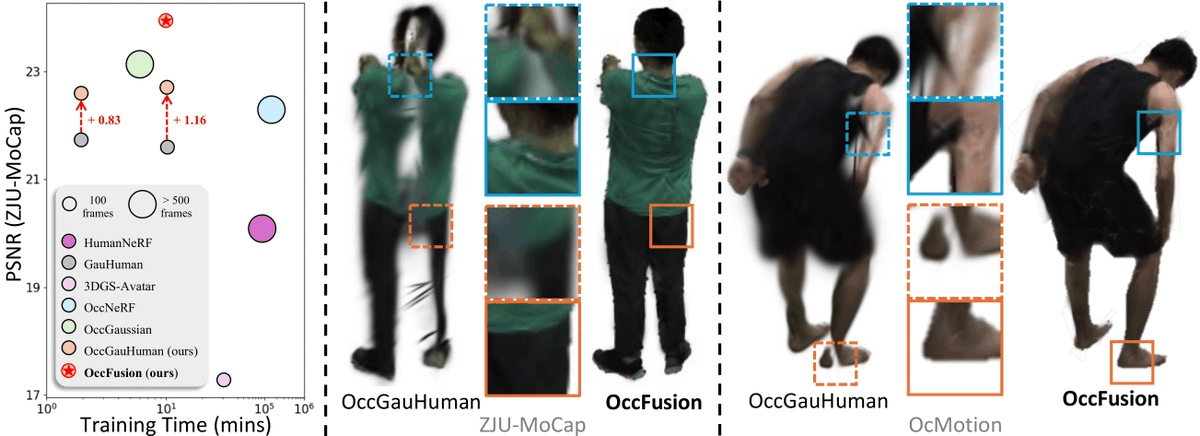
Reconstructing occluded humans from monocular video can be nice and fast! 🎆 I’m excited to share our new paper “OccFusion: Rendering Occluded Humans with Generative Diffusion Priors” 🧵
📖https://t.co/HFuFvpkVaA
🌐https://t.co/WXCsOg6H8A
The idea of "machine unlearning" is getting attention lately. Been thinking a lot about it recently and decided to write a long post: https://t.co/YWFco5xNNq 📰
Unlearning is no longer just about privacy and right-to-be-forgotten since foundation models. I hope to give a gentle overview of unlearning and touch on things like copyright, NYT v. OpenAI, NeurIPS unlearning challenge, retrieval-based systems, AI safety, & pretending to unlearn.
I hope it'll be a fun weekend read!
Human NeRFs have shown incredible abilities rendering 3D avatar from single monocular videos. But can they train on videos with occlusions? I’m excited to share our new paper “Wild2Avatar: Rendering Humans Behind Occlusions”🧵
📖https://t.co/kr7MeRFyIs
🌐https://t.co/19hZtslhpv
@IlyaKuzovkin@ZijiaoC@HelenJuanZhou @TarrLab @humanscotti@iScienceLuvr@NishimotoShinji decoding text and decoding images are two different tasks (involving different brain regions and different brain encoding model). If you mean decoding text from visual cortex first and use that to generate images, that’s definitely a valid method.
@IlyaKuzovkin@ZijiaoC@HelenJuanZhou @TarrLab @humanscotti@iScienceLuvr@NishimotoShinji And it’s a tradeoff when we are limited by current methods and data. I believe as our algorithms improved, we can achieve this ultimalte goal (we already see a lot great work like the one from @humanscotti )
Regarding ur text decoding comments, correct me if I misunderstood,
@IlyaKuzovkin@ZijiaoC@HelenJuanZhou @TarrLab @humanscotti@iScienceLuvr@NishimotoShinji which is why most the recon papers report different metrics (both semantic and pixel level) and that is the ultimate goal of this field of research. Targeting pixel level or semantic level first are trying to approach this ultimate goal from two different directions.
We will be hosting a workshop at AAAI this year, and we are currently accepting paper submissions on the captivating theme of ‘Brain Encoding and Decoding.’ We warmly invite you to submit your work and join us at AAAI to engage in meaningful discussions about this topic.
Thrilled to share that our work has been accepted by #NeurIPS2023 as an Oral presentation!!
Project page: https://t.co/JyXA2k41dL
We've cracked the code to decode photorealistic videos from human brain recordings! 📽️➡️🧠
@_akhaliq@NeurIPSConf#deeplearning#MachineLearning
Cinematic Mindscapes: High-quality Video Reconstruction from Brain Activity
propose Mind-Video that learns spatiotemporal information from continuous fMRI data of the cerebral cortex progressively through masked brain modeling, multimodal contrastive learning with spatiotemporal attention, and co-training with an augmented Stable Diffusion model that incorporates network temporal inflation
paper page: https://t.co/XzbqItFtN1
🧠✨Super excited to share that our work Mind-Video has been accepted by #NeurIPS2023 as an Oral presentation! 📍 Catch us live in New Orleans!
TL; DR: We've cracked the code to decode photorealistic videos straight from human brain recordings! 📽️➡️🧠
@NeurIPSConf#AI4Science
Cinematic Mindscapes: High-quality Video Reconstruction from Brain Activity
propose Mind-Video that learns spatiotemporal information from continuous fMRI data of the cerebral cortex progressively through masked brain modeling, multimodal contrastive learning with spatiotemporal attention, and co-training with an augmented Stable Diffusion model that incorporates network temporal inflation
paper page: https://t.co/XzbqItFtN1
🧵🧠 We're witnessing incredible scientific progress in image & text reconstruction from fMRI nowadays. But what about reconstructing video from fMRI? Allow me to introduce our recent preprint: Mind-Video
https://t.co/VL2KXz8o9K
https://t.co/KyNtsCxDIJ
https://t.co/bhjz0PDlS6
🧵🧠 We're witnessing incredible scientific progress in image & text reconstruction from fMRI nowadays. But what about reconstructing video from fMRI? Allow me to introduce our recent preprint: Mind-Video
https://t.co/VL2KXz8o9K
https://t.co/KyNtsCxDIJ
https://t.co/bhjz0PDlS6
Researchers are developing artificial intelligence technology they say generate the very images in our brains.
@byjacobward shares more on the extraordinary research and the concerns about what mind reading technology could mean for the future: https://t.co/aLxnmbUuJr
Excited to share that MinD-Vis has been accepted by CVPR23. 🥳
TL;DR: We use a two-stage model (self-supervised learning + latent diffusion model) to generate nature images from brain recordings.
Check out our project page: https://t.co/li0smBy911
Last night we celebrated the incredible achievements of our 18,000 graduates of 2020 with a live-streamed celebration event from the Great Hall.
To the graduating class of 2020, congratulations, you did it.
#USYDClassOf2020.