The Human Made Mark, Initiative to Certify AI-Free Film and TV Productions, Launches at Site of Prehistoric Cave Paintings in France (EXCLUSIVE) https://t.co/hoUQXpadC7
A human consumes about 2,000 calories per day. Over 20 years, that’s roughly 17,000 kWh of total food energy. Training GPT-4 consumed an estimated 50 GWh of electricity. That’s 3,000 humans worth of “training energy” for a single model run.
And GPT-4 is already dead. OpenAI retired GPT-4o from ChatGPT on February 13th. The model that took 50 GWh to train got less than two years of flagship status before replacement. The human you spent 17,000 kWh “training” for 20 years produces economic output for the next 40 to 60 years. The amortization window on GPT-4 was shorter than a car lease.
Now look at what replaced it. GPT-5.2, released December 2025, is OpenAI’s current default. The GPT-5 series consumes an estimated 18 Wh per average query according to the University of Rhode Island’s AI Lab, up to 40 Wh for extended reasoning. That’s 8.6 times more electricity per response than GPT-4. With 2.5 billion queries hitting ChatGPT daily and GPT-5.2 now the default model, the inference math gets staggering fast. Even at a blended average well below 18 Wh, you’re looking at daily electricity consumption that could power over a million American households.
This is what Altman is actually doing. OpenAI hit $13 billion in annual recurring revenue but still isn’t profitable. They need you to think of AI energy consumption as natural and inevitable, the same way you think about feeding a child, because the alternative framing is that they’re burning through enough electricity to rival small countries while racing to build 1-gigawatt Stargate data centers. The food analogy makes the energy costs feel biological and unavoidable instead of what they are: an engineering and business choice that scales with every model generation.
The comparison sounds clever at a fireside chat in India. It falls apart the second you do the arithmetic.
Today’s American History Lesson: Puerto Rico has been part of the U.S. since 1898, and Puerto Ricans have been U.S. citizens since 1917 🇵🇷 🇺🇸
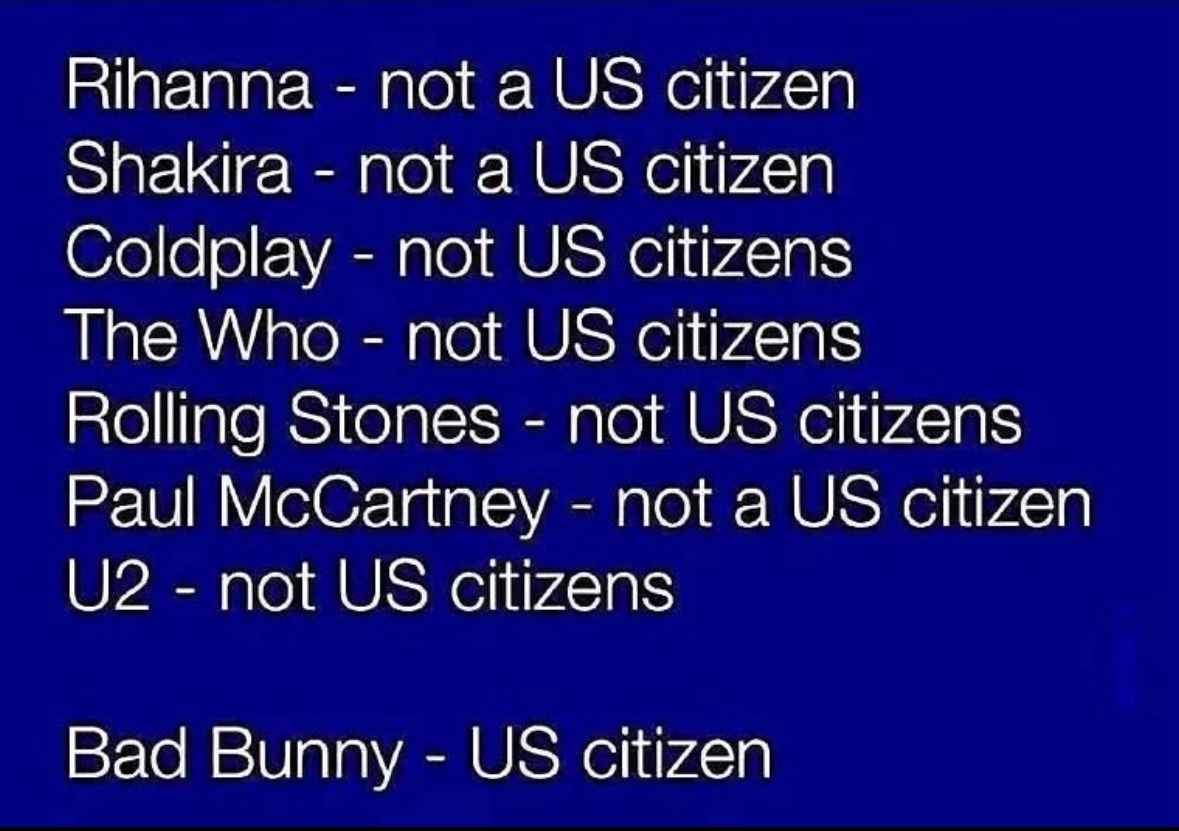
We’ve cheered many non-Americans at the #SuperBowl. Bad Bunny isn’t one of them.
🏈 🎤
El discurso más potente de hoy en Davos fue el del primer ministro canadiense, Mark Carney. Un mensaje escrito por él mismo y que, seguramente, será recordado como uno de los que mejor capturaron —y marcaron— este momento de la historia
Escúchenlo, son 17 minutos bien invertidos👇
Ozzy Osbourne meets his idol Paul McCartney for the first time (2001)
Ozzy loved The Beatles. They were his favorite band and a huge inspiration to him.