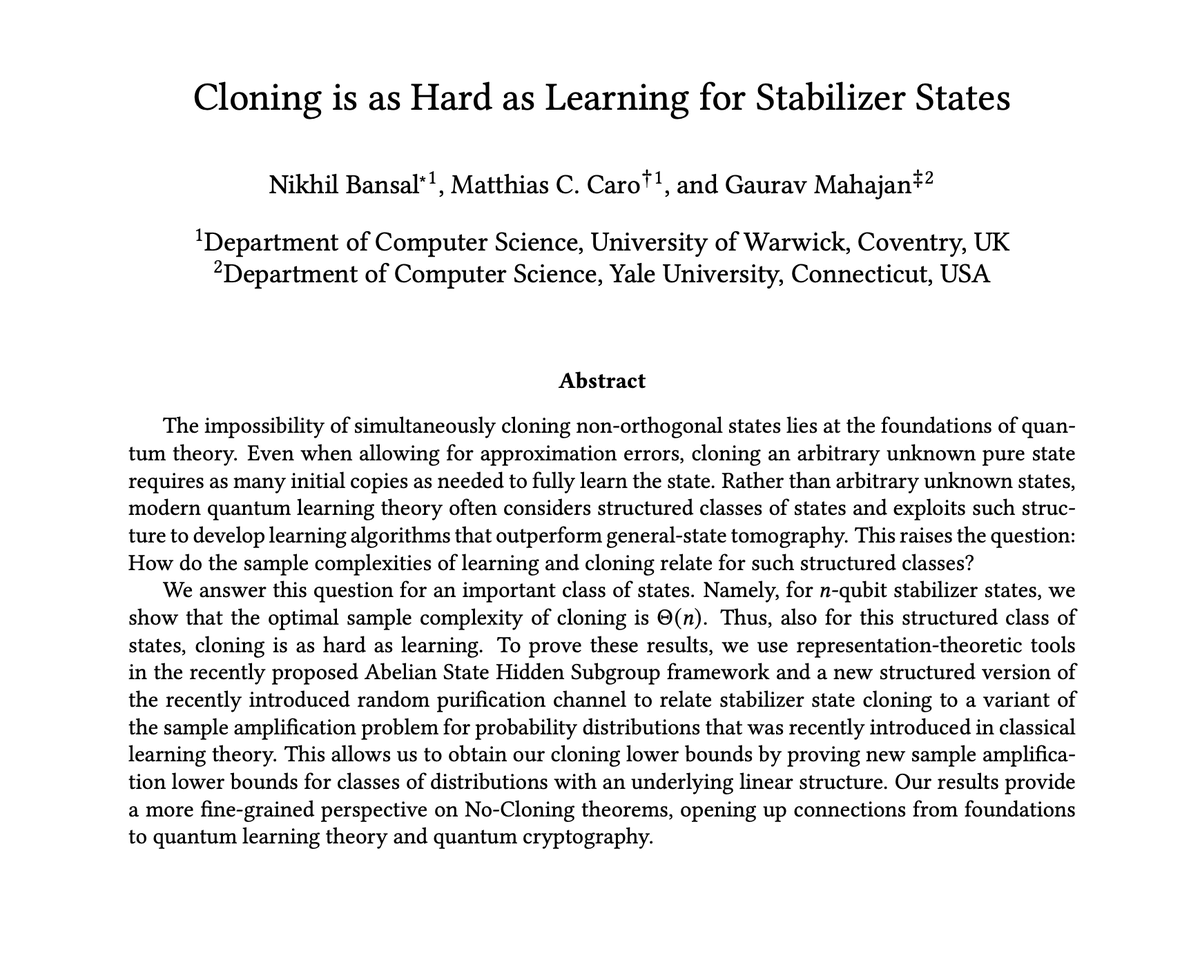
Can quantum cloning be easier than learning for structured classes of states❓
We ask this question for stabilizer states in our recent work: https://t.co/nDKqPGo4Jw.
1/⚛️
Mathematics -is- a human endeavour.
There is something which maybe you're calling mathematics that has nothing to do with humans, some 'platonic otherworld' of abstract ideas. But what I call mathematics is the human attempt to explore and understand this world.
Can quantum cloning be easier than learning for structured classes of states❓
We ask this question for stabilizer states in our recent work: https://t.co/nDKqPGo4Jw.
1/⚛️
Finally, I would like to thank the brilliant @IMathYou2 and @gauravmahajn for many many interesting discussions. I learnt a lot about classical and quantum learning theory throughout this project from them 😄.
⚛️/⚛️
Charles Bennett and Gilles Brassard have been named the winners of the A.M. Turing Award, one of the highest honors in computing, for their work establishing the foundations of quantum information theory. The award comes with a $1 million prize. https://t.co/PFTEye35cu
The researchers Lijie Chen (left), Igor Oliveira (top-right) and Jitau Li recently used “reverse mathematics” to connect a theorem called the pigeonhole principle to a whole class of complexity problems. https://t.co/dxgKeNNJPq
Join us for the first Quantum Cambridge–Oxford–Warwick Colloquium (Quantum COW, if you insist...), 11–12 December 2025 at the University of Oxford.
This meeting focuses on Quantum Low-Depth Complexity, with talks, tutorials, and open discussions.
Details: https://t.co/hIQyiUy5ri
📢The Workshop Algorithms & Complexity @ Warwick will be held on 22-23 September at the University of Warwick! The event will highlight several recent exciting advances in the field of Algorithms and Complexity. Looking forward to seeing many of you there!
https://t.co/X1AKDRmbP5