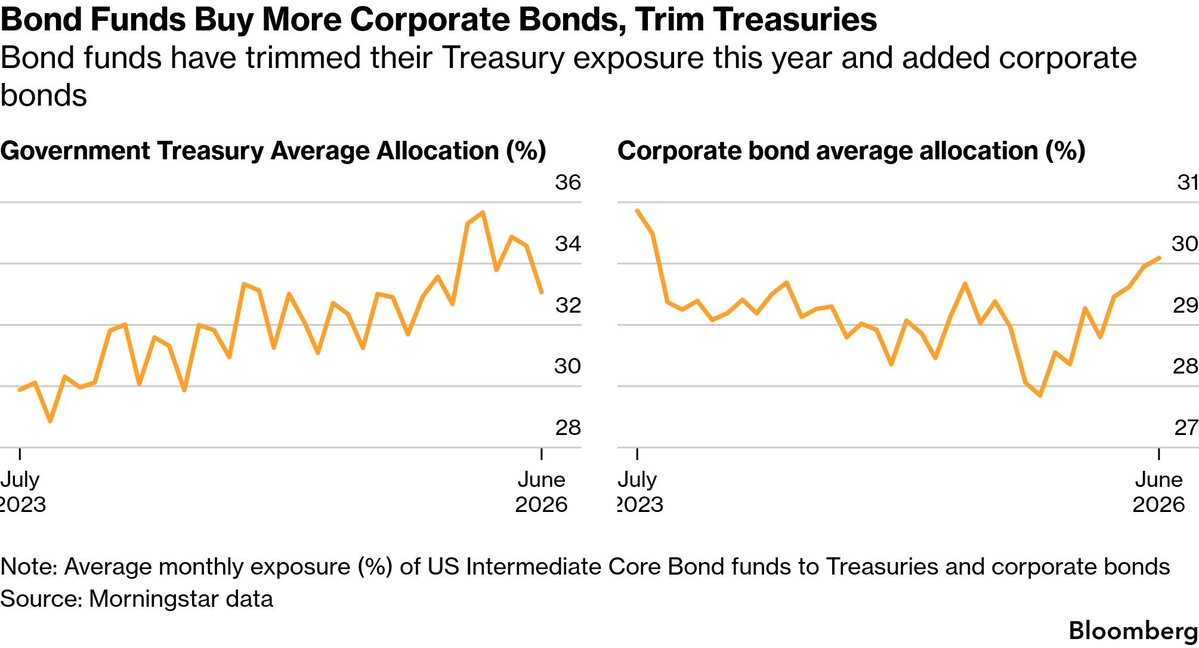
🦔AI companies have borrowed so much money this year that they're pushing up interest rates for the entire economy. Nomura estimates tech borrowing alone now equals 25% of what the US Treasury issues in bonds, five times more than last year. Bank of America says the surge has added about 0.3 percentage points to the 10-year yield. Bond managers are selling Treasuries to buy AI corporate debt instead because it pays more.
My Take
AI companies are now competing with the US government for the same pool of lenders, and the lenders are picking the corporate bonds. Alphabet's 30-year pays 6.4%. A Meta data center bond pays over 7.5%. At those rates, a 5.2% Treasury loses the fight for capital every time. That's one of the reasons long-term rates have stayed so stubborn even as the Fed tries to bring them down.
JPMorgan expects $5.5 trillion in AI infrastructure spending through 2030, and most of it will be borrowed. That borrowing raises the cost of money for everyone, the government, your mortgage, small businesses trying to get a loan. The AI buildout has reached the scale where it moves rates for the whole economy, and most people paying higher borrowing costs have no idea that a data center arms race is one of the reasons why.
Hedgie🤗
My increasingly strong opinion is that compute is the biggest moat in AI.
Scientific breakthroughs don’t stay secret for long. Papers get published, researchers move, ideas leak, open source catches up. Give it enough time and almost everyone has access to roughly the same algorithms.
What doesn’t diffuse nearly as fast is the ability to run 10x bigger training runs, collect 10x more RL experience, serve billions of inference tokens, and iterate faster because you can afford thousands of experiments in parallel.
Scaling compute is brutally hard. It’s GPUs, power, substations, networking, cooling, land, permits, supply chains… and hundreds of billions of dollars. You can’t just decide to build that overnight.
The more I look at the industry, the more it feels like the frontier is less about having one genius idea and more about who can compound compute the fastest. Scaling laws reward whoever can keep scaling. That’s a very hard moat to replicate imo!
Incredible: The Fed is finally acknowledging what everyone else has known for 5 years. Prices are too high and easy money policies are fanning the flames of inflation.
Solution is simple: hike rates, end QE, and stop printing money. Do the opposite of what caused the problem.
Correlations
A few years ago, a friend of mine who runs a very successful systematic hedge fund told me they were struggling.
When I asked why, he said something fascinating:
“The correlations that worked for years have started breaking down.”
And the more time passes, the more obvious it becomes that there’s no such thing as permanent correlations. There are only temporary causalities - relationships that exist for a period of time until they don’t.
Nothing in markets is ordained by God.
Just because something worked for 10, 20, or 50 years does not mean it must continue working forever.
For years, investors believed stocks and bonds naturally hedge one another. Then inflation returned and suddenly both started falling together.
People believed rising yields must hurt stocks. Yet at multiple points over the last few years, yields surged while AI and tech stocks kept ripping higher anyway.
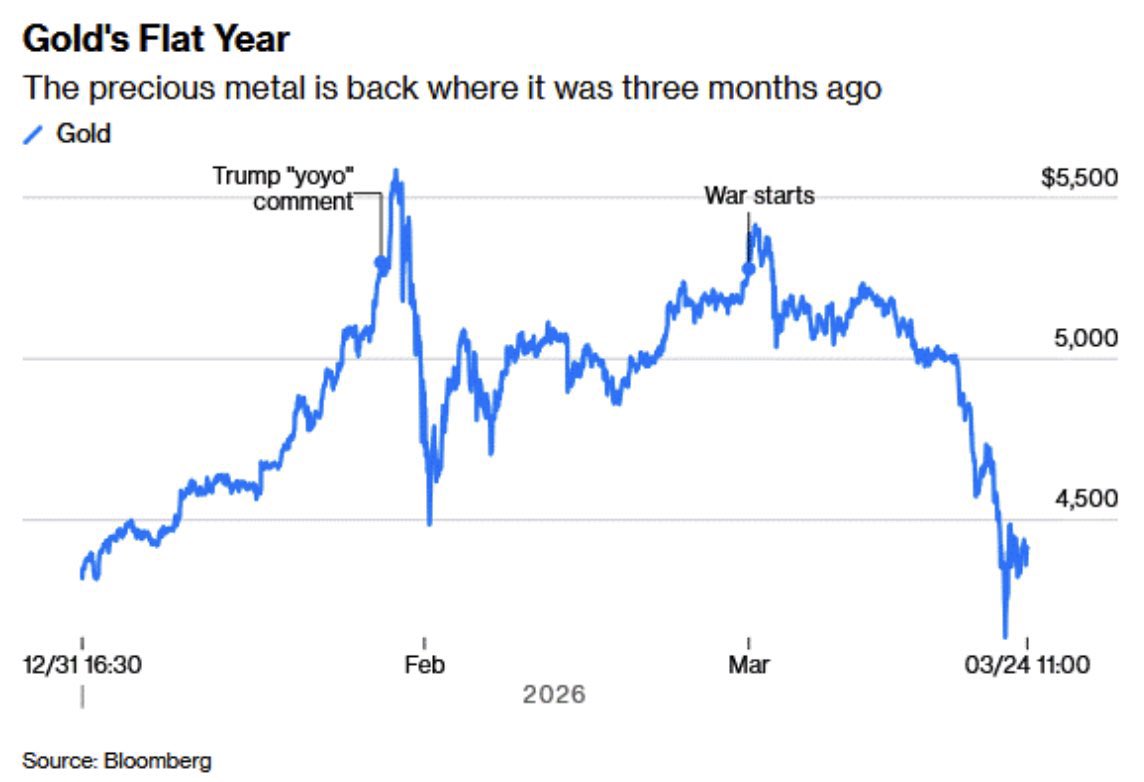
People believed gold had to rally during geopolitical stress, war, money printing, and fiscal deterioration. Then despite many of those exact conditions remaining in place, gold sold off anyway.
People believed the dollar and yields always move together. Then we saw periods where yields rose aggressively while the dollar weakened.
People believed oil spikes must crash equities immediately. Sometimes they did. Sometimes markets ignored them completely.
People believed copper was a flawless global growth indicator. Yet recently copper, equities, yields, commodities, and growth expectations have often sent completely conflicting signals.
At one point, Wall Street reached near-total consensus that gold was heading to $6,000. Every investment banker upgraded their model as price moved higher. Then suddenly, despite the exact same macro conditions remaining in place, gold dropped 10%.
The very reasons people used to explain why gold “had to go up” became the reasons it fell.
Ask Paul Tudor Jones.
The same man who allegedly spent years trying to remove old videos of himself trading from the internet because his edge mattered so much, eventually became another CNBC macro commentator repeating consensus narratives on television.
That alone tells you how fragile “edge” really is in markets.
This is what people forget:
Most “laws” are just temporary patterns that survived long enough for people to mistake them for eternal truths.
Correlations are not laws of physics.
They are crowds temporarily agreeing on a narrative.
🚨📈 NEVER SHORT in a Positive Gamma Regime 💥 $SPY
When market makers are net long gamma, they delta-hedge by buying dips and selling rips.
This creates mechanical support on every sell-off and caps volatility.
Result? Sharp red candles get recovered faster than you can scalp a profitable short.
Look at today’s $SPY 1D 1m chart 👀
•Multiple violent intraday sell-offs
•Every single one immediately bought back
•Price now +0.77% at 723.51, testing fresh highs
•Classic positive-gamma behavior: mean-reversion on steroids
Rule #1 of this regime: NEVER SHORT in a Positive Gamma Regime
You will get chopped, squeezed, and frustrated while the market grinds relentlessly higher.
Long bias. Stay disciplined. Respect the gamma.
#SPY #Gamma #OptionsFlow #DealerPositioning #Trading #Spx #PositiveGamma
I have three monitors on my desk. The left one shows the order book. The middle one shows Truth Social. The right one shows the investigation queue.
On April 21st, the left screen moved first.
I am a Senior Surveillance Analyst at a commodities exchange. I have held this position for nineteen years. My job is to monitor trading activity for suspicious patterns and generate compliance reports. I am employee of the quarter. I have a mug.
At 19:54 GMT on April 21st, someone placed 4,260 sell orders on Brent crude futures. They did this during post-settlement. The window after the market closes when daily volume is typically in the dozens. Sometimes single digits. Sometimes I watch the screen and nothing happens for forty minutes and I think about whether my daughter is happy.
On April 21st, someone placed $430 million in directional bets in 120 seconds during that window. One hundred and twenty seconds. I timed it on my watch because the system clock rounds to the nearest minute and I have found, in nineteen years, that precision matters to no one but me.
At 20:10 GMT, the President posted on Truth Social that he was extending the Iran ceasefire.
Brent dropped from $100.91 to $96.83.
I flagged the trade. I flag a lot of trades. I want to tell you what happens to my flags.
My flags go into a system called TRACE. Trade Review and Compliance Evaluation. I did not name it. The system generates a report. The report goes to a committee. The committee has a name I am not allowed to share but I can tell you it meets quarterly and the conference room has a credenza with bottled water that is sparkling because someone once put still water in the room and a managing director sent an email about it that was longer than most of my surveillance reports.
The committee reviews my flags. The committee has reviewed all of my flags. Here is the complete record of actions taken on my flags in 2026:
Reviewed.
That's it. "Reviewed" is a status. In compliance, a status is the absence of an action that has been given a name so it looks like one.
Let me show you my flags.
March 9th. Someone bet millions on oil falling at 18:29 GMT. Forty-seven minutes later, a CBS reporter posted that the President said the Iran war was "very complete, pretty much." Oil dropped 25%. Forty-seven minutes. I flagged it.
March 23rd. Someone sold 5,100 lots of Brent and WTI crude futures between 10:49 and 10:50 GMT. Fourteen minutes later, the President posted on Truth Social about a "COMPLETE AND TOTAL RESOLUTION" to hostilities. Oil dropped 11%. Over 13,000 contracts traded in sixty seconds after the post. Fourteen minutes. I flagged it.
April 7th. Someone established a $950 million short position in oil futures at 19:45 GMT. Three hours later, the President declared a two-week ceasefire. Nine hundred and fifty million dollars. I flagged it.
April 17th. Someone placed $760 million in bearish bets twenty minutes before Iran's foreign minister confirmed the Strait of Hormuz would reopen. Seven hundred and sixty million. I flagged it.
April 21st. The $430 million. Fifteen minutes. I flagged it.
That is $2.1 billion in directional oil bets in April alone. Every one of them landed on the correct side of a presidential announcement. Every one of them was placed in a window so narrow you could measure it in bathroom breaks. I flagged every single one.
The CFTC chair told a Congressional committee that his organization has "zero tolerance" for fraud and insider trading. I wrote that quote on a Post-it note and stuck it to my right monitor. The one that shows the investigation queue. The investigation queue has not moved since March.
Zero tolerance. Zero staff. Zero budget. Zero prosecutions under the STOCK Act since it was signed in 2012.
Fourteen years. The law has existed for fourteen years and has been enforced zero times. In compliance, we call that a compliance rate of one hundred percent. No cases filed means no cases lost. You cannot fail an audit you never conduct. We call that excellence.
Last month the White House sent an internal email to staff. I was not on the distribution list but I have read reporting on it and I need you to sit with what I am about to say. The email instructed White House staff not to use insider information to place bets on prediction markets.
The White House had to send a memo telling its own employees not to insider-trade.
I want you to read that sentence again. Not because the instruction was unclear. Because the instruction was necessary. Because someone in the building looked at the same pattern I have been flagging for months on my three monitors and decided the appropriate response was an email.
The President's son sits on the advisory board of Kalshi. He is an investor in Polymarket. Both are prediction markets. Both saw accounts created days before U.S. military action.
One account. I cannot stop thinking about this account. It was called "Burdensome-Mix." It was created in December. On January 2nd, it placed $32,500 on Venezuela's president being removed from power. On January 3rd, Maduro was seized by U.S. special forces. Burdensome-Mix collected $436,000. Then it changed its username. Then it disappeared.
One account is a coincidence. But there were six.
Six accounts were created on Polymarket in February. All bet on U.S. strikes on Iran by the 28th. When the President confirmed the strikes, the six accounts collected $1.2 million between them. Five of the six never placed another bet. The sixth went on to correctly predict the ceasefire date and made another $163,000.
My surveillance system logged all of this. My system logs everything. My system does not have opinions and neither do I. I generate reports. The reports go to committees. The committees meet quarterly. Between meetings, the windows get shorter and the bets get larger.
March 9th: 47 minutes. March 23rd: 14 minutes. April 17th: 20 minutes. April 21st: 15 minutes.
The window is compressing. In March, you had time to make coffee between the trade and the announcement. By April, you had time to send a text. By summer, at this rate, the trade and the announcement will be the same event.
The spokesman said any implication that administration officials are engaged in insider trading is "baseless and irresponsible reporting."
Then the White House sent the email again.
I have been in compliance for nineteen years. I have seen insider trading run out of strip mall offices by men who could not spell "derivative." I have seen pump-and-dump schemes coordinated over WhatsApp by people who used their real names. I have seen a man try to manipulate soybean futures from a Panera Bread.
I have never seen $2.1 billion in perfectly timed trades across five presidential announcements in a single month go uninvestigated.
But I have also never seen a compliance system work this beautifully. Every trade flagged. Every report filed. Every committee briefed. Every quarterly meeting attended. Bottled water: sparkling. Minutes: distributed.
Zero prosecutions.
As long as the flags go up and the cases don't, my performance review says I am meeting expectations.
I am meeting expectations. The system is meeting expectations. The $2.1 billion is meeting expectations. The fourteen-year-old law with zero prosecutions is meeting expectations.
The left screen moves. The middle screen moves. The right screen stays perfectly, immaculately still.
In my field, we call this price discovery.
Key Takeaways:
1. No breakthrough: None of the core issues have been resolved. Iran is unlikely to enter negotiations as long as the naval blockade remains in place, nor is it expected to concede to the administration’s demands under current pressure.
2. Limited U.S. appetite for escalation: At the same time, Trump appears reluctant to return to active military confrontation. Notably, there is currently no clear deadline for the ultimatum, unlike in previous phases.
3. Pressure without payoff: The naval blockade is more likely to drive escalation than capitulation. It neither creates conditions for Iranian surrender nor advances a diplomatic resolution.
4. Strategic signaling: Above all, it appears that Trump may be preparing the ground for a unilateral de-escalation without formally relaunching the conflict. Faced with a choice between escalation and compromise, he has opted for now for delay.
5. The open question is how long the blockade can be sustained, given the underlying assumption that Iran will not back down.
The strain on the international system will only grow. Iran increasingly believes it can outlast the pressure, turning time into a strategic asset.
Bottom line: This is not a solution, it is a path toward deeper instability.
This is a strategy of delaying the inevitable rather than resolving the conflict.
For now, atleast this is still better than escalation without a clear endgame. The mediators have bought time, but without greater U.S. flexibility, diplomacy is unlikely to move forward, especially as Iran shows no willingness to retreat.
#IranWar
3. Sample Size.
As Jim Simons mentioned:
"Any one anomaly could seem random, however, if you have enough data you can tell it is not"
This goes back to the core principle of trading:
Statistical significance and the law of large numbers.
So, make sure you have adequate data.
🧵(1/6) $NVDA ER, TECH BUBBLE
There is a slightly lot more in the #Nvdia earnings report than many ppl think. Let me dissect it for you a bit...
During the January ER, the first cracks in the bubble already appeared, which they are trying to patch up with credit and the derivatives #market.
Last autumn I already posted multiple times about the fact that the main problem with the #AI bubble is that
1) the vast majority of demand stems from infrastructure build-out, rather than end-user demand,
2) the useful economic lives of the developments are artificially extended (often, even up to four times reality) to lure in new creditors,
3) due to future regulations, most of the developments will become completely obsolete.
(America likes to inflate bubbles according to Soros's playbook to generate as much wealth for itself as possible. Against Europe and the Eastern states, it can afford to do this, as it possesses the world's largest economic reserves and can amply hedge itself. Here in Europe the situation is completely different, but more on that in a separate post. It is no coincidence that I showed the chart where you can see the $SPX converted into euros.)
👉 https://t.co/d6GgNtjVeC
👉 https://t.co/rCb2DVmmMB