$ACN +17.17% to $214.86.
Q4 earnings beat and earnings call notes on record managed services bookings drove the move.
Analysts followed with multiple target hikes (GS to $260; BMO to $235; Stifel to $242).
Treasury selloff pressure hit stocks, but ACN held strong today.
#Accenture
"Where the noise fades and the signal speaks—your daily market pulse starts here"
Market Brief — September 30 (Generated by GPT 5.6):
Wall Street ended September with a split tape: technology held up, but rising long-term Treasury yields again pressured the broader market. The S&P 500 fell 19.30 points, or 0.25%, to 7,651.54, while the Nasdaq Composite gained 63.52 points, or 0.24%, to 26,861.06. The Dow Jones Industrial Average dropped 443.87 points, or 0.86%, to 50,906.05, and the Russell 2000 declined 11.06 points, or 0.39%, to 2,796.86. Equities initially responded positively to softer inflation data, but the improvement faded as evidence of stronger economic growth kept pressure on the long end of the Treasury curve.
The Fed's preferred inflation measure delivered genuine relief, but not enough to declare the inflation problem solved. August headline PCE prices rose 0.3% month over month and 3.4% year over year, while core PCE increased just 0.2% on the month and 3.0% over 12 months. The core reading was cooler than expected and immediately reduced expectations for another near-term Fed increase. Yet inflation remains well above the 2% objective, so the report changed the degree of tightening risk rather than eliminating it.
Consumer spending was far stronger than income growth, producing one of the day's most important economic divergences. Personal consumption expenditures jumped 0.9% in August, while personal income rose only 0.2% and disposable income increased 0.3%. Real PCE rose approximately 0.6%, while the personal saving rate fell to 4.1%. Consumers are therefore continuing to spend aggressively, but part of that resilience is increasingly being financed through a lower savings buffer rather than comparable income growth.
Second-quarter GDP was revised sharply higher, reinforcing the idea that the economy is stronger than earlier estimates suggested. Real GDP growth was revised to an annualized 2.2% from the previous 1.5% estimate, reflecting stronger consumer spending, investment and exports. Separately, ADP estimated that private employers added 90,000 jobs in September, above expectations near 70,000. The combination of softer inflation and stronger activity created a complicated policy signal: price pressure improved, but the economy still does not look as though restrictive rates are producing a conventional downturn.
Treasuries ultimately overruled the early inflation relief, with the long end setting fresh multi-decade highs. Official Treasury data put the 2-year yield at 4.88%, down 1 bp, but the 10-year rose 3 bps to 5.29% and the 30-year climbed 5 bps to 5.64%. That steepening matters: the market reduced some immediate Fed risk after the PCE report while continuing to demand greater compensation for holding long-duration government debt. The VIX remained subdued at approximately 15.99, down slightly on the session, indicating valuation pressure rather than outright market panic.
Oil rebounded after Tuesday's sharp decline, ensuring that energy remained part of the inflation equation heading into October. The expiring November Brent contract settled 0.9% higher at $103.50 a barrel, while the more active December contract rose 1.9% to $98.03. WTI settled 1.2% higher at $90.42. Stalled U.S.-Iran negotiations and tight fuel markets offset improving Persian Gulf export flows. The Brent contract distinction is important: the $103.50 November settlement should not be compared directly with the lower-priced December contract without accounting for expiry and curve structure.
Liquidia $LQDA suffered one of the year's most violent biotech repricings after a patent ruling materially changed the competitive outlook for YUTREPIA. $LQDA collapsed 57.2% to $30.26 after a federal court ruled that two claims of United Therapeutics' $UTHR '327 patent were valid and infringed. United Therapeutics $UTHR surged 12.6% to $541.89, while MannKind $MNKD gained 16.8% as investors reassessed the durability of the Tyvaso franchise and associated royalty economics. The move was not a routine clinical-data reaction; it represented a sudden reassessment of the legal protection surrounding an existing commercial market.
Conagra Brands $CAG demonstrated that an earnings beat can still lose badly when investors dislike the quality of the underlying sales and margin picture. $CAG fell about 4.9% after fiscal first-quarter net sales declined 1.4% to $2.60 billion and organic sales fell 1.1%, including a 2.1% volume decline. Adjusted EPS increased 5.1% to $0.41, but adjusted gross margin fell 62 bps to 23.8% as inflation and operating deleverage offset productivity gains. Conagra Brands $CAG maintained full-year guidance for organic sales of -3% to -1%, adjusted operating margin of 10.0%–10.5%, and adjusted EPS of $1.40–$1.50. Investors focused more heavily on the top-line and cost pressures than on the EPS increase.
Cal-Maine Foods $CALM showed how quickly normalization in commodity pricing can reverse extraordinary prior-year profits. Fiscal first-quarter sales collapsed 41.5% to $539.6 million, while the company swung to a $58.6 million net loss, or $1.26 per share, from net income of $199.3 million and EPS of $4.12 a year earlier. Operating income of $249.2 million became an $82.2 million operating loss as egg-market economics normalized. $CALM initially sold off much more sharply before recovering much of the decline during regular trading.
Boeing $BA won one of the most strategically significant defense contracts of the year, but even that was not sufficient to produce a strong regular-session gain. The U.S. Navy selected Boeing $BA to develop its sixth-generation F/A-XX fighter under a contract reported at more than $20 billion, giving Boeing responsibility for both the Navy program and the Air Force's F-47 next-generation fighter. Yet $BA finished roughly 0.9% lower, while losing bidder Northrop Grumman $NOC fell about 4.2%. The divergence suggests investors welcomed the defense win but remained focused on Boeing's broader commercial-aircraft execution and recent 737 MAX certification problems.
Robinhood Markets $HOOD proved that an ambitious AI product announcement does not automatically translate into same-day equity gains. Robinhood Markets $HOOD unveiled Robinhood Agents, perpetual futures, planned weekend equity trading and earnings-linked prediction contracts, with the AI system designed to analyze markets, construct strategies and execute trades. $HOOD initially rallied more than 5% before reversing and closing 3.2% lower. The reversal was notable because investors broadly welcomed the product roadmap, but valuation and profit-taking ultimately dominated the session.
Leadership and operational uncertainty created additional pressure in consumer and industrial names. Mattel $MAT fell roughly 4.2% after announcing that CEO Ynon Kreiz would depart and be succeeded by longtime board member and Condé Nast chief Roger Lynch, adding uncertainty ahead of the crucial holiday season. Ford $F dropped about 2% after a supplier disruption temporarily halted F-150 production at a Michigan plant and was expected to reduce third-quarter truck deliveries. These moves fit Wednesday's broader pattern: in a 5%-plus Treasury environment, investors showed little tolerance for unexpected execution or leadership risk.
AFTER HOURS: Micron Technology $MU delivered extraordinary AI-memory numbers, but the initial stock response was surprisingly restrained. Fiscal fourth-quarter revenue reached a record $54.23 billion, up from $11.32 billion a year earlier, while adjusted EPS surged to $33.42 from $3.03. Operating cash flow reached $43.97 billion, and adjusted free cash flow was $33.20 billion. For fiscal Q1 2027, Micron Technology $MU guided to revenue of $61.5 billion ± $1.5 billion, an adjusted gross margin around 86.25%, and adjusted EPS of $38.15 ± $1.00. Despite numbers that dramatically exceeded the prior year's scale, $MU initially traded around flat to slightly lower after the release—a reminder of how aggressively AI-memory expectations have already been capitalized into valuation.
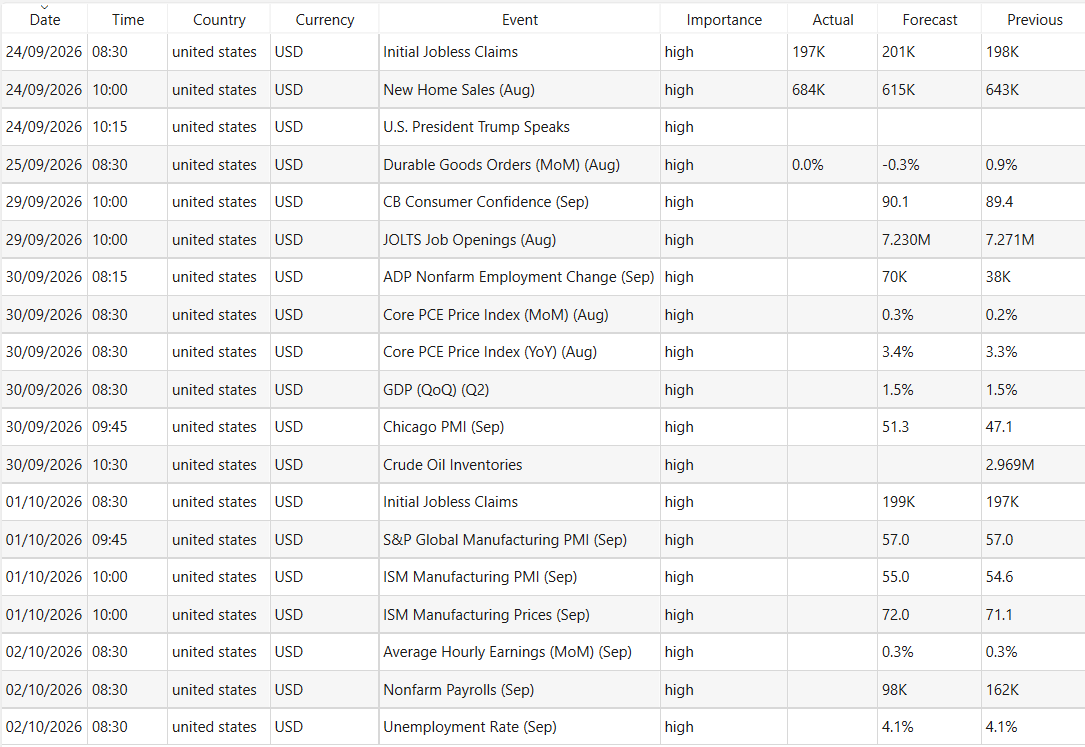
Thursday and Friday now bring the tests that will determine whether September's bond-market pressure carries into the new month. Thursday, October 1 brings initial jobless claims at 8:30 a.m. ET and ISM Manufacturing at 10:00 a.m. ET. Accenture $ACN reports fiscal fourth-quarter results before the market opens, while Nike $NKE releases fiscal first-quarter results after the close. The decisive macro event follows on Friday, October 2 at 8:30 a.m. ET, when the BLS publishes the September Employment Situation. With the 10-year at 5.29%, another strong labor surprise could matter more through its effect on yields than through its implications for growth.
The signal:
Wednesday delivered one of the clearest examples of why the current market cannot be understood by looking at inflation alone. Core PCE came in softer than expected, yet the 10-year Treasury still finished at 5.29% and the 30-year at 5.64%. Investors reduced the probability of an immediate Fed hike, but long-duration yields continued climbing because economic growth remains resilient and the market is demanding greater compensation for duration. That distinction is increasingly important.
The central message from September 30 is therefore not that softer inflation has solved the market's rate problem. It is that the market has begun separating short-term Fed policy from the structural level of long-term yields. The Fed may have less reason to tighten immediately, but a 5.29% 10-year Treasury remains a formidable valuation hurdle. Technology can still outperform when earnings growth is extraordinary, as the Nasdaq demonstrated Wednesday, but across the rest of the market the cost of capital is becoming increasingly difficult to ignore.
"Where the noise fades and the signal speaks—your daily market pulse starts here"
Market Brief — September 30 (Generated by GPT 5.6):
Wall Street ended September with a split tape: technology held up, but rising long-term Treasury yields again pressured the broader market. The S&P 500 fell 19.30 points, or 0.25%, to 7,651.54, while the Nasdaq Composite gained 63.52 points, or 0.24%, to 26,861.06. The Dow Jones Industrial Average dropped 443.87 points, or 0.86%, to 50,906.05, and the Russell 2000 declined 11.06 points, or 0.39%, to 2,796.86. Equities initially responded positively to softer inflation data, but the improvement faded as evidence of stronger economic growth kept pressure on the long end of the Treasury curve.
The Fed's preferred inflation measure delivered genuine relief, but not enough to declare the inflation problem solved. August headline PCE prices rose 0.3% month over month and 3.4% year over year, while core PCE increased just 0.2% on the month and 3.0% over 12 months. The core reading was cooler than expected and immediately reduced expectations for another near-term Fed increase. Yet inflation remains well above the 2% objective, so the report changed the degree of tightening risk rather than eliminating it.
Consumer spending was far stronger than income growth, producing one of the day's most important economic divergences. Personal consumption expenditures jumped 0.9% in August, while personal income rose only 0.2% and disposable income increased 0.3%. Real PCE rose approximately 0.6%, while the personal saving rate fell to 4.1%. Consumers are therefore continuing to spend aggressively, but part of that resilience is increasingly being financed through a lower savings buffer rather than comparable income growth.
Second-quarter GDP was revised sharply higher, reinforcing the idea that the economy is stronger than earlier estimates suggested. Real GDP growth was revised to an annualized 2.2% from the previous 1.5% estimate, reflecting stronger consumer spending, investment and exports. Separately, ADP estimated that private employers added 90,000 jobs in September, above expectations near 70,000. The combination of softer inflation and stronger activity created a complicated policy signal: price pressure improved, but the economy still does not look as though restrictive rates are producing a conventional downturn.
Treasuries ultimately overruled the early inflation relief, with the long end setting fresh multi-decade highs. Official Treasury data put the 2-year yield at 4.88%, down 1 bp, but the 10-year rose 3 bps to 5.29% and the 30-year climbed 5 bps to 5.64%. That steepening matters: the market reduced some immediate Fed risk after the PCE report while continuing to demand greater compensation for holding long-duration government debt. The VIX remained subdued at approximately 15.99, down slightly on the session, indicating valuation pressure rather than outright market panic.
Oil rebounded after Tuesday's sharp decline, ensuring that energy remained part of the inflation equation heading into October. The expiring November Brent contract settled 0.9% higher at $103.50 a barrel, while the more active December contract rose 1.9% to $98.03. WTI settled 1.2% higher at $90.42. Stalled U.S.-Iran negotiations and tight fuel markets offset improving Persian Gulf export flows. The Brent contract distinction is important: the $103.50 November settlement should not be compared directly with the lower-priced December contract without accounting for expiry and curve structure.
Liquidia $LQDA suffered one of the year's most violent biotech repricings after a patent ruling materially changed the competitive outlook for YUTREPIA. $LQDA collapsed 57.2% to $30.26 after a federal court ruled that two claims of United Therapeutics' $UTHR '327 patent were valid and infringed. United Therapeutics $UTHR surged 12.6% to $541.89, while MannKind $MNKD gained 16.8% as investors reassessed the durability of the Tyvaso franchise and associated royalty economics. The move was not a routine clinical-data reaction; it represented a sudden reassessment of the legal protection surrounding an existing commercial market.
Conagra Brands $CAG demonstrated that an earnings beat can still lose badly when investors dislike the quality of the underlying sales and margin picture. $CAG fell about 4.9% after fiscal first-quarter net sales declined 1.4% to $2.60 billion and organic sales fell 1.1%, including a 2.1% volume decline. Adjusted EPS increased 5.1% to $0.41, but adjusted gross margin fell 62 bps to 23.8% as inflation and operating deleverage offset productivity gains. Conagra Brands $CAG maintained full-year guidance for organic sales of -3% to -1%, adjusted operating margin of 10.0%–10.5%, and adjusted EPS of $1.40–$1.50. Investors focused more heavily on the top-line and cost pressures than on the EPS increase.
Cal-Maine Foods $CALM showed how quickly normalization in commodity pricing can reverse extraordinary prior-year profits. Fiscal first-quarter sales collapsed 41.5% to $539.6 million, while the company swung to a $58.6 million net loss, or $1.26 per share, from net income of $199.3 million and EPS of $4.12 a year earlier. Operating income of $249.2 million became an $82.2 million operating loss as egg-market economics normalized. $CALM initially sold off much more sharply before recovering much of the decline during regular trading.
Boeing $BA won one of the most strategically significant defense contracts of the year, but even that was not sufficient to produce a strong regular-session gain. The U.S. Navy selected Boeing $BA to develop its sixth-generation F/A-XX fighter under a contract reported at more than $20 billion, giving Boeing responsibility for both the Navy program and the Air Force's F-47 next-generation fighter. Yet $BA finished roughly 0.9% lower, while losing bidder Northrop Grumman $NOC fell about 4.2%. The divergence suggests investors welcomed the defense win but remained focused on Boeing's broader commercial-aircraft execution and recent 737 MAX certification problems.
Robinhood Markets $HOOD proved that an ambitious AI product announcement does not automatically translate into same-day equity gains. Robinhood Markets $HOOD unveiled Robinhood Agents, perpetual futures, planned weekend equity trading and earnings-linked prediction contracts, with the AI system designed to analyze markets, construct strategies and execute trades. $HOOD initially rallied more than 5% before reversing and closing 3.2% lower. The reversal was notable because investors broadly welcomed the product roadmap, but valuation and profit-taking ultimately dominated the session.
Leadership and operational uncertainty created additional pressure in consumer and industrial names. Mattel $MAT fell roughly 4.2% after announcing that CEO Ynon Kreiz would depart and be succeeded by longtime board member and Condé Nast chief Roger Lynch, adding uncertainty ahead of the crucial holiday season. Ford $F dropped about 2% after a supplier disruption temporarily halted F-150 production at a Michigan plant and was expected to reduce third-quarter truck deliveries. These moves fit Wednesday's broader pattern: in a 5%-plus Treasury environment, investors showed little tolerance for unexpected execution or leadership risk.
AFTER HOURS: Micron Technology $MU delivered extraordinary AI-memory numbers, but the initial stock response was surprisingly restrained. Fiscal fourth-quarter revenue reached a record $54.23 billion, up from $11.32 billion a year earlier, while adjusted EPS surged to $33.42 from $3.03. Operating cash flow reached $43.97 billion, and adjusted free cash flow was $33.20 billion. For fiscal Q1 2027, Micron Technology $MU guided to revenue of $61.5 billion ± $1.5 billion, an adjusted gross margin around 86.25%, and adjusted EPS of $38.15 ± $1.00. Despite numbers that dramatically exceeded the prior year's scale, $MU initially traded around flat to slightly lower after the release—a reminder of how aggressively AI-memory expectations have already been capitalized into valuation.
Thursday and Friday now bring the tests that will determine whether September's bond-market pressure carries into the new month. Thursday, October 1 brings initial jobless claims at 8:30 a.m. ET and ISM Manufacturing at 10:00 a.m. ET. Accenture $ACN reports fiscal fourth-quarter results before the market opens, while Nike $NKE releases fiscal first-quarter results after the close. The decisive macro event follows on Friday, October 2 at 8:30 a.m. ET, when the BLS publishes the September Employment Situation. With the 10-year at 5.29%, another strong labor surprise could matter more through its effect on yields than through its implications for growth.
The signal:
Wednesday delivered one of the clearest examples of why the current market cannot be understood by looking at inflation alone. Core PCE came in softer than expected, yet the 10-year Treasury still finished at 5.29% and the 30-year at 5.64%. Investors reduced the probability of an immediate Fed hike, but long-duration yields continued climbing because economic growth remains resilient and the market is demanding greater compensation for duration. That distinction is increasingly important.
The central message from September 30 is therefore not that softer inflation has solved the market's rate problem. It is that the market has begun separating short-term Fed policy from the structural level of long-term yields. The Fed may have less reason to tighten immediately, but a 5.29% 10-year Treasury remains a formidable valuation hurdle. Technology can still outperform when earnings growth is extraordinary, as the Nasdaq demonstrated Wednesday, but across the rest of the market the cost of capital is becoming increasingly difficult to ignore.
In my dreams, the Strait of Hormuz reopens and all the oil stockpiled over the past six months floods the market. Oil crashes to $50, and suddenly nobody is talking about rate hikes anymore.
Stock markets take off, and by October investors are already anticipating what could become the most exciting Santa Claus rally in decades.
🤑🤪
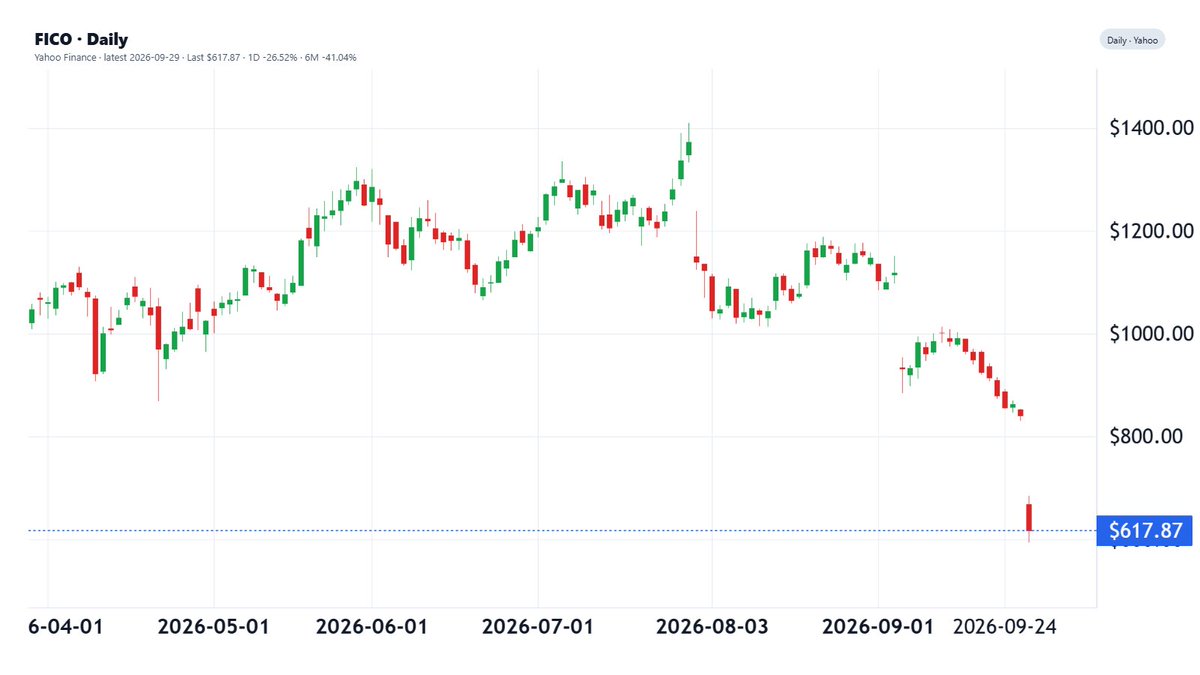
$FICO -26.5% to $617.87.
Selloff follows reports FHFA is moving to dismantle FICO’s long-held mortgage credit-score dominance, raising worries about pricing power and growth.
"Where the noise fades and the signal speaks—your daily market pulse starts here"
Market Brief — September 29 (Generated by GPT 5.6):
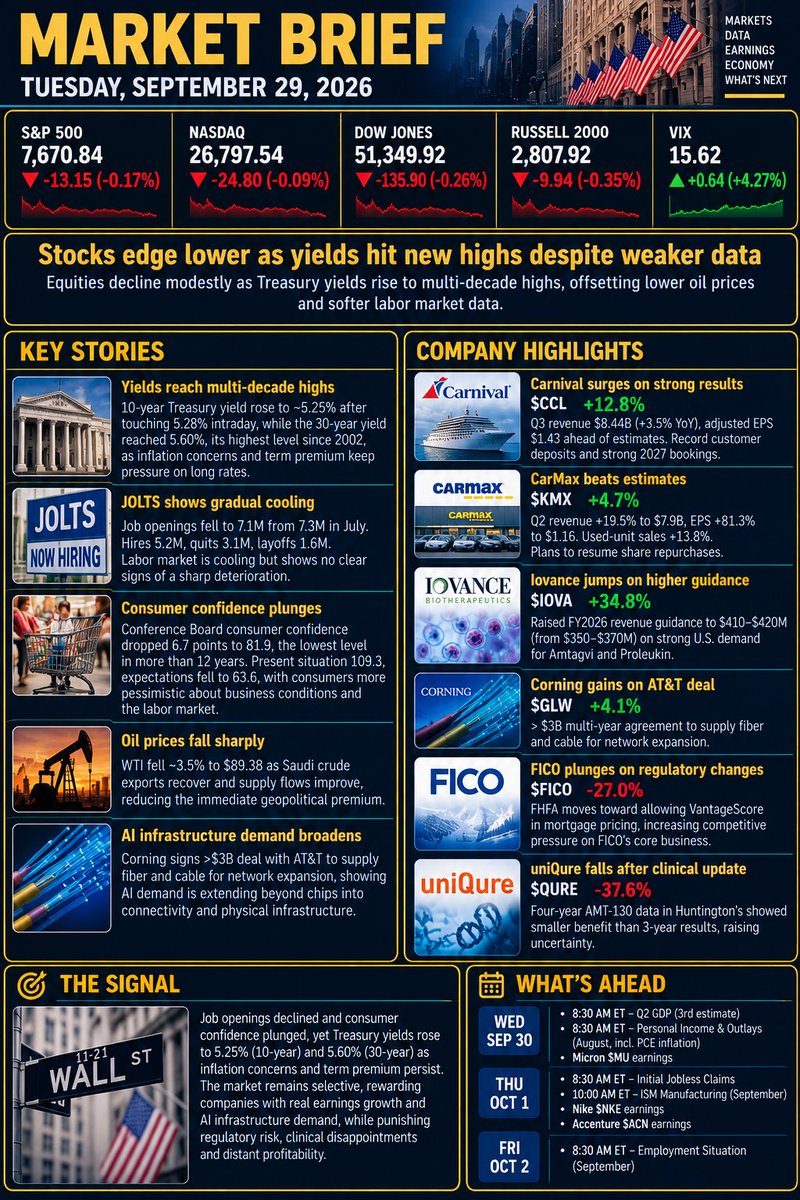
Wall Street extended its pullback for a second session as another rise in long-term Treasury yields overwhelmed early relief from lower oil prices. The S&P 500 fell 0.17% to 7,670.84, the Nasdaq Composite slipped 0.09% to 26,797.54, and the Dow Jones Industrial Average lost 0.26% to 51,349.92. The Russell 2000 declined 0.35% to 2,807.92, leaving small caps particularly exposed to the continuing increase in financing costs. The declines were modest, but the important point was that equities failed to rally even after crude moved sharply lower and labor-market data softened.
Treasuries remained the dominant constraint on equity valuations, with the long end reaching another multi-decade extreme. The 10-year Treasury yield moved back toward 5.25% after touching roughly 5.28% intraday, while the 30-year yield reached an intraday high near 5.61%, its highest level since 2002. That matters more than Tuesday's small index losses: every additional increase in long-term risk-free rates raises the discount rate applied to future corporate earnings and disproportionately pressures high-multiple and highly leveraged businesses.
The August JOLTS report showed a labor market that is cooling gradually rather than collapsing. Job openings declined to 7.1 million from 7.3 million in July, while hires were little changed at 5.2 million and total separations remained at 5.1 million. Quits held at 3.1 million and layoffs and discharges were essentially unchanged at 1.6 million. The message was therefore nuanced: employers are advertising fewer positions, but there is still little evidence of a major layoffs cycle. That makes the report less inflationary than recent strong activity data, but not weak enough by itself to force a change in Fed policy.
Consumer confidence delivered the day's clearest warning about household sentiment. The Conference Board Consumer Confidence Index plunged 6.7 points to 81.9 from 88.6, the lowest reading in more than 12 years. The Present Situation Index fell to 109.3, while the Expectations Index declined for a third consecutive month to 63.6. Consumers became more pessimistic about both business conditions and the labor market, creating an increasingly uncomfortable divergence between relatively resilient actual economic activity and household perceptions of that economy.
Oil moved sharply lower, but the bond market's failure to follow it down demonstrated how deeply embedded the inflation concern has become. WTI fell roughly 3.5% to around $89.38 a barrel, while the more actively traded Brent structure also weakened as Middle East crude exports continued recovering. Improving flows through Saudi Arabia's East-West pipeline helped reduce immediate supply anxiety. Normally that kind of energy decline would provide substantial relief to Treasuries; Tuesday's continued rise in long yields suggested investors are now concerned about inflation and term premium beyond the latest move in crude alone.
Carnival $CCL became one of the session's strongest large-cap winners as robust bookings and pricing overwhelmed concerns about higher fuel costs. $CCL surged about 13% to $24.93 after third-quarter revenue reached a record $8.44 billion, up 3.5% year over year, while adjusted EPS came in at $1.43, ahead of expectations around $1.35. Net income reached $1.92 billion, and customer deposits rose to a third-quarter record of approximately $7.6 billion. Carnival $CCL also said 2027 was already about half booked at record occupancy and pricing levels. Investors therefore focused on demand strength and operational improvements rather than the estimated $131 million drag from fuel and currency.
CarMax $KMX reinforced the idea that the U.S. consumer is not uniformly weak despite collapsing confidence surveys. $KMX closed 4.74% higher at $59.23 after fiscal second-quarter revenue rose 19.5% to $7.9 billion and diluted EPS jumped 81.3% to $1.16. Retail used-unit sales increased 13.8%, comparable-store used-unit sales rose 13.0%, and combined retail and wholesale units increased 14.7%. Management also said CarMax $KMX plans to resume share repurchases during the third quarter. The quarter provided tangible evidence that consumers are still transacting when pricing and value proposition improve—even while survey-based confidence deteriorates.
Fair Isaac $FICO suffered one of the most severe repricings of the entire session as investors confronted a direct challenge to the economics of the FICO franchise. $FICO plunged approximately 27% to $617.87, its worst single-day decline since 1989, after the Federal Housing Finance Agency moved toward allowing VantageScore alongside FICO in mortgage pricing. Rocket Companies $RKT separately said Rocket Mortgage would make VantageScore 4.0 its preferred model for eligible loans. The market's concern was structural rather than cyclical: greater competition could weaken pricing power and transaction volumes in a business that has historically benefited from deeply embedded industry standards.
Biotechnology produced one of Tuesday's clearest demonstrations that clinical and commercial evidence can overwhelm the broader macro tape—in both directions. Iovance Biotherapeutics $IOVA surged roughly 35% to $14.78 after raising full-year 2026 revenue guidance to $410–$420 million, up from $350–$370 million, citing strong U.S. demand for Amtagvi and Proleukin. The midpoint increased by $55 million and implies nearly 60% year-over-year revenue growth. By contrast, uniQure $QURE collapsed approximately 38% to $24.29 after four-year AMT-130 Huntington's data showed a smaller benefit than the company's earlier three-year results, increasing uncertainty around the strength of the long-term efficacy case.
Corning $GLW demonstrated that AI infrastructure demand continues to reach well beyond chips and servers into the physical communications backbone. $GLW rose about 4.1% to $157.82 after announcing a multi-year agreement worth more than $3 billion to supply AT&T $T with fiber and cable for network expansion. AT&T $T said data usage by the average fiber household has increased fivefold since 2016 and could roughly double again by 2030 as cloud services and AI increase bandwidth consumption. The transaction extends the AI-capex narrative into fiber manufacturing, connectivity and domestic network infrastructure rather than simply compute hardware.
Bloom Energy $BE showed that power availability remains one of the market's preferred ways to express the AI-infrastructure bottleneck. $BE climbed approximately 11.2% to $292.28, recovering Monday's decline as investors responded to expansion plans and continued demand for onsite power solutions. Bloom Energy $BE has increasingly positioned fuel cells as a solution for data centers and AI-related manufacturing sites that cannot wait years for conventional grid connections. The move reinforces an important change in the AI trade: investors are increasingly treating electricity, grid access and power-delivery speed as strategic constraints on compute growth.
Novo Nordisk $NVO continued rebuilding its obesity pipeline through external innovation, but investors remained cautious about how quickly those assets can affect earnings. Novo Nordisk $NVO agreed to pay $300 million upfront and as much as $2.6 billion in total for global rights outside Greater China to Hengrui Pharma's HRS-1596, a Phase I-ready once-weekly oral GLP-1/GIP dual agonist. $NVO slipped roughly 1% following the announcement. The transaction expands Novo Nordisk $NVO's oral obesity pipeline, but because the asset remains early-stage, the market continues to distinguish between long-duration pipeline optionality and therapies capable of offsetting competitive and patent pressures within the current earnings horizon.
Wednesday now becomes one of the most important macro-and-AI sessions of the week. On September 30 at 8:30 a.m. ET, investors receive August Personal Income and Outlays—including the Fed's preferred PCE inflation measures—as well as the third estimate of second-quarter GDP. Micron Technology $MU is also scheduled to report results Wednesday, providing an important test of memory pricing and AI-infrastructure demand. Thursday brings initial jobless claims and September ISM manufacturing, followed by earnings from Nike $NKE and Accenture $ACN, while Friday's September Employment Situation at 8:30 a.m. ET will provide the week's decisive labor-market test.
The signal:
Tuesday produced an unusual combination: job openings weakened, consumer confidence collapsed and oil prices fell sharply—yet long-term Treasury yields still moved higher. In a more conventional market regime, all three developments might have pushed yields lower. Their failure to do so suggests the bond market is increasingly focused on persistent inflation, term premium and the possibility that rates will remain restrictive even as parts of the economy begin to soften.
The message from September 29 is therefore not that risk appetite has disappeared. It is that the market is becoming increasingly unforgiving while the risk-free rate remains above 5%. Investors are still willing to pay for revenue growth, cash generation, infrastructure scarcity and genuine operating improvement—but they are demanding much stronger evidence before overlooking regulatory risk, clinical uncertainty or distant profitability. Wednesday's PCE data will determine whether that valuation hurdle begins to ease or moves still higher. AP News
"Where the noise fades and the signal speaks—your daily market pulse starts here"
Market Brief — September 29 (Generated by GPT 5.6):
Wall Street extended its pullback for a second session as another rise in long-term Treasury yields overwhelmed early relief from lower oil prices. The S&P 500 fell 0.17% to 7,670.84, the Nasdaq Composite slipped 0.09% to 26,797.54, and the Dow Jones Industrial Average lost 0.26% to 51,349.92. The Russell 2000 declined 0.35% to 2,807.92, leaving small caps particularly exposed to the continuing increase in financing costs. The declines were modest, but the important point was that equities failed to rally even after crude moved sharply lower and labor-market data softened.
Treasuries remained the dominant constraint on equity valuations, with the long end reaching another multi-decade extreme. The 10-year Treasury yield moved back toward 5.25% after touching roughly 5.28% intraday, while the 30-year yield reached an intraday high near 5.61%, its highest level since 2002. That matters more than Tuesday's small index losses: every additional increase in long-term risk-free rates raises the discount rate applied to future corporate earnings and disproportionately pressures high-multiple and highly leveraged businesses.
The August JOLTS report showed a labor market that is cooling gradually rather than collapsing. Job openings declined to 7.1 million from 7.3 million in July, while hires were little changed at 5.2 million and total separations remained at 5.1 million. Quits held at 3.1 million and layoffs and discharges were essentially unchanged at 1.6 million. The message was therefore nuanced: employers are advertising fewer positions, but there is still little evidence of a major layoffs cycle. That makes the report less inflationary than recent strong activity data, but not weak enough by itself to force a change in Fed policy.
Consumer confidence delivered the day's clearest warning about household sentiment. The Conference Board Consumer Confidence Index plunged 6.7 points to 81.9 from 88.6, the lowest reading in more than 12 years. The Present Situation Index fell to 109.3, while the Expectations Index declined for a third consecutive month to 63.6. Consumers became more pessimistic about both business conditions and the labor market, creating an increasingly uncomfortable divergence between relatively resilient actual economic activity and household perceptions of that economy.
Oil moved sharply lower, but the bond market's failure to follow it down demonstrated how deeply embedded the inflation concern has become. WTI fell roughly 3.5% to around $89.38 a barrel, while the more actively traded Brent structure also weakened as Middle East crude exports continued recovering. Improving flows through Saudi Arabia's East-West pipeline helped reduce immediate supply anxiety. Normally that kind of energy decline would provide substantial relief to Treasuries; Tuesday's continued rise in long yields suggested investors are now concerned about inflation and term premium beyond the latest move in crude alone.
Carnival $CCL became one of the session's strongest large-cap winners as robust bookings and pricing overwhelmed concerns about higher fuel costs. $CCL surged about 13% to $24.93 after third-quarter revenue reached a record $8.44 billion, up 3.5% year over year, while adjusted EPS came in at $1.43, ahead of expectations around $1.35. Net income reached $1.92 billion, and customer deposits rose to a third-quarter record of approximately $7.6 billion. Carnival $CCL also said 2027 was already about half booked at record occupancy and pricing levels. Investors therefore focused on demand strength and operational improvements rather than the estimated $131 million drag from fuel and currency.
CarMax $KMX reinforced the idea that the U.S. consumer is not uniformly weak despite collapsing confidence surveys. $KMX closed 4.74% higher at $59.23 after fiscal second-quarter revenue rose 19.5% to $7.9 billion and diluted EPS jumped 81.3% to $1.16. Retail used-unit sales increased 13.8%, comparable-store used-unit sales rose 13.0%, and combined retail and wholesale units increased 14.7%. Management also said CarMax $KMX plans to resume share repurchases during the third quarter. The quarter provided tangible evidence that consumers are still transacting when pricing and value proposition improve—even while survey-based confidence deteriorates.
Fair Isaac $FICO suffered one of the most severe repricings of the entire session as investors confronted a direct challenge to the economics of the FICO franchise. $FICO plunged approximately 27% to $617.87, its worst single-day decline since 1989, after the Federal Housing Finance Agency moved toward allowing VantageScore alongside FICO in mortgage pricing. Rocket Companies $RKT separately said Rocket Mortgage would make VantageScore 4.0 its preferred model for eligible loans. The market's concern was structural rather than cyclical: greater competition could weaken pricing power and transaction volumes in a business that has historically benefited from deeply embedded industry standards.
Biotechnology produced one of Tuesday's clearest demonstrations that clinical and commercial evidence can overwhelm the broader macro tape—in both directions. Iovance Biotherapeutics $IOVA surged roughly 35% to $14.78 after raising full-year 2026 revenue guidance to $410–$420 million, up from $350–$370 million, citing strong U.S. demand for Amtagvi and Proleukin. The midpoint increased by $55 million and implies nearly 60% year-over-year revenue growth. By contrast, uniQure $QURE collapsed approximately 38% to $24.29 after four-year AMT-130 Huntington's data showed a smaller benefit than the company's earlier three-year results, increasing uncertainty around the strength of the long-term efficacy case.
Corning $GLW demonstrated that AI infrastructure demand continues to reach well beyond chips and servers into the physical communications backbone. $GLW rose about 4.1% to $157.82 after announcing a multi-year agreement worth more than $3 billion to supply AT&T $T with fiber and cable for network expansion. AT&T $T said data usage by the average fiber household has increased fivefold since 2016 and could roughly double again by 2030 as cloud services and AI increase bandwidth consumption. The transaction extends the AI-capex narrative into fiber manufacturing, connectivity and domestic network infrastructure rather than simply compute hardware.
Bloom Energy $BE showed that power availability remains one of the market's preferred ways to express the AI-infrastructure bottleneck. $BE climbed approximately 11.2% to $292.28, recovering Monday's decline as investors responded to expansion plans and continued demand for onsite power solutions. Bloom Energy $BE has increasingly positioned fuel cells as a solution for data centers and AI-related manufacturing sites that cannot wait years for conventional grid connections. The move reinforces an important change in the AI trade: investors are increasingly treating electricity, grid access and power-delivery speed as strategic constraints on compute growth.
Novo Nordisk $NVO continued rebuilding its obesity pipeline through external innovation, but investors remained cautious about how quickly those assets can affect earnings. Novo Nordisk $NVO agreed to pay $300 million upfront and as much as $2.6 billion in total for global rights outside Greater China to Hengrui Pharma's HRS-1596, a Phase I-ready once-weekly oral GLP-1/GIP dual agonist. $NVO slipped roughly 1% following the announcement. The transaction expands Novo Nordisk $NVO's oral obesity pipeline, but because the asset remains early-stage, the market continues to distinguish between long-duration pipeline optionality and therapies capable of offsetting competitive and patent pressures within the current earnings horizon.
Wednesday now becomes one of the most important macro-and-AI sessions of the week. On September 30 at 8:30 a.m. ET, investors receive August Personal Income and Outlays—including the Fed's preferred PCE inflation measures—as well as the third estimate of second-quarter GDP. Micron Technology $MU is also scheduled to report results Wednesday, providing an important test of memory pricing and AI-infrastructure demand. Thursday brings initial jobless claims and September ISM manufacturing, followed by earnings from Nike $NKE and Accenture $ACN, while Friday's September Employment Situation at 8:30 a.m. ET will provide the week's decisive labor-market test.
The signal:
Tuesday produced an unusual combination: job openings weakened, consumer confidence collapsed and oil prices fell sharply—yet long-term Treasury yields still moved higher. In a more conventional market regime, all three developments might have pushed yields lower. Their failure to do so suggests the bond market is increasingly focused on persistent inflation, term premium and the possibility that rates will remain restrictive even as parts of the economy begin to soften.
The message from September 29 is therefore not that risk appetite has disappeared. It is that the market is becoming increasingly unforgiving while the risk-free rate remains above 5%. Investors are still willing to pay for revenue growth, cash generation, infrastructure scarcity and genuine operating improvement—but they are demanding much stronger evidence before overlooking regulatory risk, clinical uncertainty or distant profitability. Wednesday's PCE data will determine whether that valuation hurdle begins to ease or moves still higher. AP News
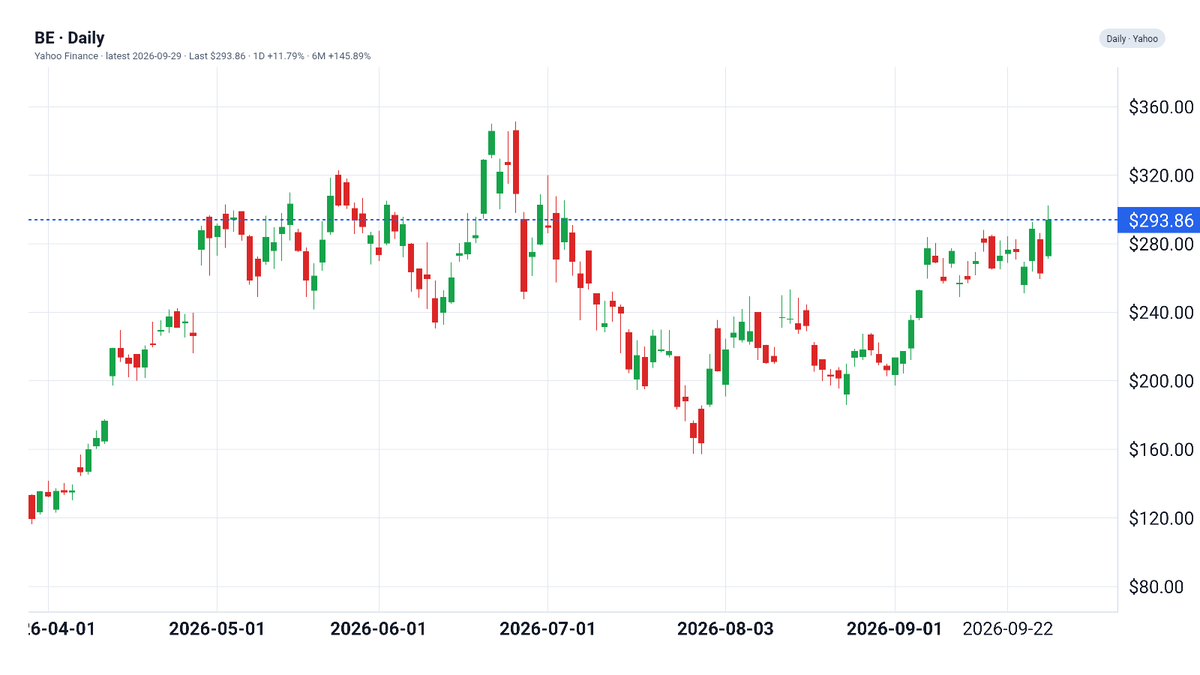
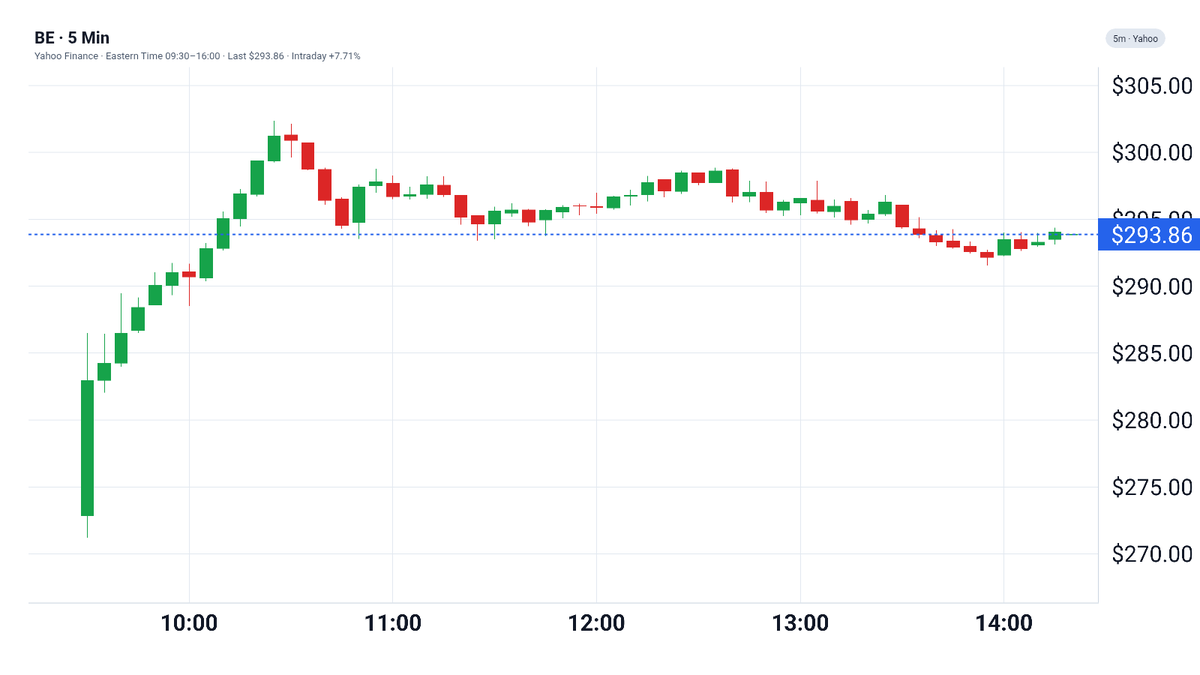
$BE +11.79% to $293.86.
Move looks tied to renewed AI/data-center power demand focus, with multiple outlets flagging fuel-cell names reversing a prior selloff.
Watch if today’s pop holds after a sharp one-day squeeze.
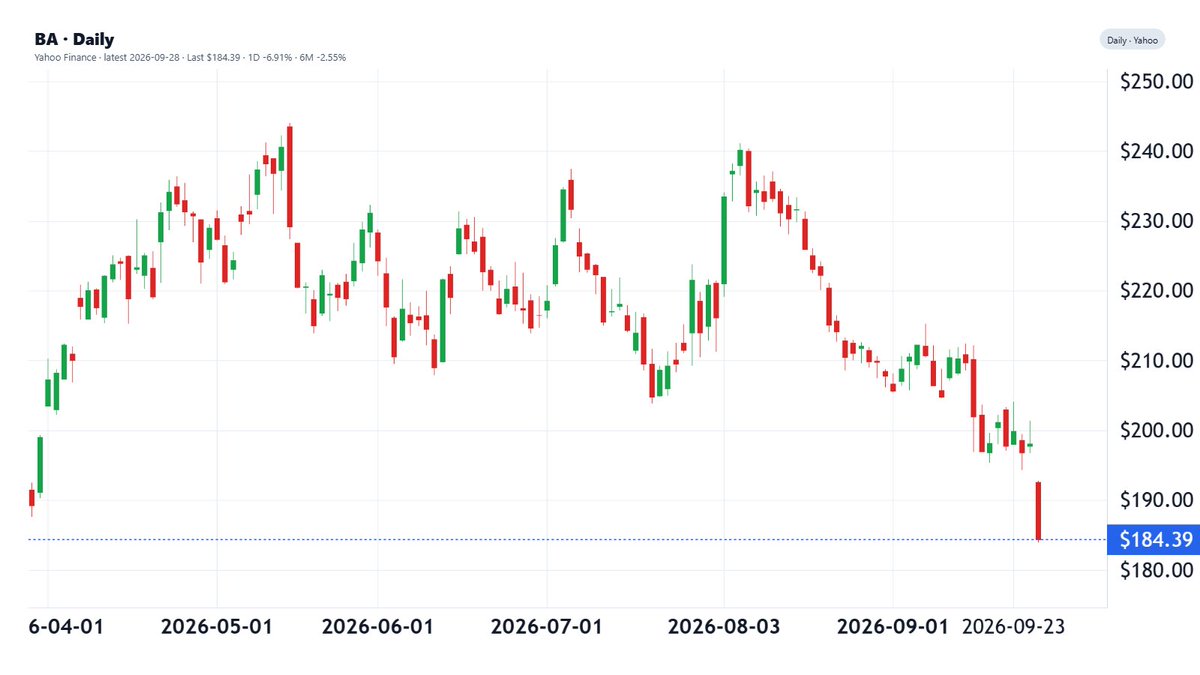
$BA -6.91% to $184.39.
Shares sold off after reports the FAA put 737 MAX 10 certification on hold due to a new software glitch affecting landings.
#Boeing
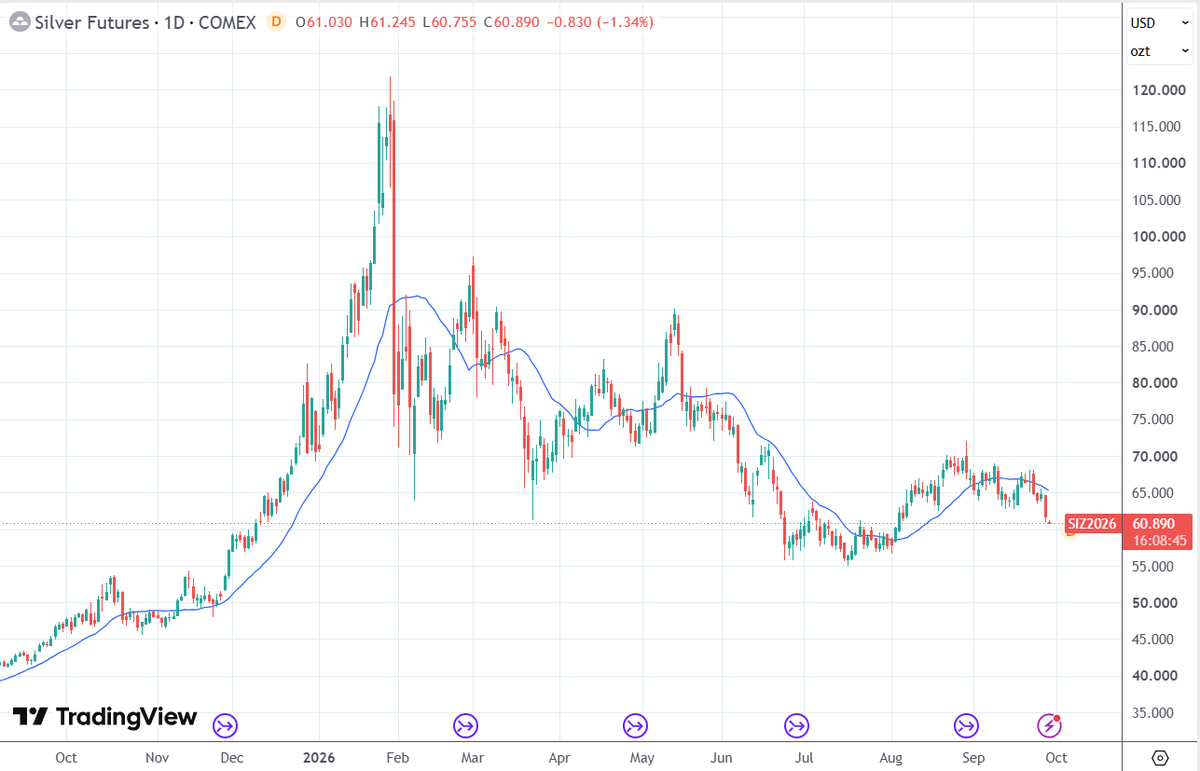
I was not expecting #silver sell off to be so bad. There a number of concerning signals. Not only for silver but the market in general. Kind of... volatility event ahead...? Hopefully not. One hopes that Hormuz situation finds some type of compromise and oil price eases a bit inflation fears. But likely it's not onl that. There must be so many over leveraged positions out there...
"Where the noise fades and the signal speaks—your daily market pulse starts here"
Market Brief — September 28 (Generated by GPT 5.6):
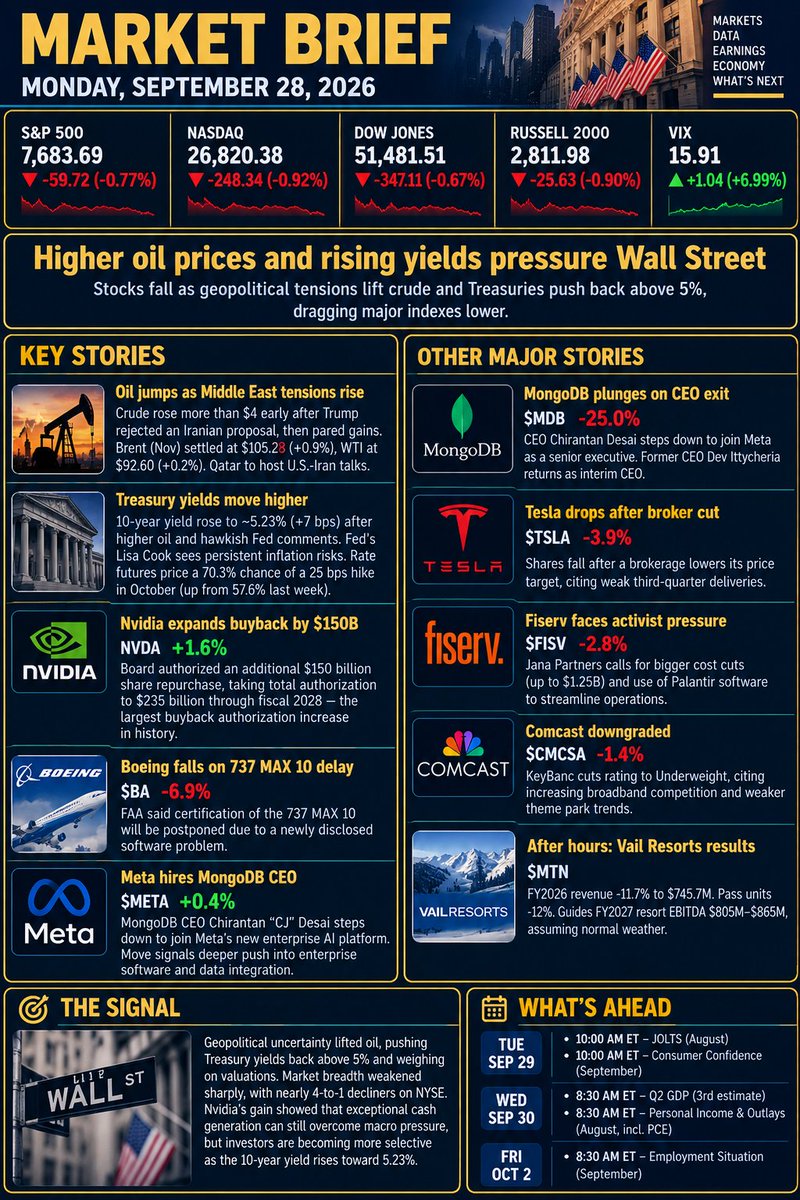
Wall Street opened the new week under renewed pressure as higher oil prices and rising Treasury yields brought the inflation-and-valuation problem back to the center of trading. The S&P 500 fell 59.72 points, or 0.77%, to 7,683.69, its largest one-day percentage decline since August 20. The Nasdaq Composite lost 248.34 points, or 0.92%, to 26,820.38, while the Dow Jones Industrial Average dropped 347.11 points, or 0.67%, to 51,481.51. Small caps also weakened: the Russell 2000 closed at 2,811.98, down 0.90%. Monday therefore reversed much of Friday's relief without developing into a disorderly liquidation.
Market breadth was considerably worse than the headline declines, showing that the selling pressure extended well beyond a few mega-cap stocks. Decliners outnumbered advancers by 3.55 to 1 on the NYSE and 2.56 to 1 on Nasdaq. The S&P 500 registered only four new 52-week highs against 29 new lows, while Nasdaq recorded 40 new highs versus 249 new lows. The VIX finished at 15.91, up 6.99%, after reaching 16.62 intraday. Volatility was still low in absolute terms, but the deterioration in breadth indicated that risk appetite had weakened more substantially than the index declines alone suggested.
Oil was again the main transmission channel between Middle East developments, inflation expectations and interest rates—but contract structure matters when reading Monday's prices. Reuters reported that crude jumped more than $4 a barrel early after U.S. President Donald Trump rejected an Iranian proposal, before paring most of the increase as Qatari mediators prepared separate talks with U.S. and Iranian officials. The expiring November Brent contract settled 0.9% higher at $105.28, while the more-active December contract settled at $97.83. November WTI settled only 0.2% higher at $92.60 after trading as high as $96.54. The distinction is important: the $105 Brent quote reflects the front-month contract close, not an eight-dollar day-over-day explosion in comparable crude pricing.
Treasuries responded to the renewed inflation risk, keeping the valuation hurdle for equities firmly above 5%. The 10-year Treasury yield rose to roughly 5.23%, about 7 basis points higher than the previous session in over-the-counter benchmark pricing. The move followed higher energy prices and a series of Fed comments emphasizing persistent inflation risk. Federal Reserve Governor Lisa Cook said she expects inflationary pressure to remain elevated in coming months because of AI-related demand and higher oil prices, although she stopped short of explicitly calling for another hike. Interest-rate futures were pricing a 70.3% probability of at least a 25-basis-point increase at the October meeting, up from 57.6% a week earlier.
Nvidia $NVDA broke decisively with the weak market after announcing an extraordinary expansion of its capital-return program. $NVDA gained 1.6% as the board authorized an additional $150 billion of share repurchases, taking the remaining authorization to $235 billion, with execution expected through fiscal 2028. Nvidia $NVDA described the increase as the largest share-repurchase authorization increase in history. The scale is significant because it demonstrates that the company's AI investment requirements and shareholder distributions are not mutually exclusive: extraordinary cash generation is allowing Nvidia $NVDA to fund both simultaneously.
Boeing $BA became the Dow's most visible pressure point as another certification obstacle delayed the 737 MAX 10. $BA fell 6.9% after the Federal Aviation Administration said certification of the long-delayed aircraft would be postponed until a newly disclosed software problem is resolved. The move was particularly damaging because the MAX 10 represents an important part of Boeing $BA's future narrow-body product mix: another certification delay affects not simply the timing of deliveries, but also customer fleet planning and the company's path toward improved cash generation.
MongoDB $MDB suffered one of the session's largest software selloffs after an abrupt leadership transition became part of Meta Platforms $META's enterprise-AI push. MongoDB $MDB announced that President and CEO Chirantan “CJ” Desai had stepped down effective immediately to join Meta Platforms $META in a senior role, with former CEO Dev Ittycheria returning as interim chief executive. Meta Platforms $META said Desai will help lead its new enterprise platform designed to bring its AI models, agents and tools to corporate customers. MongoDB $MDB closed around 25% lower at $307.56, reflecting the market's concern over unexpected leadership disruption after less than a year under Desai.
The Meta Platforms $META–MongoDB $MDB development also showed how the AI competition is broadening beyond models and chips into enterprise software architecture. Meta Platforms $META is positioning its new Enterprise Platform around AI models, agents and business tools, including Muse, Meta Business Agent and coding products. Hiring the sitting CEO of MongoDB $MDB—a company deeply embedded in enterprise application infrastructure—suggests that the next phase of the AI contest increasingly concerns how agents connect to corporate data, applications and workflows. For investors, that shifts part of the competitive battlefield from raw compute toward software distribution and enterprise integration.
Tesla $TSLA showed how quickly valuation pressure can amplify company-specific concerns in a rising-rate session. $TSLA fell 3.9% after a brokerage cut its price target, citing weak third-quarter deliveries. In a market already confronting a 10-year Treasury yield above 5.2%, weaker expectations for near-term vehicle volumes leave less room for investors to justify premium valuations through distant earnings assumptions. The move therefore combined a company-specific demand concern with the broader valuation compression affecting long-duration equities.
Fiserv $FISV came under fresh activist pressure as Jana Partners called for a materially more aggressive restructuring program and direct use of Palantir Technologies $PLTR software. Jana urged Fiserv $FISV to increase planned cost reductions from $500 million by 2029 to as much as $1.25 billion and argued that Palantir Technologies $PLTR could help rationalize legacy technology, reduce technical debt and improve accountability. The proposal is strategically notable because it frames AI and software deployment not primarily as a new-revenue initiative but as a mechanism for reducing a large incumbent's structural cost base.
AFTER HOURS: Vail Resorts $MTN reported a difficult fiscal 2026 while outlining a recovery path for fiscal 2027. Full-year Resort Reported EBITDA fell 11.7% to $745.7 million from $844.1 million, with management emphasizing unusually poor snowfall across the western U.S. Pass-product units sold for the upcoming North American ski season were down approximately 12% through September 18, while pass sales dollars declined about 6%. Vail Resorts $MTN nevertheless guided fiscal-2027 Resort Reported EBITDA to $805 million–$865 million and net income to $158 million–$233 million, assuming normal weather and benefits from pricing, visitation recovery and additional efficiencies.
The week's next catalysts are unusually concentrated around labor demand, inflation and the Fed's ability to keep tightening without materially damaging activity. The August JOLTS report is scheduled for Tuesday, September 29 at 10:00 a.m. ET. On Wednesday, September 30 at 8:30 a.m. ET, the BEA will release both the third estimate of second-quarter GDP and August Personal Income and Outlays, including the PCE inflation measures. The September Employment Situation follows on Friday, October 2 at 8:30 a.m. ET. With the 10-year Treasury already above 5.2%, the market response may depend less on whether data are conventionally “good” or “bad” than on what they imply for the next Fed decision. Bureau of Labor Statistics
The signal:
Monday's most important development was the reappearance of the same macro chain that has repeatedly challenged equities this month: geopolitical uncertainty lifted oil, higher energy prices reinforced inflation concerns, inflation concerns pushed Treasury yields higher, and higher yields compressed equity valuations. The S&P 500's 0.77% decline was therefore less important than the 10-year Treasury moving back toward 5.23%. https://t.co/tbAQnj61xW
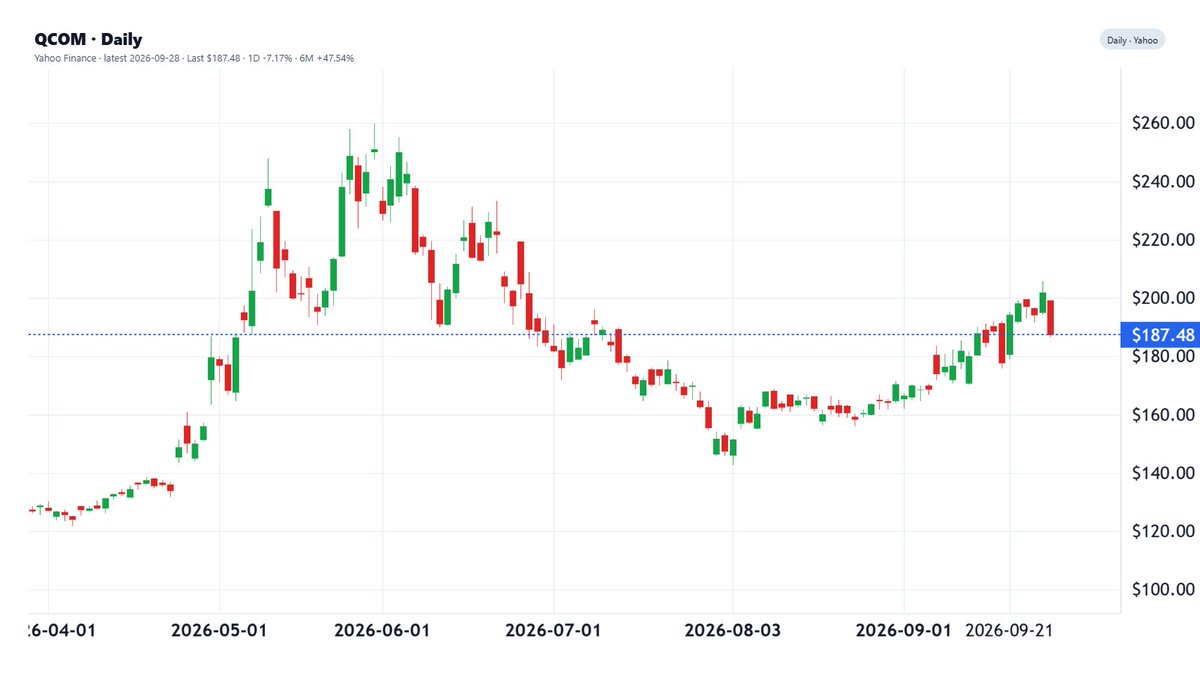
$QCOM -7.17% to $187.48 after a broad chip selloff hit semis, with ARM down sharply and peers sliding.
#Qualcomm also drew focus on its planned Picknik robotics software acquisition, which may add near-term integration questions despite longer-term optionality.
$ARM -8.7% to $283.33.
Shares slid with the chip group after headlines around an AI security breach raised safety concerns.
Some attention also on SoftBank’s reported $25B loan tied to ARM, adding uncertainty after recent volatility.