$LMT +2.42% to $604.18.
Q3 coverage points to a rising backlog, with munitions and F-35 contracts and Missile & Fire Control strength supporting the move.
UBS also argued growth isn’t priced in, adding to the post-earnings beat tailwind.
$INTC +1.72% to $86.96.
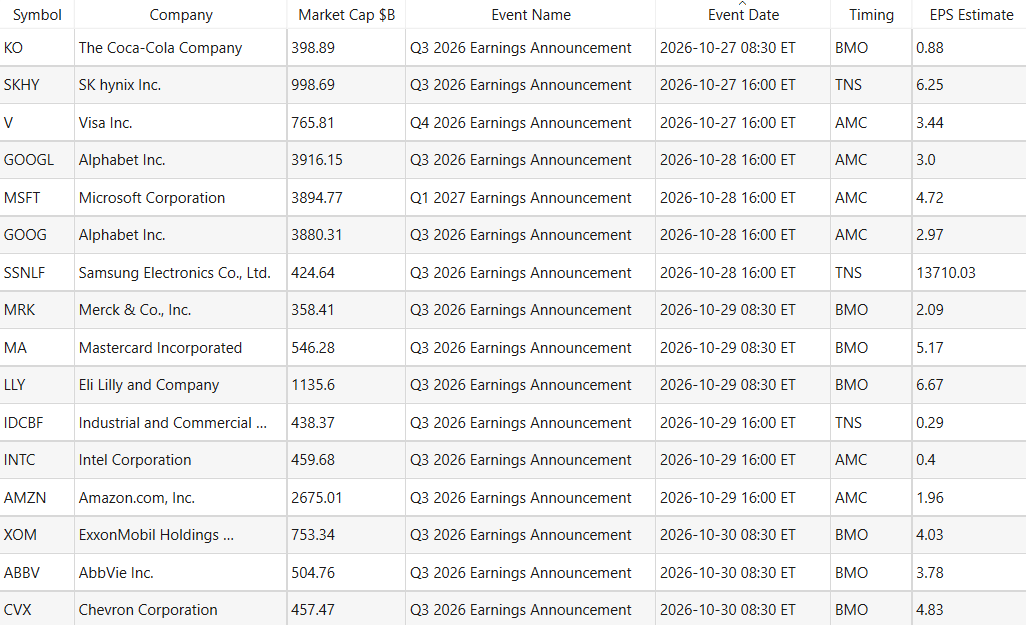
Shares lifted into earnings (29 Oct) after Wedbush flagged upside from the Arizona chip plant and Intel secured an FCC waiver for foreign-made robotics in U.S. fabs.
#Intel
"Where the noise fades and the signal speaks—your daily market pulse starts here"
Market Brief — October 23 (Generated by GPT 5.6):
Wall Street ended Friday lower as another surge in crude oil revived inflation concerns and prevented the market from stabilizing fully after Thursday's technology selloff. The S&P 500 fell 39.75 points, or 0.52%, to 7,623.68; the Dow Jones Industrial Average dropped 652.82 points, or 1.23%, to 52,215.16; and the Nasdaq Composite declined a comparatively modest 53.52 points, or 0.21%, to 25,955.34. The Russell 2000 lost 0.29% to 2,775.90. The Cboe VIX finished at 19.65, up 3.26% from Thursday's 19.03. For the week, the S&P 500 lost roughly 0.5% and the Nasdaq 0.7%, while the Dow gained 0.4% and the Russell 2000 advanced about 2%. The pattern was therefore more complicated than a continuation of Thursday's AI liquidation: technology stabilized somewhat, but higher energy prices spread the pressure into the broader market. AP News
Treasury yields rebounded from Thursday's extraordinary safe-haven rally, but the weekly move still left borrowing costs materially lower ahead of the Federal Reserve meeting. The 10-year Treasury yield rose about 3.5 bps on Friday to 4.987%, while the 2-year finished around 4.680%. For the week, however, the 10-year yield fell 11.0 bps and the 2-year declined 5.4 bps, marking a third consecutive weekly decline for the benchmark 10-year. Markets continued to assign roughly a 92% probability to no change at the October 27–28 FOMC meeting, with attention increasingly shifting toward whether persistent inflation could produce another rate increase later in the year. The important point is that Friday's higher yields represented only a partial reversal of Thursday's flight to safety, not a return to the tightening impulse seen earlier in October. The Wall Street Journal
The flash October PMIs portrayed an economy still expanding at an unusually strong rate while simultaneously generating renewed price pressure. The S&P Global U.S. Composite PMI eased from 58.4 to 57.6, and the Services PMI declined from 58.8 to 57.9, but both remained consistent with rapid expansion. The Manufacturing PMI actually edged higher to 56.0, its strongest reading in 53 months. New-order growth reached its fastest pace in more than four-and-a-half years, exports recorded their strongest increase since May 2022, and employment expanded at the second-fastest pace in more than four years. The uncomfortable part for the Fed was inflation: companies reported the sharpest increase in selling prices since August 2022. Strong activity therefore remains an equity fundamental positive, but it simultaneously reduces the case for easier monetary policy. https://t.co/L6JVjv9N7n
Consumer confidence remained deeply depressed, creating an increasingly striking gap between strong business activity and weak household perceptions of the economy. The University of Michigan's final October Consumer Sentiment Index was 48.0, essentially unchanged from September's 48.1 but 10.4% below its year-earlier level. Current Conditions fell sharply to 46.7 from 50.9, while Expectations improved to 48.8 from 46.3. Consumers cited purchasing power and affordability as central concerns, with buying conditions for durable goods plunging 18%. Inflation expectations also worsened: one-year expectations rose to 4.7% from 4.6%, and long-run expectations increased to 3.5% from 3.4%, both reaching their highest levels since May. The combination of strong PMIs and poor household confidence suggests that aggregate economic resilience is masking considerable pressure on consumers' perception of real purchasing power. Ricerche sui Consumatori
Oil became Friday's dominant cross-asset catalyst as renewed Middle Eastern supply fears pushed both benchmarks to their highest settlements in nearly six months. December Brent settled at $116.72 a barrel, up $3.55 or 3.14%, while December WTI surged $3.80, or 3.82%, to $103.27. Brent gained roughly 6% for the week. The advance followed renewed Houthi attacks in Saudi Arabia, including attacks affecting energy infrastructure, and reports of an oil spill near the United Arab Emirates. The equity beneficiaries were immediate: Exxon Mobil $XOM closed 2.79% higher at $183.21, while Chevron $CVX gained 2.88% to $233.21, with both reaching or exceeding recent 52-week highs. Energy therefore provided one of the market's clearest areas of strength, but the same oil move worsened the inflation and consumer-spending backdrop for the rest of the economy. GV Wire
American Express $AXP delivered record revenue and raised earnings guidance, but the shares closed 3.68% lower at $313.22 as investors looked beyond headline GAAP earnings and focused on a small revenue miss and a major efficiency program. Third-quarter revenue net of interest expense reached a record $20.062 billion, up 9% year over year, while net income increased 28% to $3.712 billion. GAAP EPS jumped 31% to $5.42, although adjusted EPS was $4.68, reflecting the exclusion of a one-time gain. Billed business increased 8% to $454 billion, and American Express $AXP raised its full-year adjusted EPS range to $17.60–$17.90. At the same time, management announced plans to eliminate roughly 5% of the workforce, or about 3,500 positions, in its first major layoff program in roughly a decade. The quarter showed that affluent-consumer spending remains resilient, but the negative stock reaction demonstrated that a headline earnings beat can lose some force when revenue expectations and underlying adjusted profitability set a higher hurdle. SEC
SLB $SLB surged 7.07% to $53.06 as stronger international activity, cash generation and an increasingly important AI-data-center business gave investors multiple sources of growth. Third-quarter revenue reached $9.45 billion, up 5% sequentially and 6% year over year. Adjusted EPS was $0.64, adjusted EBITDA reached $2.07 billion, operating cash flow totaled $1.51 billion, and free cash flow was $828 million. Middle East activity grew 13% sequentially as operations recovered, while North American revenue increased 7%. More unusually for an oil-services company, SLB $SLB's Data Center Solutions revenue reached $230 million, up 23% sequentially and 76% year over year, as demand for modular infrastructure and cooling systems accelerated. Friday's rally therefore reflected both the immediate benefit of stronger global energy investment and a growing second avenue of exposure to AI infrastructure. SLB
Robert Half $RHI exploded 21.74% higher to $45.87 as its staffing business produced the clearest evidence yet that a prolonged employment-demand downturn may finally be turning. Third-quarter revenue was $1.359 billion, approximately flat year over year, while net income increased to about $50 million, or $0.49 per share. More important than the consolidated growth rate, Talent Solutions returned to adjusted year-over-year revenue growth for the first time since 2022, increasing roughly 2%. Operating profitability also improved materially, giving the company significant potential operating leverage if professional hiring continues recovering. The stock's move to a new 52-week high reflected investors' willingness to look beyond the still-muted headline revenue number toward evidence that the underlying staffing cycle may have reached an inflection point. SEC
Cybersecurity became one of Friday's strongest industry groups as evidence of resilient enterprise-security budgets triggered a broad rebound after recent weakness. CrowdStrike $CRWD closed 8.25% higher at $257.57, Palo Alto Networks $PANW gained 7.22% to $380.55, and Fortinet $FTNT rose 4.05% to $179.99. The synchronized move followed improving channel commentary around spending on cloud, identity, data and AI security. The breadth is important because these companies occupy different parts of the cybersecurity stack: investors were not simply reversing the prior Palo Alto Networks $PANW vulnerability-driven selloff but reassessing the demand environment for the industry more broadly. In a market increasingly skeptical of discretionary technology expenditure, security continues to benefit from the fact that many enterprises treat protection of data and AI workloads as operationally necessary rather than optional. MarketWatch
SpaceX $SPCX reshaped the telecommunications trade after reports that it is seeking access to at least 80,000 U.S. cellular sites as it builds toward a nationwide hybrid satellite-and-terrestrial mobile network. SpaceX $SPCX closed roughly 1.9% higher, while potential infrastructure beneficiary Crown Castle $CCI surged 9.1% to $85.97 and American Tower $AMT gained about 4%. The opposite reaction hit incumbent carriers: AT&T $T plunged 7.7% to $20.99, T-Mobile US $TMUS fell 7.6% to $146.72, and Verizon Communications $VZ declined about 1.2%. Reports indicated that SpaceX $SPCX has held discussions with Crown Castle $CCI as it considers a network combining Starlink direct-to-cell satellites with terrestrial towers and recently acquired spectrum. No definitive network agreement has been announced, but Friday's stock reactions show that investors are already assigning meaningful strategic value to the possibility of a fourth nationwide wireless competitor. The Verge
CoreWeave $CRWV remained under pressure despite the broader stabilization in technology, closing 2.46% lower at $54.24 and bringing its October decline to roughly 37%. The stock had already fallen 10.1% Thursday, and Friday brought additional analyst scrutiny: Bernstein's price target was cut to $51 from $74, while other analysts have produced dramatically different estimates of the capital the company may need to finance its growth. The underlying problem remains the same one that has increasingly influenced the AI trade this month: CoreWeave $CRWV has substantial demand for its compute capacity, but debt markets are demanding unusually high yields and investors are questioning whether future cash generation will justify the financing requirements. Friday's inability to rebound alongside other technology groups showed that financing risk remains company-specific even when the broader AI narrative stabilizes. https://t.co/R2JYuxFPoO Canada
Bloom Energy $BE fell another 11.1% to $193.54 as investors focused on weak cash conversion despite exceptional revenue growth and higher guidance. Results released after Thursday's close showed third-quarter revenue of $1.236 billion, up 138.1% year over year, with product revenue up 179.4%. Non-GAAP gross margin improved to 34.5%, adjusted EPS substantially exceeded expectations, and Bloom Energy $BE raised its full-year revenue outlook to $4.4–$4.6 billion. But the company produced more than $180 million of negative free cash flow, compared with expectations for positive free cash flow, as working-capital requirements expanded sharply. The reaction goes directly to the market's current concern with capital-intensive growth: extraordinary sales growth is not enough when the expansion consumes cash faster than investors expected. SEC
Deckers Outdoor $DECK closed 4.9% lower after cutting its full-year sales outlook, providing another warning that consumer discretionary demand is becoming more selective. Quarterly EPS of $2.31 exceeded expectations, but revenue of approximately $1.48 billion missed consensus. Management lowered expected full-year revenue to $5.70–$5.73 billion from $5.86–$5.91 billion, reduced Hoka's expected growth from low-double digits to high-single digits and cut Ugg's growth expectation from mid-single digits to low-single digits. Interestingly, Deckers Outdoor $DECK raised its EPS guidance to $7.80–$7.95, partly because of tariff refunds. The stock decline therefore reflected weaker demand expectations rather than a collapse in near-term profitability—a distinction consistent with the University of Michigan data showing growing consumer sensitivity to affordability. Investopedia
Infosys $INFY fell 6.58% to $12.35 as a reduction in full-year revenue guidance outweighed strong AI growth and stable margins. Fiscal second-quarter revenue was approximately $5.14 billion, slightly above expectations, while EPS of $0.20 was in line. Operating margin remained at 21%, large-deal total contract value reached $5.2 billion, and AI-related revenue grew 29% sequentially to 10.5% of total revenue. Nevertheless, Infosys $INFY narrowed its fiscal-2027 constant-currency revenue-growth outlook to just 1%–2% from 1.5%–3%, citing pricing pressure, competitive intensity and cautious client spending. Friday's reaction shows that rapid growth in AI-related work is not yet sufficient to offset weakness in the much larger traditional enterprise-IT spending base. Yahoo Finanza
Next week's calendar places monetary policy and mega-cap earnings back at the center of the market after a week dominated by oil, AI financing and corporate dispersion. Verizon Communications $VZ reports before the open on Monday, October 26, with Welltower $WELL, Cadence Design Systems $CDNS and Nucor $NUE among the important reports after the close. The Federal Reserve begins its two-day meeting on Tuesday, October 27 and releases its policy decision at 2:00 p.m. ET on Wednesday, October 28, followed by the Chair's press conference at 2:30 p.m. ET. The week will then bring another heavy earnings slate together with advance third-quarter GDP and inflation-related data. With the 10-year Treasury near 5%, oil above $100 and Friday's PMIs showing both strong growth and accelerating prices, the Fed's interpretation of that combination will matter at least as much as the policy decision itself. Stock Titan
The signal:
October 23 changed the immediate market narrative again: technology was no longer the sole source of weakness, because oil reintroduced a broader inflation problem. The Nasdaq lost only 0.21% after Thursday's 2.6% collapse, while the Dow fell more than 1.2%. At the same time, Exxon Mobil $XOM, Chevron $CVX and SLB $SLB rallied sharply. That divergence suggests the market was moving from a narrow debate over AI capital spending toward a more complicated question about how $100-plus crude affects inflation, consumer purchasing power, corporate costs and the Federal Reserve. AP News
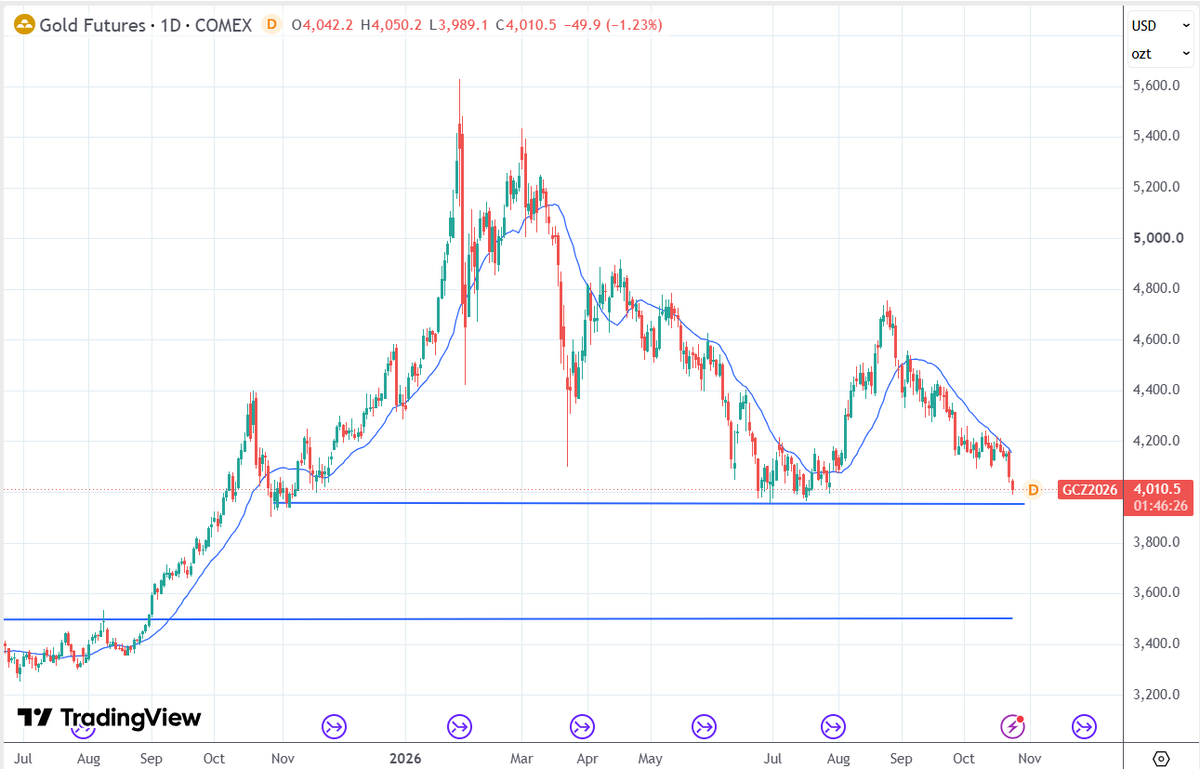
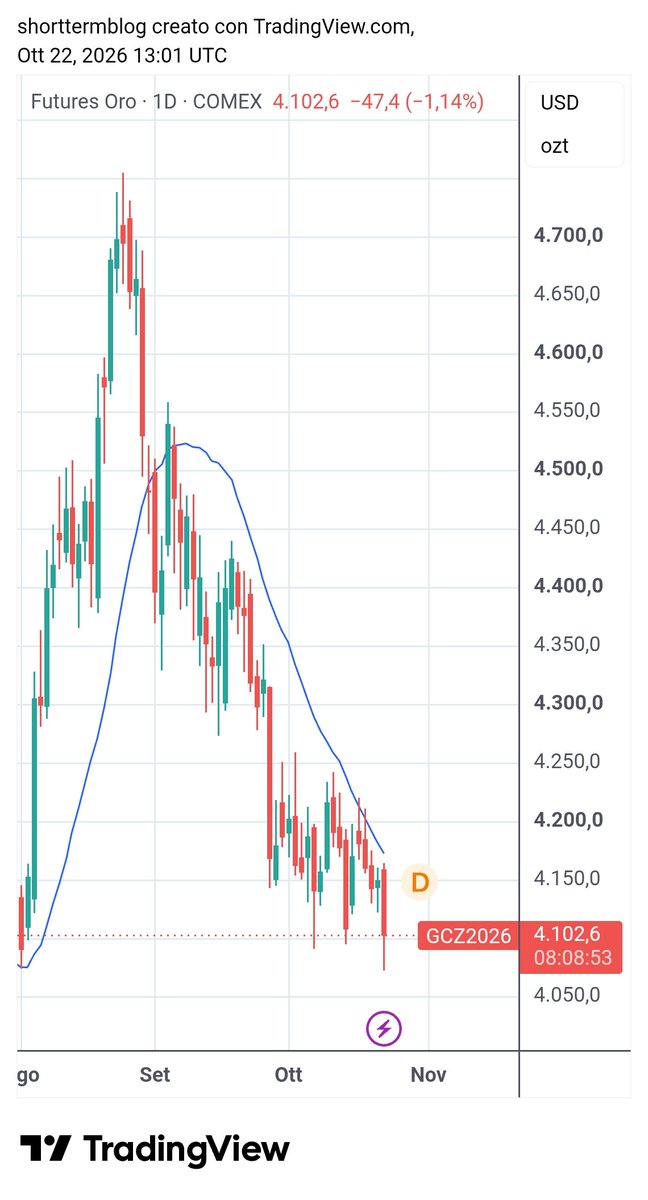
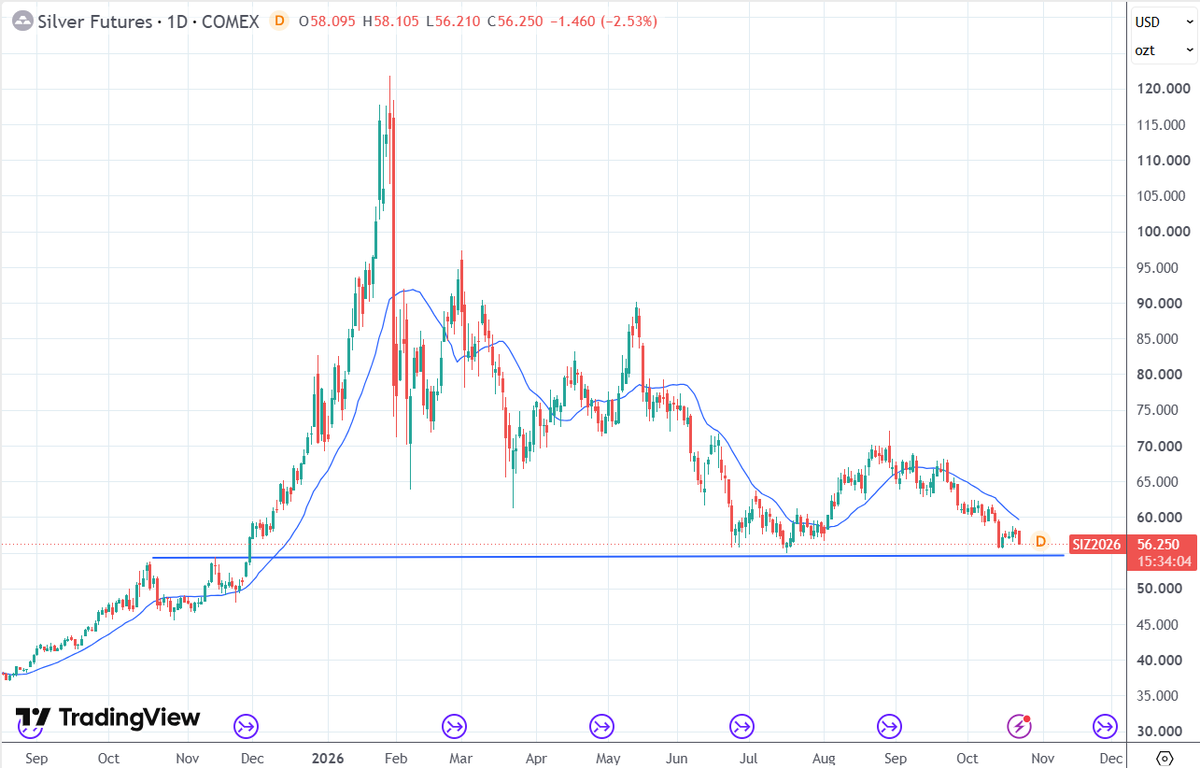
#Gold is getting very close to staring into the abyss.
It is hard to believe that only a few months ago we were reading about a new world order increasingly anchored in gold, with forecasts of $10,000 an ounce.
If that thesis were not necessarily true, but even just reasonably plausible, gold would look like a remarkable bargain at these prices.
$CRWD +7.1% to $254.83.
Cybersecurity stocks rallied after an Evercore survey pointed to firmer security budgets and strengthening demand, lifting peers like PANW and OKTA alongside #CrowdStrike.
"Where the noise fades and the signal speaks—your daily market pulse starts here"
Market Brief — October 22 (Generated by GPT 5.6):
Wall Street suffered another violent technology-led reversal on Thursday, but the underlying market was far more resilient than the Nasdaq's 2.6% collapse suggested. The S&P 500 fell 93.74 points, or 1.21%, to 7,663.43, its worst session since July, while the Nasdaq Composite plunged 694.00 points, or 2.60%, to 26,008.86. The Dow Jones Industrial Average edged 11.89 points higher to 52,867.98, and the Russell 2000 gained 3.01 points to 2,784.03. A majority of U.S. stocks actually advanced, making the session less a generalized equity liquidation than another severe repricing of AI, semiconductor and mega-cap technology exposure. The VIX closed at 20.17, up 20.92% from 16.68, confirming a sharp return of demand for protection.
Treasuries staged a powerful safe-haven rally even though the macro backdrop itself did not become more dovish. The 2-year Treasury yield fell to roughly 4.64%, the 10-year to about 4.95%, and the 30-year to around 5.29%, with the benchmark 10-year moving below 5% for the first time in roughly a month. The move was notable because it occurred alongside stronger labor-market data and sharply higher oil prices—conditions that would normally resist a major bond rally. Instead, investors sought duration as technology risk intensified and global financial stress increased. Lower yields helped reduce the valuation headwind for growth assets, but Thursday demonstrated that cheaper discount rates alone cannot offset doubts about the economics of AI investment.
The labor market remained exceptionally firm, leaving the Federal Reserve with little evidence of an abrupt deterioration in employment ahead of its October 27–28 meeting. Initial jobless claims fell 6,000 to 194,000 in the week ended October 17, below the 200,000 consensus and close to the lowest levels since 1969. The four-week moving average declined to 197,750. Continuing claims rose 25,000 to 1.728 million, while the insured unemployment rate remained at 1.1%. The data reinforce a low-hire, low-fire labor environment: layoffs remain unusually scarce even as hiring has slowed. That resilience limits the Fed's urgency to ease despite visible stress in housing and financial markets.
Oil surged as escalating Middle Eastern security risks restored a substantial geopolitical inflation premium. December Brent rose 4.0% to $113.17 a barrel, its highest close since May, while WTI climbed 2.4% to $99.47. The move followed attacks targeting Saudi energy infrastructure, continuing security incidents near Oman and persistent concern over escalation between the U.S. and Iran. Gulf export volumes have recovered considerably, but shipping risks and infrastructure vulnerability are keeping the market from fully normalizing. The juxtaposition was unusual: Treasury yields collapsed on risk aversion while crude prices surged, leaving the inflation outlook more difficult than the bond rally alone would imply.
The semiconductor complex suffered one of its sharpest reversals of the year as investors again questioned whether extraordinary AI spending will generate adequate financial returns. The PHLX Semiconductor Index fell roughly 6.7%. Nvidia $NVDA closed 4.40% lower at $212.21, Lam Research $LRCX plunged about 11.0% to $232.12, and Tesla $TSLA finished roughly 2.1% lower at $378.32 after its earnings update and reduced capital-expenditure forecast. Lam Research $LRCX had beaten quarterly revenue and EPS expectations, yet its outlook failed to exceed the exceptionally high bar embedded in the stock. The breadth of the decline across chips and AI infrastructure suggests investors were not questioning demand for compute itself; they were repricing the capital intensity, financing requirements and expected returns associated with satisfying that demand.
Meta Platforms $META became the clearest mega-cap symbol of the market's renewed anxiety over AI capital intensity, closing 7.84% lower at $642.85 despite strong operating growth. Meta Platforms $META reported third-quarter revenue of $64.6 billion, up 26% year over year, and issued strong fourth-quarter revenue guidance, but investors focused increasingly on capital expenditures of $135–$145 billion for 2026, negative quarterly operating cash flow and the creation of a new non-voting share class that could increase financing flexibility. The reaction is particularly significant because the underlying advertising franchise remains extremely profitable. Investors were not rejecting Meta Platforms $META's current business; they were demanding more evidence that the next enormous increment of AI investment will produce returns commensurate with its cost.
Procter & Gamble $PG delivered one of Thursday's clearest defensive victories, closing 5.3% higher at $165.09 after earnings demonstrated resilient demand and pricing power. Fiscal first-quarter revenue rose 4% to $23.28 billion, ahead of Wall Street expectations, while adjusted EPS reached $2.00 versus roughly $1.88 expected. Organic sales increased 4%, with strength across fabric and home care, beauty and healthcare. Procter & Gamble $PG also maintained its fiscal-year core EPS outlook and raised its total sales-growth forecast following the acquisition of Thorne. The stock's strongest daily gain since 2020 showed the premium investors were willing to pay for current earnings, durable consumer demand and visible cash generation while technology valuations were under pressure.
Spotify Technology $SPOT surged 11.08% to $583.52 as subscriber growth showed that its improving profitability is being supported by scale rather than cost reduction alone. Premium subscribers increased by 6 million to 306 million, ahead of management's forecast, while monthly active users reached 788 million and gross margin and operating income exceeded expectations. Spotify Technology $SPOT expects premium subscribers to reach roughly 316 million in the fourth quarter. The combination of user growth, expanding monetization and operating leverage offered investors precisely the type of growth profile the market currently prefers: revenue expansion accompanied by improving economics rather than open-ended capital requirements.
Lockheed Martin $LMT closed 6.85% higher at $589.28 after strong missile and aircraft demand drove double-digit growth and record backlog. Third-quarter sales increased 11% to $20.7 billion, net earnings rose 14% to $1.8 billion, or $7.97 per share, operating cash flow totaled $3.4 billion, and free cash flow reached $3.0 billion. Backlog surged 27% sequentially to a record $292 billion, including $52.5 billion tied to the multi-year PAC-3 MSE award. Lockheed Martin $LMT also raised its 2026 outlook. Defense offered a particularly strong contrast with AI infrastructure: geopolitical demand is producing contracts, backlog and current cash flow rather than requiring investors to underwrite uncertain long-duration returns.
Comcast $CMCSA closed about 3.0% higher at $22.74 as improving economics at Peacock and strong wireless additions outweighed continued pressure in broadband. Third-quarter revenue was $29.30 billion, down 6.1% on a reported basis but up 0.5% pro forma, while adjusted EPS reached $1.07 and free cash flow totaled $4.21 billion. Domestic wireless net additions were 368,000, bringing total wireless lines to 10.6 million. Peacock generated $261 million of adjusted EBITDA on $1.8 billion of revenue, its second consecutive profitable quarter, although Comcast $CMCSA lost more broadband customers than analysts expected. The positive closing reaction suggests investors gave greater weight to improving streaming profitability, cash generation and wireless expansion than to the deterioration in legacy broadband.
Union Pacific $UNP closed 3.55% higher at $298.09 after volume growth and pricing produced another strong railroad quarter. Third-quarter net income reached $2.1 billion, up 16%, diluted EPS increased 16% to $3.49, and adjusted EPS rose 15% to $3.53. Revenue carloads increased 6%, while the adjusted operating ratio was 58.8%. Union Pacific $UNP reaffirmed its longer-term earnings framework and said pricing dollars continue to exceed inflation dollars. The stock's gain showed that investors remained willing to reward companies in the physical economy where volume, pricing and operational efficiency are already translating into current earnings growth.
Valero Energy $VLO closed 2.40% lower at $426.28 despite extraordinary refining profitability, as investors treated the current earnings surge as at least partly cyclical. Third-quarter net income attributable to Valero Energy $VLO reached roughly $6.8 billion, or $23.89 per diluted share, while refining operating income surged to approximately $8.8 billion. Renewable diesel and ethanol also contributed positive operating income, and operating cash flow approached $6.9 billion. Yet the shares declined even with Brent above $113. The response suggests investors were unwilling to capitalize today's unusually strong refining margins as though they represent a durable normalized earnings level.
Moderna $MRNA collapsed 25.94% to $182.05 even though detailed Phase 3 melanoma-vaccine results were clinically positive, making it one of the session's clearest examples of a sell-the-news reaction. Intismeran autogene, developed with Merck $MRK, reduced the risk of recurrence or death by 42% and the risk of distant metastasis or death by 38% when combined with Keytruda. Moderna $MRNA had rallied more than 500% during 2026 before Thursday, however, leaving extraordinary expectations embedded in the stock ahead of the full data. Merck $MRK fell only modestly by comparison. The enormous divergence in the two stock reactions demonstrates that a positive fundamental result can still destroy market value when the preceding valuation has already discounted an even more exceptional outcome.
AFTER HOURS — Western Digital $WDC reversed part of a brutal regular-session decline after reporting exceptional AI-driven storage growth. Western Digital $WDC closed the regular session 7.16% lower at $351.41 as the broader AI-infrastructure trade sold off, but shares were up roughly 2.6% to around $360.49 in early after-hours trading following results. Fiscal first-quarter revenue reached $4.38 billion, up 55% year over year, non-GAAP gross margin expanded to 58.1%, adjusted EPS surged 161% to $4.64, and free cash flow reached $1.38 billion. Management projected December-quarter revenue around $5.1 billion, well above expectations, and raised the dividend. Western Digital $WDC therefore provided a useful distinction inside the AI complex: infrastructure demand was still generating rising margins and free cash flow even as the broader market sold companies associated with AI spending.
AFTER HOURS — Bloom Energy $BE showed how punishing the expectations bar has become: the company delivered spectacular growth and raised guidance, yet the stock fell both during the regular session and again after the release. Bloom Energy $BE closed 8.73% lower at $217.71, then was trading around $203.35, down another 6.6% after hours shortly before 5:00 p.m. ET. Third-quarter revenue surged 138.1% to $1.236 billion, product revenue increased 179.4%, non-GAAP gross margin expanded to 34.5%, and adjusted EPS reached $0.94, comfortably above expectations. Bloom Energy $BE raised full-year revenue guidance to $4.4–$4.6 billion and adjusted EPS guidance to $3.10–$3.40. The negative reaction despite a beat-and-raise illustrates the danger of extreme expectations: growth itself is no longer sufficient when valuation already assumes near-perfect execution and investors are increasingly focused on cash conversion and capital requirements.
Friday's calendar will test whether Thursday's risk-off move remains concentrated in technology or spreads into the broader economic narrative. S&P Global's flash U.S. PMIs are due at 9:45 a.m. ET on Friday, October 23, followed by the University of Michigan's final October consumer-sentiment reading at 10:00 a.m. ET. American Express $AXP and SLB $SLB are among the important companies reporting before the open. Beyond Friday, attention will quickly shift toward the Federal Reserve's October 27–28 policy meeting, where officials must weigh resilient employment and oil-driven inflation pressure against stress in rate-sensitive sectors and renewed financial-market volatility.
The signal:
October 22 was not a conventional broad-market selloff; it was an unusually concentrated repricing of the companies most closely associated with AI capital expenditure. The Nasdaq lost 2.6%, Nvidia $NVDA fell 4.4%, Meta Platforms $META dropped 7.84% and Lam Research $LRCX lost about 11%, yet the Dow and Russell 2000 finished higher and most U.S. stocks advanced. That divergence matters. Capital did not leave the equity market uniformly—it moved away from the most capital-intensive and expectation-sensitive technology exposures toward businesses offering current profits, contractual visibility or defensive cash flows.
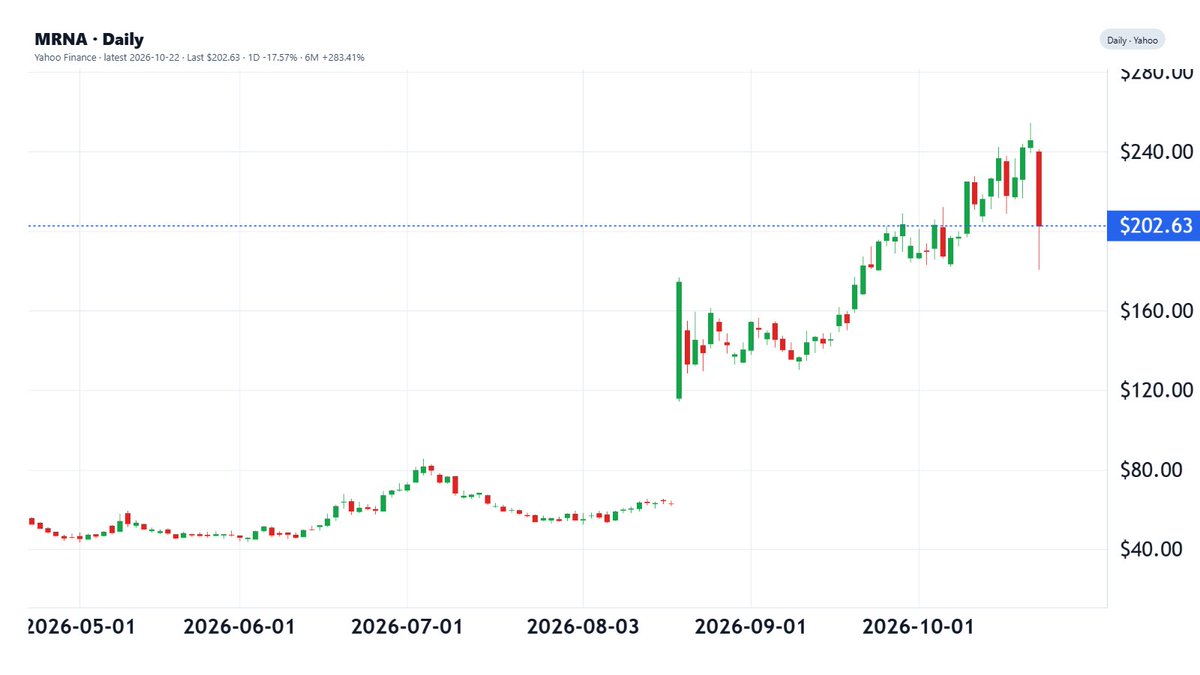
$MRNA -17.57% to $202.63 after reports an embargoed Phase 3 melanoma vaccine dataset leaked on social media and fell short of high expectations.
The selling pressure centered on the trial readout and communication lapse.
I'm afraid something bad may be brewing in the markets.
We'll see who's willing to buy the dip this time around.
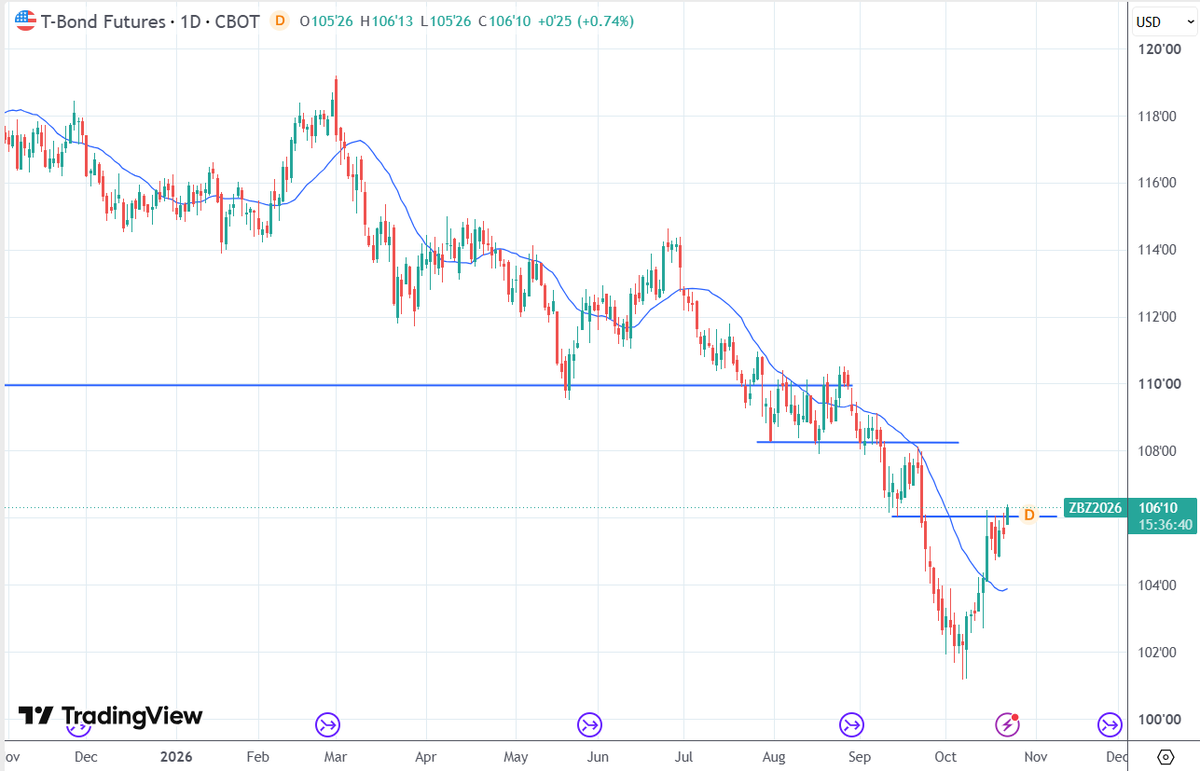
Even precious metals are taking a beating, while bonds have suddenly emerged as the safe haven.
"Where the noise fades and the signal speaks—your daily market pulse starts here"
Market Brief — October 21 (Generated by GPT 5.6):
Wall Street extended its rebound on Wednesday as powerful earnings from newly public SpaceX $SPCX and renewed strength across AI infrastructure stocks pushed the Nasdaq decisively higher. The S&P 500 gained 0.58% to 7,757.17, the Nasdaq Composite rose 1.05% to 26,702.86, and the Dow Jones Industrial Average added 360.21 points, or 0.69%, to 52,856.09. The Russell 2000 advanced about 0.3% to 2,781.02. The S&P 500 has now recovered much of last week's technology-led decline and sits only about 1.1% below its October 6 record close, while the VIX fell another 4.04% to 16.61, down sharply from 19.99 last Friday. Wednesday was therefore more constructive than Monday's narrow rebound: large-cap AI, industrials and selected financials all contributed, although the session still contained significant company-specific losers.
Treasury yields finished modestly higher despite another weak housing signal, leaving financial conditions restrictive even as equities rallied. The 2-year Treasury yield ended around 4.823%, the 10-year near 5.145%, and the 30-year around 5.437%. The Treasury's $13 billion 20-year auction cleared at 5.469%, the highest auction yield for the maturity since 1986 and slightly above the pre-auction market level, indicating somewhat softer demand even though the bid-to-cover ratio improved to 2.73. The important point for equities is that Wednesday's technology rally occurred with the 10-year still above 5.1%: investors were rewarding earnings and AI demand despite a demanding cost-of-capital environment rather than benefiting from a major rates tailwind.
Mortgage demand deteriorated for a seventh consecutive week even as borrowing rates finally edged lower, reinforcing evidence that housing remains one of the economy's clearest pressure points. Mortgage applications fell 5.3% in the week ended October 16 after declining 2.7% previously. Purchase applications dropped 7% week over week and 18% year over year, while refinancing applications declined 2% and remained 59% below year-earlier levels. The average 30-year fixed mortgage rate fell to 7.41%, its first decline in more than two months, but that modest relief was not enough to revive demand. Combined with Tuesday's weak housing starts and pending-home-sales data, the report suggests that mortgage affordability remains constrained even before any further tightening from the Federal Reserve. https://t.co/pQEHNEiTg7
Oil remained elevated but finished mixed as improving Persian Gulf export flows competed with continuing security risks around the Strait of Hormuz. December WTI settled 0.7% lower at $97.15 a barrel, while Brent was essentially unchanged at $108.82. U.S. crude inventories unexpectedly fell 3.1 million barrels, gasoline inventories declined 3.0 million barrels, and distillate stocks rose 1.7 million. The inventory draw normally would have supported prices, but reports that Persian Gulf exports have recovered close to prewar levels helped offset concerns over continuing attacks on shipping. For markets, the result was preferable to another surge above $100 in the active WTI contract, but Brent near $109 still represents a meaningful inflationary input.
SpaceX $SPCX delivered the session's defining earnings report, showing that massive AI infrastructure investment can still command investor enthusiasm when accompanied by extraordinary revenue growth and operating leverage. Third-quarter revenue reached $14.6 billion, up 161% year over year, while operating income totaled $2.8 billion, net income $4.4 billion, and adjusted EBITDA $8.8 billion, up 306%. The company's Super Intelligence segment generated $7.6 billion of revenue, driven by cloud-services agreements, the Cursor acquisition and AI software, while Connectivity revenue rose 69% year over year as Starlink expanded. $SPCX closed approximately 7.8% higher. The results directly addressed one of the market's recent concerns: SpaceX demonstrated that enormous compute investment can coexist with current profitability rather than requiring investors to rely entirely on distant future returns.
SpaceX $SPCX also introduced a potentially transformative strategic variable by confirming that special committees are exploring a possible combination with Tesla $TSLA. Elon Musk said both companies are examining a transaction, although he emphasized that meaningful obstacles remain. The prospect contributed to a roughly 3.4% regular-session gain in Tesla $TSLA, even before Tesla reported its own quarterly results after the close. A transaction would combine SpaceX's launch, satellite connectivity and fast-growing AI-compute operations with Tesla's vehicles, autonomy, robotics and physical-AI ambitions, but at this stage it remains exploratory rather than an announced merger agreement. Investors therefore treated the possibility as an additional strategic option rather than a completed catalyst.
Super Micro Computer $SMCI provided a second powerful validation of near-term AI infrastructure demand by dramatically raising its preliminary September-quarter revenue estimate. The company now expects fiscal first-quarter revenue of $18.5 billion to $19.5 billion, versus previous guidance of $14.5 billion to $15.5 billion, primarily because of stronger demand for AI platforms. Supermicro also raised its estimated gross-margin range to 12.0%–12.5% from 10.4%–10.8%, suggesting that the revenue acceleration is not coming solely through lower-margin volume. $SMCI rose roughly 9.6% during Wednesday's regular session. The combination of SpaceX and Supermicro strengthened the argument that AI-compute demand itself remains robust even as investors debate financing structures and return on invested capital.
Nvidia $NVDA reinforced the AI rebound with a 2.5% gain as Jensen Huang used GTC Berlin to expand the company's pitch from chips toward complete AI infrastructure. Huang introduced the Vera Rubin DSK Pod, a modular data-center architecture designed to reduce AI-factory deployment times from months to days, while emphasizing sovereign AI, robotics, enterprise agents and physical AI. Nvidia has committed nearly $10 billion to Europe's technology ecosystem over the past year and says it is working with more than 12,000 European partners. The strategic message matters because Nvidia is seeking to broaden the addressable market beyond hyperscaler GPU purchases toward full-stack infrastructure, software and national AI capacity. Wednesday's stock reaction showed investors were again willing to reward that expansion narrative after last week's severe semiconductor selloff.
Capital One Financial $COF advanced after a substantial earnings beat demonstrated that the Discover integration is adding earnings power without a deterioration in credit trends. Third-quarter net income reached $3.5 billion, or $5.61 per diluted share, while adjusted EPS was $6.69, well above the roughly $5.50 expected by analysts. Revenue increased to about $16.3 billion, and the provision for credit losses declined sequentially to $2.92 billion. Management said integration of Discover continues to progress and expected synergies are being realized. $COF gained roughly 2.5%, reflecting confidence that the acquisition can improve scale and profitability rather than simply increase complexity and credit exposure.
United Airlines $UAL rallied despite a modest earnings miss as record revenue growth and easing oil prices outweighed the immediate effect of sharply higher fuel expense. Third-quarter operating revenue increased 17% year over year to $17.9 billion, an all-time quarterly record, while adjusted EPS of $2.54 came slightly below the roughly $2.57 consensus estimate. Fuel expense rose 62%, underscoring the pressure created by this year's energy shock, but management expects fourth-quarter revenue growth of more than 20%. $UAL closed about 7.3% higher at $104.94 amid Wednesday's softer WTI settlement. The stock reaction suggests investors were looking through current fuel pressure toward revenue momentum and the possibility that lower forward oil prices could materially improve airline economics.
AT&T $T moved sharply in the opposite direction despite beating headline earnings expectations, illustrating how subscriber quality and competitive positioning can matter more than a conventional earnings beat. Third-quarter revenue increased to approximately $32.5 billion, adjusted EPS reached $0.65, and free cash flow totaled about $5 billion. AT&T added 379,000 postpaid phone customers, 442,000 fiber customers and 327,000 fixed-wireless subscribers, while management raised full-year adjusted EPS guidance to around $2.40. Yet $T fell roughly 6.5%, as wireless phone additions merely met expectations and investors focused on competition, rising costs and the prospect of greater pressure from alternative connectivity platforms including SpaceX's Starlink. The reaction demonstrates that solid current cash flow is insufficient when the market questions the future competitive trajectory.
Netflix $NFLX fell 5.3% to $65.04 as investors punished slowing revenue growth and a weaker advertising outlook despite strong current-quarter profitability. Third-quarter revenue increased 11.8% to $12.87 billion, the company's slowest sales growth in roughly three years, while fourth-quarter revenue is projected at approximately $13.44 billion, representing another sequential slowdown in the growth rate. At least 18 analysts cut their price targets following the report, with concern focused on U.S. engagement, content execution and advertising monetization. Wednesday's selloff pushed the shares to their lowest level in more than two years. Netflix therefore became an important counterexample to the day's AI optimism: strong profits are not enough when the market perceives deterioration in the forward growth trajectory.
AFTER HOURS — Meta Platforms $META rallied about 4% after record revenue and accelerating adoption of its Muse AI agent helped investors look through an enormous legal charge and even higher infrastructure spending. Third-quarter revenue rose approximately 26% to $64.6 billion, while net income reached roughly $9.9 billion despite a $9.9 billion legal charge related to social-media litigation. Ad impressions increased 10% and average price per ad rose 14%. Meta narrowed its 2026 capital-expenditure forecast to $135 billion–$145 billion, raising the lower end by $5 billion, while quarterly capex reached roughly $34.9 billion. Management also introduced a new non-voting Class C share structure intended to provide additional financing flexibility. Most importantly for the AI thesis, the Muse assistant has already attracted millions of users, giving investors early evidence that Meta's infrastructure spending is beginning to support a consumer product with monetization potential.
AFTER HOURS — Tesla $TSLA produced mixed operating results but gained roughly 1.6% as unexpectedly positive free cash flow and the possibility of a SpaceX $SPCX combination outweighed weak profit margins. Revenue was approximately $28.0 billion, broadly flat year over year and slightly below expectations, while adjusted EPS of $0.48 modestly exceeded consensus. Operating profit fell to about $718 million, capital expenditure more than doubled to roughly $4.7 billion, and operating expenses climbed sharply as Tesla increased spending on autonomy, AI and robotics. Yet free cash flow reached approximately $1.5 billion, substantially better than analysts had expected. With Full Self-Driving subscriptions up 67% to 1.74 million and special committees exploring a potential SpaceX combination, investors focused more on liquidity and strategic optionality than on the weak current operating margin.
AFTER HOURS — Lam Research $LRCX fell roughly 8% despite record operating performance because revenue and EPS came slightly below elevated expectations. September-quarter revenue reached a record $8.22 billion, up 22% sequentially, while non-GAAP gross margin improved to 52.4%, operating margin reached 40.2%, and adjusted EPS increased to $2.20 from $1.82 in the June quarter. Lam guided December-quarter revenue to $8.6 billion ± $400 million, gross margin to 52.5% ±1 point and EPS to $2.33 ± $0.15. The underlying business remains extremely strong, with AI-driven semiconductor demand increasing deposition and etch intensity, but the negative stock reaction showed just how demanding expectations have become after the sector's extraordinary capital-spending cycle.
AFTER HOURS — $IBM moved about 1%–2% higher after exceeding earnings and revenue expectations and raising its cash-flow outlook. Third-quarter revenue increased approximately 4.7% to $17.1 billion, while adjusted EPS of $2.95 topped the roughly $2.85 consensus. Software revenue grew 8%, infrastructure revenue increased 4%, and consulting was approximately flat. IBM maintained its full-year revenue-growth expectation of 4%–5% but increased its free-cash-flow outlook to growth of more than $1 billion. The modest positive reaction suggests investors saw evidence of stabilization after the company's disappointing second-quarter update, although IBM still needs stronger organic growth to demonstrate that its AI and software investments can generate sustained acceleration rather than simply support steady mid-single-digit expansion.
Thursday's calendar shifts attention from mega-cap technology toward labor-market data and a broad cross-section of industrial, consumer and communications earnings. Weekly initial jobless claims are due Thursday morning, followed later by the Conference Board's Leading Economic Index and the Kansas City Fed manufacturing survey. Before the open, major reports include Lockheed Martin $LMT, Comcast $CMCSA, Procter & Gamble $PG, Union Pacific $UNP, Blackstone $BX, Spotify $SPOT and Valero Energy $VLO. After three consecutive S&P 500 gains, those results will test whether this week's recovery can broaden beyond AI and technology into consumer, defense, transportation, media and energy businesses.
The signal:
October 21 provided the strongest evidence yet that last week's AI selloff was a valuation and financing reset rather than a collapse in underlying compute demand. SpaceX $SPCX delivered 161% revenue growth and $8.8 billion of adjusted EBITDA, Super Micro $SMCI raised revenue expectations by billions of dollars, and Nvidia $NVDA outlined another expansion of the AI infrastructure stack. Those are difficult data points to reconcile with a thesis that AI demand is suddenly disappearing. What changed last week was investors' willingness to finance every participant at any valuation—not the fundamental requirement for more computing capacity.