As someone building in comp neuro at the #1 school for CS, I’ve been asked time and time again how someone in ML can break into neuro
In fact, I've been asked this so much I took it upon myself to compile a clean guide of both computational and anatomical/physiological neuroscience that can be anyone's entry point to the world of comp neuro
https://t.co/EiSyE4xDEv
100+ people saved this neuro dataset post yesterday. More ML people want into this than I thought
If that's you, say hi, curious to know what you'd build
If you’ve got ML experience and want to break into neuro, here’s a good penetration point
ReadyNeuro is an open fMRI dataset built from 817 studies on OpenNeuro.
A good first project: mask part of a scan and train a model to predict what’s missing.
https://t.co/XiZZrzeBLp
Another open brain dataset worth a taking a crack at to build foundational brain models
MICrONS mapped a cubic millimeter of mouse visual cortex. 200k+ cells, half a billion synapses, and activity from ~75k of those neurons while the mouse watched videos.
A good first project: use the activity to predict which neurons are wired together. This will create an index for Schafer parcels that you can compare with others.
https://t.co/jKE3GG7OKk
@ThePolarisTeam@GoogleDeepMind Would love to build RL environments for you guys with our neural foundation models (https://t.co/DnU7KPkfx8). Happy to speak.
If you’ve got ML experience and want to break into neuro, here’s a good penetration point
ReadyNeuro is an open fMRI dataset built from 817 studies on OpenNeuro.
A good first project: mask part of a scan and train a model to predict what’s missing.
https://t.co/XiZZrzeBLp
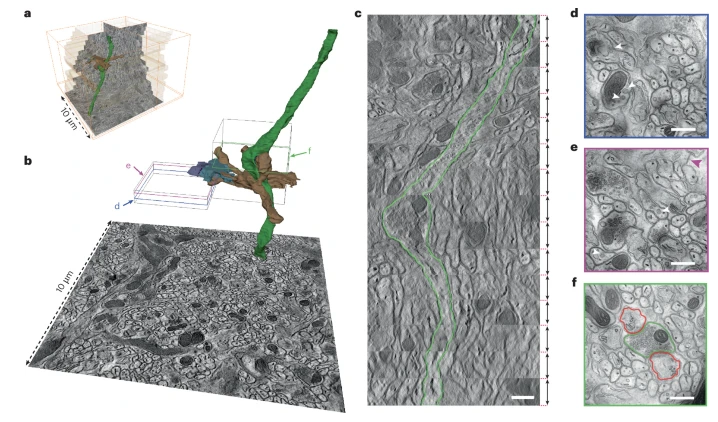
Most connectomes miss gap junctions, the electrical synapses. This method actually resolves them.
If you're doing graph ML on wiring diagrams, that's a whole class of missing edges
Electron tomography of thick tissue sections at a few tilt angles and with volume reconstruction enables connectomics and volume electron microscopy.
https://t.co/8MgAF8VSoq
Grateful for all the people who make me who I am today.
Recently I’ve been blocking hours to analyze traits, behaviors, and mannerisms that I see working for people around me, and start practicing them immediately.
This only works because the people I get to surround myself with are so awesome
Introducing People API powered by @typesafeai
Try it at https://t.co/kU3IBHJqhb
- $0.07 for full profile search
- Find anyone with any identity
- Phone number, Social traces, Personal email, etc.
- #1 on people search bench
0% markup, Pay per call
OpenSource Repo link below 👇
Today our neural encoders just hit SOTA on predicting emotion vectors for a piece of stimulus. (Up 10% from second in class)
What’s more is the neural encoder we used for this is lobotomized. We only used visual embeddings, and are working towards adding linguistic embeddings to this encoder.
All to say this is some pretty exciting stuff and if it keeps pointing up the way it is, we’ll soon be able to define emotion vectors as target neural states.
Today one of my ML engineers showed me his personal website. Instead of firing him on spot, I decided to make an x post about him
Joke apart, he’s been up to some awesome stuff and if you want to have some good, deeply technical conversations on neural encoders or denoising brain data to higher dimensionality (EEG->fMRI) etc. @guhanvenkaty
https://t.co/dVufisMW2j
Reading about open source pretraining architecture is genuinely awesome. Unpacking ‘why’ behind a lot of these architectural decisions is the best way to formalize ML intuition
Ultimately the thing that will enable the superintelligence boom is alignment
Had the opportunities to hear some great conversations about this at CMU and @PoShenLoh had a great take on the application of intelligence.
He thinks fundamentally agents will be directed where humans want them most because humans are the strongest reward signal for agents.
Ensuring this remains true is the million dollar problem.
I think this clip of Nick Bostrom is quite under-appreciated
He inverts “if anyone builds it everyone dies” to “if nobody builds it everyone dies” and posits superintelligence as poised to extend lives to 1200 to 1400 years
As someone building in comp neuro at the #1 school for CS, I’ve been asked time and time again how someone in ML can break into neuro
In fact, I've been asked this so much I took it upon myself to compile a clean guide of both computational and anatomical/physiological neuroscience that can be anyone's entry point to the world of comp neuro
https://t.co/EiSyE4xDEv
@dkawjr@circuitfreud Definitely biased by the goals of the people that asked me to put this guide together haha. Most of them are very computational so they wanted to first understand what kind of data they would be playing with before learning how/why we go about getting that data
looks like you can play magic tricks on Claude
ask it which line looks longer and it can pick the top one. they’re the same length.
curious how interpretability folks would go about explaining this
GTA VI with a brain implant is wild but the button mapping is the cool part
imagine tapping your ring finger → button press
imagine sliding your hand forward → the plane pulls up
what would you put on a controller you never have to hold?