@DanTabin@Sauers_ I worked exactly on this topic and on 2D landscapes, but it remains unpublished. I have a large paper on PCA and manifold learning half-written.
We’re calling it: The war in Ukraine has entered a new phase.
@KatStepanenko and I have authored a new special report studying how Ukraine is actively challenging the positional character of the war that has dominated the battlefield since 2023.
Data on Russia’s battlefield performance indicates that the character of the war is shifting in favor of Ukrainian forces – at least for now. Russian forces rates of advances are stagnating while Ukrainian forces are employing novel tactics and operational concepts in efforts to break out of positional warfare. Neither Russia nor Ukraine can conduct operational maneuvers yet, however.
The bottom line is that the war in Ukraine is competitive and far from stalemated. Ukrainian forces are out-innovating Russian forces in both military technologies and in applying these new technologies in effective operational concepts that can help Ukrainian forces break out of positional warfare. Ukraine is employing mechanized equipment in tactical maneuvers in ways that were impossible 12 months ago. Russia’s ability to conduct infiltration missions will likely continue to degrade as Ukraine’s intermediate-range strike campaign pushes Russia’s logistics and forward operating bases further away from the frontlines, reducing resourcing to sustain infantry tasked with infiltration missions. Ukraine may be able to scale these effects if they resourced properly by international partners.
Ukraine’s advantage in intermediate range strikes is notably not permanent, and Russia will very likely eventually develop countermeasures to mitigate Ukraine’s advantages. Ukraine’s international partners thus have a rare and temporary opportunity to help Ukraine exploit favorable battlefield dynamics while Ukraine has the upper hand.
Key Points of the report:
• Russia’s rate of advance is plummeting during the Russian Spring-Summer 2026 offensive.
• Russia is losing more soldiers to make fewer gains, with monthly Russian casualty rates reportedly outpacing monthly recruitment since December 2025.
• Ukraine is starting to regain more ground than it is losing for the first time since 2023.
• Ukraine’ recent counterattacks feature unique characteristics and deviate from key trends that defined the positional character of the war since 2023.
• Ukraine is conducting a pattern of more frequent mechanized counterattacks at the tactical level for the first time since 2023.
• The Ukrainian command’s operational planning is maturing.
• Ukraine’s early 2026 counterattacks in the south were successful likely due to better planning and preparation of the battlefield.
• Ukraine has been conducting a coherent campaign to suppress and destroy Russian air defenses since late 2025, in order to shape the battlefield as part of more sophisticated campaign planning.
• Ukraine significantly intensified its intermediate-range strike campaign against dynamic targets in Spring 2026 in order to degrade Russian logistics at operational depths ahead of planned Ukrainian maneuver.
• Ukrainian forces started actively disrupting Russian railway logistics in occupied Ukraine and Russian western regions in Spring 2026.
• Ukrainian intermediate-range strikes are already achieving notable operational effects, including degrading Russia's ability to use the key Russian highway connecting Russia to occupied Crimea and GLOCs around Donetsk City.
• Ukrainian forces decisively seized the initiative in intermediate-range strikes by fielding new technologies such as the US-made Hornet strike UAV, among other systems.
• Ukrainian forces are achieving temporary tactical drone overmatch in some frontline sectors, which is slowing Russian offensive operations by degrading the effectiveness of Russian shaping operations.
• Ukrainian forces likely achieved tactical drone overmatch in certain frontline sectors after degrading Russia’s drone capabilities in late 2025 to early 2026 - primarily by suppressing drone launch positions and increasingly intercepting Russian tactical UAVs.
• Ukraine’s degradation of Russian forces at operational depth combined with tactical-level drone overmatch likely is creating vulnerabilities in the Russian lines.
• Ukraine’s intermediate-range strike campaign is likely far from its zenith, assuming continued support from Ukraine’s partners, and will likely intensify over 2026 as Ukraine fields new weapons capable of striking Russian’s operational rear.
Link to full report: https://t.co/rCeWbYJNiB
People often say Russia is little more than a gas station. But it is actually more than that. It is a gas station run by people with weaponized mental illness.
For the past two years, we have discussed how Ukraine is building drones that can hit targets 100 to 150 kilometers away. These drones are being produced in enough numbers to disrupt Russian logistics. During this time, some people doubted this was possible, calling it too optimistic or asking, "Why can't Russians do the same thing?"
To me, the answers were clear. Ukraine has better technology across various forms of communication, either on its own or with allies' help. Starlink is one example, but it is not the only or even the most important one.
Ukraine also has more experience and stronger command-and-control systems for drones. While these systems are not perfect, they are better than what Russia has, especially at the scale needed for this kind of operation.
Ukraine developed many different technologies and weapons in parallel, and for a good deal of time, none of these projects had much, if any, impact on the war itself. So, for a long time, it seemed nothing was happening, and this, along with Russia's media narrative (and the profound willingness of people to fall for Russian propaganda), led many to believe Russia was inevitably winning, which was never true, and is certainly untrue now.
Now, these technologies and weapons have reached the front line at about the same time, within a few weeks or months of each other. Some are better or more specialized than others, and some will be countered or may fail. Still, the fact that they all appeared together makes it very hard for Russia to adapt and stop them.
Ukraine will be able to send very cheap drones with a range of over 100 kilometers into Russia's rear areas. These drones can be guided by many different methods to hit every important target at first, and probably, in time, every target.
Russia has already had to close some roads and routes because of the threat. This is just the start. The danger will only grow as Ukraine increases production over time. These drones are cheap and easy to make, and Ukraine will produce them in large numbers. Russia does not have any technology that can handle this threat right now.
SHORAD can create small protected areas, but if it is used often, it will eventually be destroyed.
Electronic warfare probably will not solve the problem, but it might help a little.
Nets along highways will help, but only slightly. And nets can pose risks and hazards of their own. When they collapse, they can close roads, forcing vehicles through chokepoints that can be mined and attacked.
Interceptor drones can work, but they need a lot of resources that would otherwise go to offensive operations.
The Russian military is dealing with a problem no army has faced before, and there is no clear solution. Their best option is to spread supplies across many vehicles and use every possible road and path to move them forward. However, this is very inefficient and only helps as much as Ukraine's drone production allows.
If Ukraine hit a train full of Russian civilians it would be all over world news this morning.
But when Russia hits a train full of Ukrainian civilians it's just another Wednesday.
We have a sick world because our media is sick
So America is on edge, angry and reaching a boiling post--and this is President Trump's latest tweet.
Serious Nero fiddling while Rome is burning vibes...
Hard as it is to accept it, we in Europe must come to terms with the fact that this is precisely the kind of country a significant percentage of the US population wants to have.
Europe cannot be the ally or the partner of this.
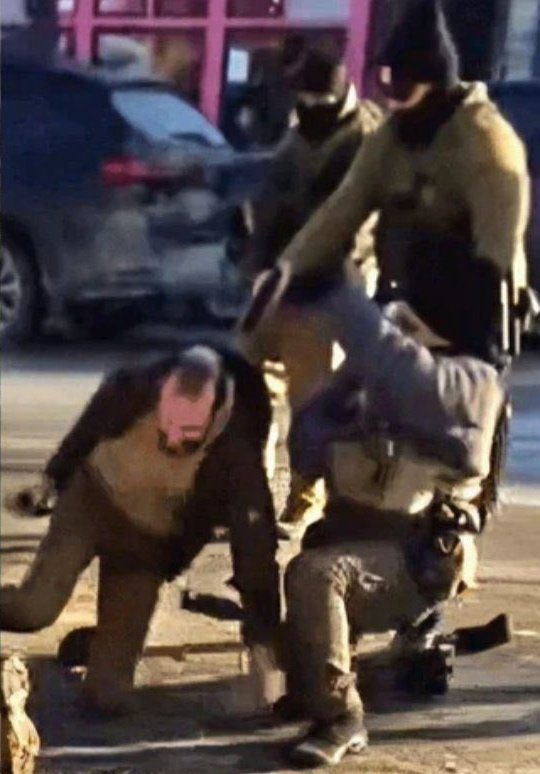
Federal agents shot a guy despite outnumbering him about 10-1, while he’s on the ground. They’re going to say he reached for a gun. But there’s 10 of you! Just let 5 grab each arm. How are they this bad at their jobs? Bad training and a rotten culture.
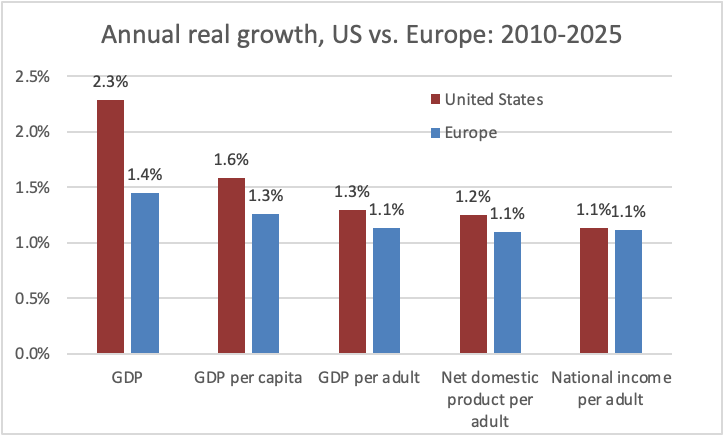
"The US is strong, Europe is weak"
You hear it everywhere: in the US national defense strategy, in speeches by Trump, Bessent, Lutnick, etc., in Davos this week.
You hear it everywhere but it's a myth.
The US has not grown faster than Europe since 2010, not by one iota. 🧵
I’m genuinely shocked that Davos is FILLED with thousands of journalists - Politico & Bloomberg have entire headquarters on the high street. And I was the only person to confront Witkoff about his Russia $ deals. The media is a completely broken club.
Steve Witkoff ran away when I confronted him about his financial ties to Russia.
His real estate company has been bankrolled directly by a former advisor to Vladimir Putin's sovereign wealth fund.
He’s been making pro russia statements for months.
"Until the last few days when I told them about Iceland, they loved me. They called me Daddy."
1. No one is calling you Daddy you dirty pedo.
2. It’s Greenland not Iceland you dumb fuck.
Trump has been speaking for over 50 minutes now and he hasn’t taken a single question at what is supposed to be a press conference. He’s been rambling incoherently nonstop. 25th amendment now.