What an exciting time to be alive.
We're starting to explore a regime of physics that has always been out of reach: large, highly entangled quantum systems that we can build and control ourselves.
Quantum mechanics itself is on very solid ground. It has passed every experimental test for a century, and it already underpins the modern world, from the chips in your phone to lasers and MRI.
We know the rules. What we often can't do is calculate what they produce once many particles become deeply entangled. Fully describing the state of just 300 entangled qubits can take more numbers than there are atoms in the observable universe, and no classical computer can keep up.
Quantum computers are the first machines that let us create these states on purpose and study them directly. Scaling them to millions of qubits takes us into territory no one has ever been able to test.
There are two possible outcomes, and both are extraordinary.
If quantum mechanics holds at that scale, as most physicists expect, we gain an instrument for physics we've never been able to compute: new phases of matter, new materials and molecules, and open puzzles like high-temperature superconductivity, still not fully explained 40 years after its discovery. Early machines have already produced exotic states, like time crystals and non-Abelian anyons, that once existed only in theory.
If it doesn't hold, and these systems behave in ways the theory can't explain, that would be the biggest discovery in physics since quantum mechanics itself.
And there's precedent for this.
Electromagnetism was always around us, in lightning and lodestones, long before we understood it well enough to build motors, power grids and radio. The nucleus sat inside every atom for billions of years before the 20th century turned it into nuclear power and medicine.
Entanglement fits the same pattern: it's already everywhere in nature, and we're only now learning to engineer it at scale.
We can't predict where that leads, and history suggests we'd guess wrong. The inventors of the transistor and the laser didn't foresee the smartphone or the internet. The biggest impact of mastering entanglement will likely be something no one has imagined yet, or dare I say even capable of imagining.
There's a new intercontinental data pathway between Geneva and Seoul—a post-quantum one. The data that traverses it—ours.
This pathway is part of a multi-layered post-quantum security connection between our offices in Switzerland and South Korea. It's a model for governments and enterprises the world over.
Financial loss. Damage to critical infrastructure. Reputational harm. Toppled stability. Without quantum-level security, many pitfalls lie ahead.
But our hybrid solution, which leverages both quantum key distribution (#QKD) and post-quantum cryptography (#PQC), points the way to quantum-level security.
Read the full blog → https://t.co/dBnBQzgDtP
#IonQ #QuantumIsNow #FutureOfQuantum #QuantumSecurity
But zoom out:
Generative models keep turning cheap sensors into stand-ins for expensive ones. Early, small example: most of Raman's discriminating power, recovered from a photo, on one setup.
Direction: the spectrometer moves from the point of use into the training set.
https://t.co/qI8PBFnMJD
No spectrometer. No laser. Just a brightfield photo of a cell.
New from @MIT (Tadesse lab): an AI model that predicts the cell's Raman fingerprint from that photo. 0.98 cosine similarity vs. the measured spectrum.
Software partly standing in for a six-figure instrument. 🧵
@MIT Reality check:
• Small data: ~200 cells per immune type. By our SI math, test sets are 20-45 unique cells plus augmented copies.
• One lab, one microscope.
• A near-constant spectrum also scores high cosine.
• GFP+/- are separate cultures; batch effects not ruled out.
@TU_Muenchen But zoom out: space QKD's real problems are cost and uptime. Infrared fixes daylight but needs bigger telescopes and pricier detectors. This route keeps silicon detectors and metro fiber.
Direction: daylight QKD is becoming an engineering problem.
https://t.co/t3cWILQHN8
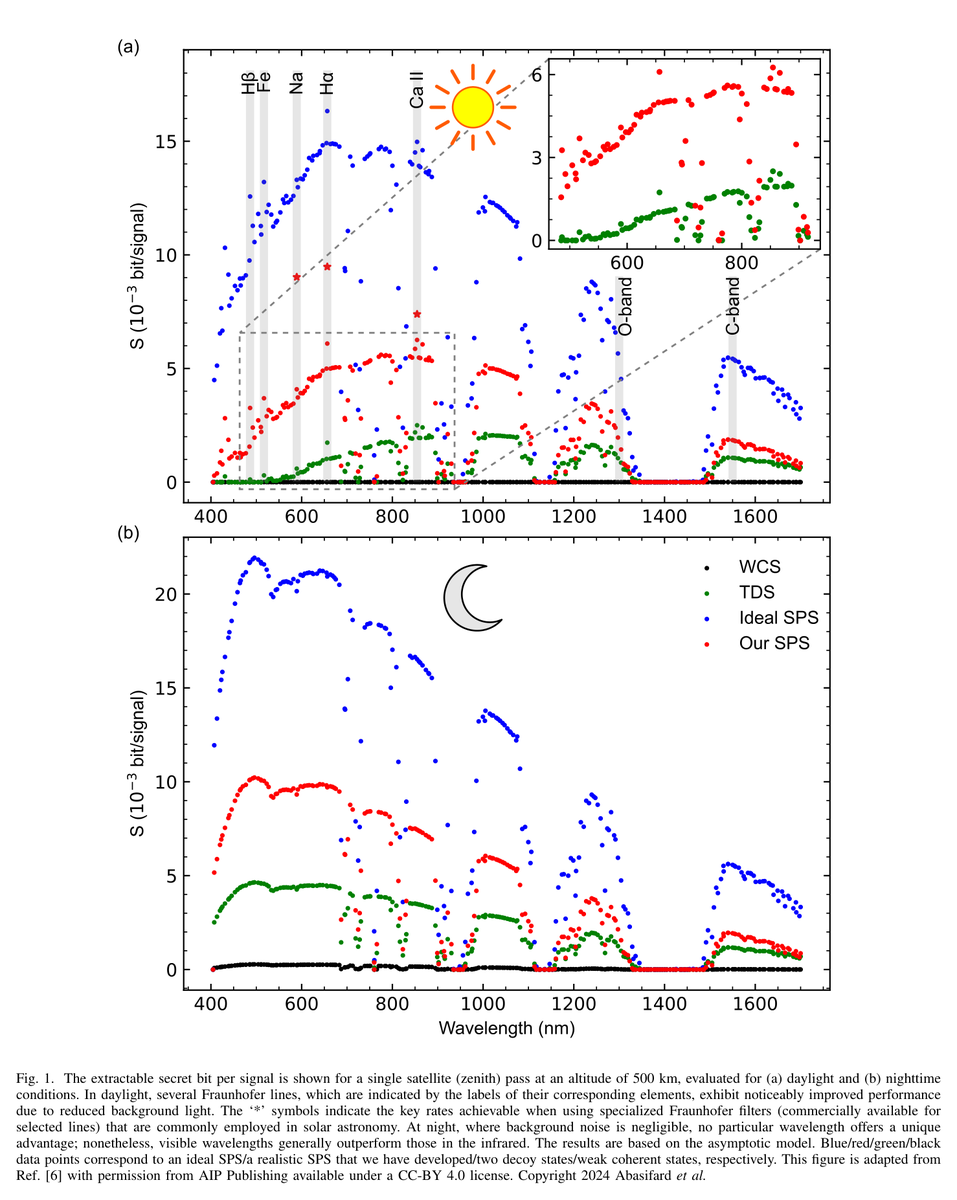
Satellite QKD has a sunlight problem. Daylight blinds the single-photon detectors, so the satellites mostly work at night.
New proposal from @TU_Muenchen (Vogl group): hide the photons in a dark line of the solar spectrum at 854 nm, then run them into fiber. 🧵
@TU_Muenchen Reality check:
• A proposal, not an experiment. Every key rate is modeled
• The 854 nm hBN emitter hasn't been made yet
• Asymptotic model: no finite-key effects, best case
• Night model assumes no moonlight
• Satellite as trusted node is a security compromise