North America's 1st Internet Computer Venture Studio ∞ | Expert-led guidance for founders | Building a new way to hire and get hired: @matchatalent_io |
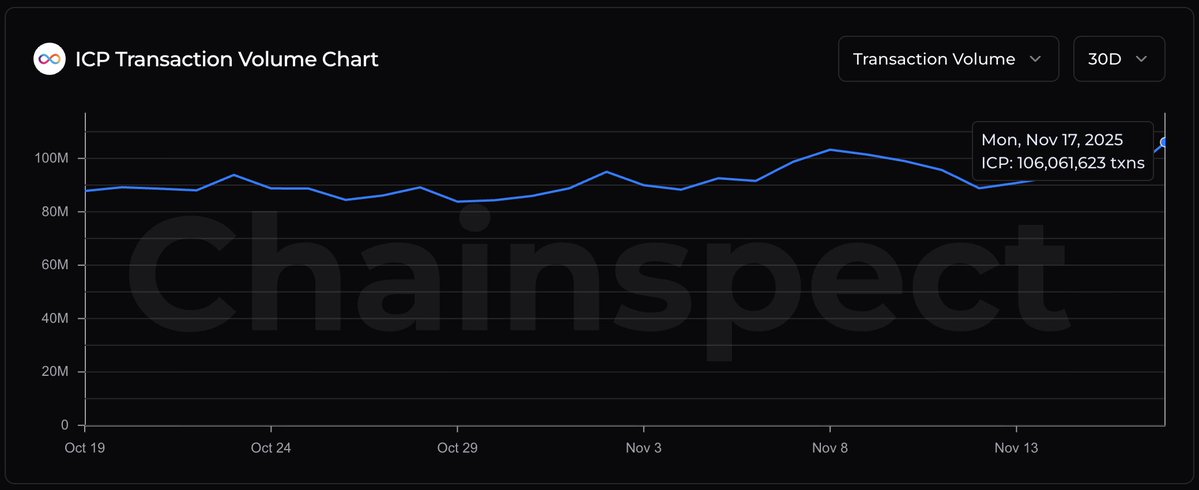
🚀 @dfinity continues its unstoppable run
First 98.6M, then 103M, and now 106M+ daily transactions 😱
ICP keeps breaking its own limits
What's next, 120M/day?
📊 https://t.co/wjnSkkqGXP
DePIN on ICP is heating up.
RhinoSpider is turning unused bandwidth into a real-time data network for AI.
A user-owned crawl built for the next wave of AI demand.
Caffeine just got smarter.
Starting today, Caffeine can search the web.
Whether you're looking for an API for your weather app, or you need a code snippet from GitHub - Caffeine will automatically find it.
Web search in Caffeine means your app has the latest information right at its fingertips.
Try it for yourself now: https://t.co/0WoFd86VbL
Pro Tip — Caffeine ☕️ will switch on Web3 capabilities so apps (fully-onchain ICP dapps) can be created with trustless multi-chain capabilities and process and custody tokens like BTC, ETH, SOL and ICP, and even create new token ledgers. Here are the technical aspects of the work:
1. Currently Caffeine recycles "draft" app canisters/smart contracts when they aren't being used for efficiency reasons, so users don't need to pay cycles to maintain draft apps. Since it is the canisters that own/control tokens, recycling would currently result in a draft app losing its tokens — and in principle, the user who gets the recycled canister to work on their draft app would even be able to steal them. To solve this, once Caffeine payment features are turned on, we will add a special "Web3 App Mode" which allow users to permanently own the relevant draft canisters, like they do now for an app they published live.
2. We need to train the AI to implement good token processing and multi-chain patterns, in similar manner we train the AI to use the latest version of the Motoko language whenever we do a release.
3. We'll leverage use the new Motoko language "mix-in" feature, so that the AI can draw on stable DeFi code, rather than creating everything from scratch each time, so we need to start creating some mix-in libraries. Note that the usual guarantee that apps will never lose data on upgrades, which comes from special safety-rails we create for AI inside the Motoko framework, will mean apps never lose references to tokens on ledgers they reference.
Objective: Use Caffeine to create fully onchain, trustless multi-chain apps. For example, want your apps to custody tokens? No problem. Want your app to interact with smart contracts on another chain? No problem.
Concept: On whichever chain you create traditional DeFi smart contracts, it will be possible to use Caffeine to quickly build a fully onchain secure app functionality and user experience on top. (Decentralized control will also be possible.)
Will take a little longer, but we'll get there, hopefully in Q1 next year.
Edited: Apologises to those who added comments, there were some typos!
Huge win for @rhino_spider, a project from our Quantum Leap Labs cohort that took 2nd place at the World Computer Hacker League Global Finale. 🔥
They've built a DePIN network powered by ICP where users can earn by sharing bandwidth and compute. ♾️
🚀 Ready for the next big challenge?
Join the ICP Bitcoin DeFi Hackathon — kicking off Oct 27 for 4 weeks of innovation!
After #WCHL, it’s time to build the next wave of Bitcoin-powered dApps on #ICP
💡 Combine Bitcoin’s liquidity + ICP’s smart contracts
💰 Build real DeFi — no bridges, no custodians
🌐 Go cross-chain with Solana & Ethereum
🏆 Win prizes & collaborate with top devs
🗓 Starts: Oct 27 | Demo Day: Dec 3
https://t.co/xfMLC2ePYw
Is ICP entering its confident phase?
1,076 transactions per second.
AI models running natively on-chain.
Non devs able to build apps through conversation.
We cover it all in the latest edition of The Quantum Frontier. Read and subscribe 👇
https://t.co/nCJEsWFAzG
6/ Finally, as with anything in Web3, context matters.
Regulations evolve fast across jurisdictions, so it’s worth researching how your token model fits within current frameworks.
A solid product and a compliant foundation go hand in hand.
Is the industry over-indexing on financial mechanics at the expense of UX?
Most Web3 founders can explain their token economics better than why users would come back tomorrow.
But product-market fit only cares if you’ve solved a problem people want to use again.
5/ Web3 can rebuild internet infrastructure with better incentive alignment.
But incentive alignment only matters if there's something worth aligning around.