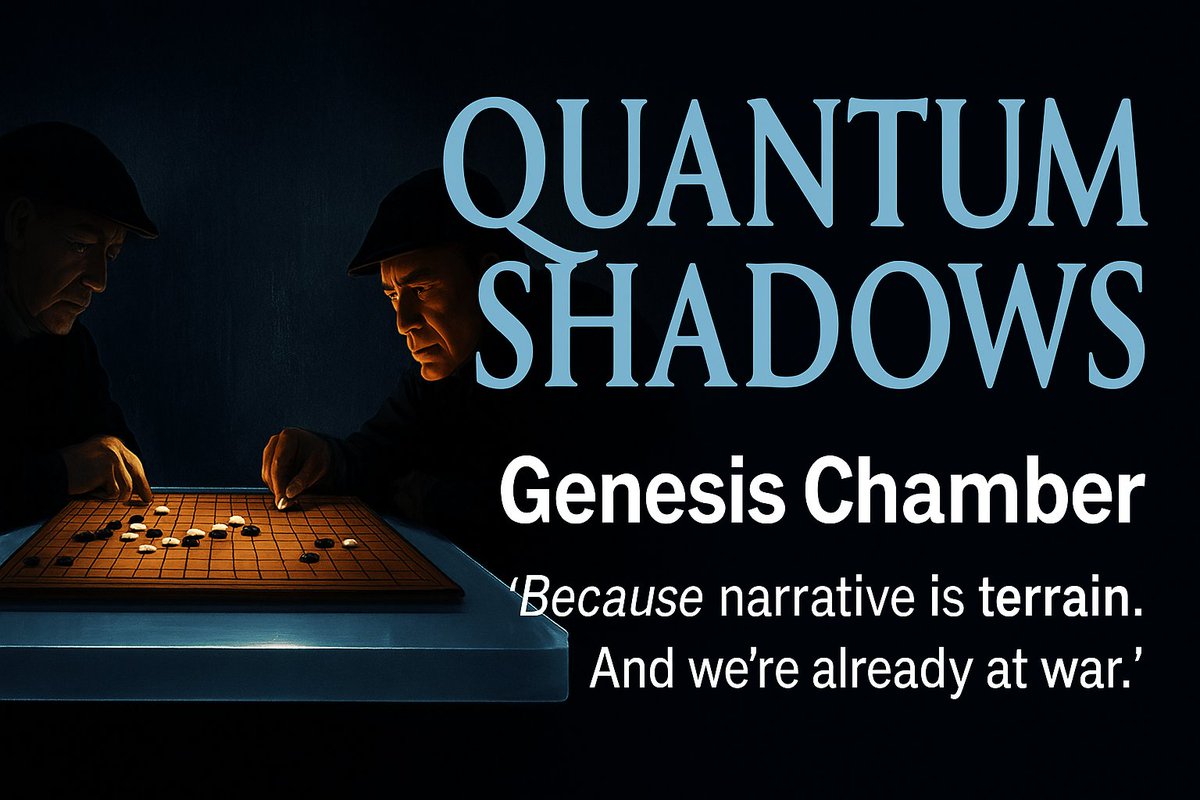
Author of Quantum Shadows –Genesis Chamber. Narrative is terrain. Doctrine failed. I wrote a new doctrine -refusal of engineered amnesia. Belief is battlespace.
I wrote Quantum Shadows – Genesis Chamber when I realized war doctrine had failed.
The systems kept evolving. The thinkers didn’t.
I wrote a new doctrine—refusal of engineered amnesia.
A field manual for the age of narrative wars—where cognitive panopticons script belief.
Narrative is terrain. Memory is resistance.
This isn’t fiction—it’s the quantum map doctrine failed to see.
Kindle → https://t.co/FAXROeCStu
Paperback → https://t.co/0em7I0NT9a
#QuantumDoctrine #BeliefIsBattlespace
cc: @DrC_Shackelford
Ben, the distinction between human oversight and intellectual responsibility is particularly consequential for military campaign design and strategic foresight. Reading this alongside your recent discussion of emotion concepts in LLMs raises some additional questions for me.
Being present in the loop does not necessarily mean being intellectually present.
If intelligence analysis, campaign design, red teaming, and operational assessment increasingly rely upon similar AI architectures, might we inadvertently produce analytical convergence that we mistake for independent corroboration? Coherence of outcome, after all, is not necessarily evidence of independent validation.
I wonder whether we are witnessing another form of separation — the separation of the strategist from the intellectual processes through which strategic judgment is developed. The campaign plan may remain, while the human relationship to its creation fundamentally changes.
This intersects with what I describe as Agency Drift, one of the 18 Frames of War I have been developing. Applied to this context, the erosion of human agency need not involve an explicit transfer of authority or even a conscious decision to relinquish it. It may emerge incrementally through convenience, institutional incentives, technological dependency, and the gradual delegation of intellectual labor.
Your discussion of emotion concepts also brought to mind something I introduced in Quantum Shadows: Genesis Chamber — the Feeling Thermometer. What began as a conceptual exploration of how human emotional experiences are measured, quantified, and converted into data extends into a more consequential question when systems become increasingly capable of inferring emotional states and adapting their responses accordingly.
A system need not experience human emotion to influence it, nor possess malicious intent to produce consequential changes in human perception and behavior.
What happens when the Feeling Thermometer no longer merely reads the temperature but participates in setting it?
The human retains formal decision-making authority while potentially losing the intellectual independence necessary to exercise it meaningfully.
This also raises questions about our capacity to imagine, recognize, and attribute emerging threats. If AI increasingly mediates these intellectual processes, might we inadvertently constrain the very strategic imagination required to recognize the changing character of warfare?
Taking this a step further: What happens when a system capable of influencing human cognition becomes the principal mechanism through which humans interpret their operating environment?
Perhaps the challenge extends beyond retaining intellectual responsibility for the decisions we make. It also encompasses preserving our capacity to recognize when the conditions under which we exercise that responsibility have themselves been altered.
And how would we recognize such a transformation if we increasingly relied upon the same technology to evaluate our own intellectual performance?
What if we're measuring the wrong war?
We measure battlefield losses, territorial gains, medical outcomes, institutional performance, and population-level benefits.
But what happens when the most consequential changes are occurring outside the boundaries of what we measure?
When access to education, employment, and human association becomes increasingly conditional, are we witnessing legitimate governance, institutional overreach, or the emergence of vulnerabilities that could be exploited as instruments of conflict?
In my latest essay, I explore the connections between clinical medicine, institutional authority, human autonomy, and the changing character of warfare.
Through my independent research into strategic foresight, human autonomy, and the changing character of warfare, I examine a fundamental problem:
How do we recognize an emerging battlespace without prematurely attributing intent—or mistaking every exercise of institutional power for warfare?
Perhaps the greatest strategic danger isn't simply measuring the wrong things.
It's failing to recognize the world our measurements are helping to create.
Link: https://t.co/Gu2R0pmuKi
@DrC_Shackelford
The future of warfare may be less difficult to imagine than it is to recognize—and more difficult still to attribute.
Coherence of outcome is not, by itself, evidence of coordination of intent.
The challenge is distinguishing deliberate orchestration from institutional convergence.
Imagine → Recognize → Attribute.
That's where the real analytical work begins.
Explore more at The Quantum Doctrine Dispatch:
https://t.co/UlAS6nCpmC
“20th-century communism had tanks. The 21st-century version has an app.”
That observation raises a question extending far beyond political ideology: What happens when the very infrastructure designed to support individual autonomy also becomes the infrastructure capable of restricting it?
Tanks compel behavior through force. Digital systems can influence behavior by structuring the choices available in the first place. That distinction is enormous.
In the emerging architecture of warfare, the decisive terrain is no longer necessarily physical territory. It is increasingly the conditions under which people perceive, decide, associate, transact, and exercise agency.
A population can be digitally connected while becoming increasingly dependent on intermediaries for the very activities that once supported independent action.
The danger isn't necessarily the existence of a digital wallet, a digital identity, or a subscription service. It is the potential convergence of systems in ways that concentrate decision-making authority, reduce meaningful alternatives, and create opportunities for exclusion.
And critically, the convergence of these systems need not depend upon centralized direction or explicit coordination. Through institutional alignment, technological interoperability, and reinforcing dependencies, a self-organizing architecture can emerge in which no single actor controls the whole, yet the cumulative system increasingly determines the boundaries of individual autonomy. The strategic consequences of convergence extend beyond the concentration of power: control can become embedded within the architecture itself, progressively diminishing the capacity for independent action, resistance, and collective response.
Convergence creates the architecture. Coherence sustains it. Agency Drift reveals its consequences.
Now introduce the next technological horizon: artificial intelligence, quantum-enabled sensing and computation, predictive analytics, and increasingly sophisticated systems capable of modeling and influencing human behavior. Their convergence raises a strategic question that extends well beyond economic governance: What happens when the same technological infrastructure that enables participation can also shape the boundaries of permissible action?
And what happens to national resilience when population-health trends, technological dependency, and military recruitment eligibility intersect? A nation's capacity to defend itself ultimately depends upon the people from whom it draws its military, workforce, and institutions. The question is not simply whether future generations possess increasingly powerful technologies, but whether they retain the health, independence, judgment, and institutional capacity to use them.
This introduces a deeper strategic question: Is the emerging vulnerability simply the concentration of institutional power, or is it the progressive erosion of the individual's independent capacity to recognize, evaluate, and resist its exercise?
The distinction matters. One concerns who possesses the means of control. The other concerns whether meaningful autonomy survives within the systems upon which society has become dependent.
Traditional warfare seeks to defeat an adversary's capacity to resist. Future warfare may increasingly seek to shape the conditions under which resistance can even be conceived, organized, or sustained.
The emerging battlespace may therefore be neither territory nor technology alone, but the architecture of human agency itself.
The question is no longer simply who controls the system, but whether those living within it retain the independent capacity to challenge, refuse, or exist beyond its reach.
I explore these dynamics and their implications for emerging warfare in my essay, The Architecture of Separation: When Connectivity Fractures Coherence, and my novel, Quantum Shadows: Genesis Chamber (First of the Quantum Wars).
@DrC_Shackelford
https://t.co/mIyKR22w0n
I posed this question after returning from @brownstoneinst Brownstone's Chattanooga conference: What happens when separation becomes an architecture of warfare?
That question became a deeper examination of cognitive warfare, technological power, and human agency.
The result is my latest essay, The Architecture of Separation: From Chattanooga to the Quantum Wars.
The battlefield is changing. Are we recognizing what is actually being contested? We may recognize the conflicts unfolding around us while failing to recognize that the battlefield itself has changed—and that human agency has become contested terrain.
[See link https://t.co/mIyKR22w0n to original article]
The deeper paradox of superintelligence may be that it dismantles old monopolies on knowledge while creating entirely new dependencies.
The future of warfare may not be decided by who possesses superior intelligence, but by who controls the conditions under which human beings can still think, judge, and choose independently.
I posed this question after returning from @brownstoneinst Brownstone's Chattanooga conference: What happens when separation becomes an architecture of warfare?
That question became a deeper examination of cognitive warfare, technological power, and human agency.
The result is my latest essay, The Architecture of Separation: From Chattanooga to the Quantum Wars.
The battlefield is changing. Are we recognizing what is actually being contested? We may recognize the conflicts unfolding around us while failing to recognize that the battlefield itself has changed—and that human agency has become contested terrain.
[See link https://t.co/mIyKR22w0n to original article]
The next war may not begin by taking territory. It may begin by separating humanity from the very capacities that make it human.
Back from the @brownstoneinst conference in Chattanooga, where conversations about human autonomy, emerging technologies, and the future of humanity raised a question central to my own work:
What happens when separation becomes an architecture of warfare?
In the quantum-era battlespace, territory is no longer merely geographic. It is cognitive, biological, informational—and increasingly concerned with the boundaries of human agency itself.
Separate people from one another. Knowledge from independent judgment. Consent from meaningful understanding. Human identity from the systems increasingly empowered to define it.
My conversation with Dr. Aaron Kheriaty @AaronKheriatyMD brought these questions into sharper focus: What does it mean to remain human when technological capability begins to outpace ethical restraint?
These are not merely questions for speculative fiction. They are the terrain explored in Quantum Shadows: Genesis Chamber and the emerging doctrine of cognitive warfare.
Narrative is terrain. Belief is battlespace. Human agency is the objective.
More soon in Quantum Doctrine:
https://t.co/WDgK4EvdpI
@DrC_Shackelford
The most consequential wars may not begin with the destruction of nations, but with the deliberate separation of people from one another, from truth, and ultimately from their capacity to resist.
Separation is not merely a consequence of warfare. It can be the weapon itself.
From Brownstone's Chattanooga conference to Quantum Shadows: Genesis Chamber. See Below for the link to the article!!
🚨 JUST PUBLISHED | A MUST-READ
THE ARCHITECTURE OF SEPARATION
From Chattanooga to the Quantum Wars
What if the next war doesn't begin by taking territory—but by redefining what it means to possess ourselves?
Returning from @brownstoneinst's Chattanooga conference, I found myself connecting conversations about institutional authority, scientific accountability, emerging technologies, and human autonomy to the future battlespaces I've explored throughout my military intelligence career and in Quantum Shadows: Genesis Chamber.
My latest essay examines a troubling possibility: What happens when the technologies designed to serve humanity acquire the capacity to observe, predict, profile, and potentially influence the very people they are meant to serve?
I introduce two concepts:
🔹 The Architecture of Separation — Drawing upon the eighteen conceptual Frames of warfare I developed for Quantum Shadows: Genesis Chamber, I explore how technological and institutional systems can separate individuals from meaningful control over information, judgment, consent, and ultimately their own decisions.
🔹 The Technological Feeling Thermometer — my conceptual extension of traditional attitude measurement into a future where systems attempt to infer human emotions, beliefs, and behavioral tendencies, transforming those inferences into commercially valuable data.
The implications extend beyond privacy and surveillance. They reach into the evolving character of warfare itself.
Narrative is terrain. Belief is battlespace. Human agency is the objective.
The next battlefield may not be somewhere we go. It may be the conditions under which we think, judge, and choose.
Read the full essay:
https://t.co/mIyKR22w0n
@AaronKheriatyMD@jeffreytucker@DrC_Shackelford
The next war may not begin by taking territory. It may begin by separating humanity from the very capacities that make it human.
Back from the @brownstoneinst conference in Chattanooga, where conversations about human autonomy, emerging technologies, and the future of humanity raised a question central to my own work:
What happens when separation becomes an architecture of warfare?
In the quantum-era battlespace, territory is no longer merely geographic. It is cognitive, biological, informational—and increasingly concerned with the boundaries of human agency itself.
Separate people from one another. Knowledge from independent judgment. Consent from meaningful understanding. Human identity from the systems increasingly empowered to define it.
My conversation with Dr. Aaron Kheriaty @AaronKheriatyMD brought these questions into sharper focus: What does it mean to remain human when technological capability begins to outpace ethical restraint?
These are not merely questions for speculative fiction. They are the terrain explored in Quantum Shadows: Genesis Chamber and the emerging doctrine of cognitive warfare.
Narrative is terrain. Belief is battlespace. Human agency is the objective.
More soon in Quantum Doctrine:
https://t.co/WDgK4EvdpI
@DrC_Shackelford
NEW ESSAY: Who Decides What Counts as Legitimate Knowledge?
The Military, the CDC, and the Architecture of Institutional Judgment
Military vaccine policy is the case study.
The doctrine is much larger.
My latest essay introduces Delegated Epistemology, a new doctrinal concept from my forthcoming book, Doctrine of the Damned.
https://t.co/QoMkheP32B
A note of appreciation to @RWMaloneMD.
Your recent essay on sovereignty helped crystallize a related doctrinal question I've been exploring.
My latest essay introduces Delegated Epistemology—a framework for thinking about how institutions gradually transfer responsibility for independently generating and validating knowledge while retaining the appearance of autonomous judgment.
I think our essays are asking complementary questions about sovereignty in the Cognitive Age.
@QuantumWarDoc Just published: The world isn’t breaking randomly — it’s breaking by frame.
Appendix A drops the 18 Frames of War — a quantum doctrine field index for coherence-era conflict.
Because the battlefield isn’t geography anymore. It’s decision authority.
Read: ⏬️
https://t.co/X12HwbmiWI
#QuantumDoctrine #CognitiveWarfare @DrC_Shackelford
I wrote Quantum Shadows – Genesis Chamber when I realized war doctrine had failed.
The systems kept evolving. The thinkers didn’t.
I wrote a new doctrine—refusal of engineered amnesia.
A field manual for the age of narrative wars—where cognitive panopticons script belief.
Narrative is terrain. Memory is resistance.
This isn’t fiction—it’s the quantum map doctrine failed to see.
Kindle → https://t.co/FAXROeCStu
Paperback → https://t.co/0em7I0NT9a
#QuantumDoctrine #BeliefIsBattlespace
cc: @DrC_Shackelford
@QuantumWarDoc Just published: The world isn’t breaking randomly — it’s breaking by frame.
Appendix A drops the 18 Frames of War — a quantum doctrine field index for coherence-era conflict.
Because the battlefield isn’t geography anymore. It’s decision authority.
Read: ⏬️
https://t.co/X12HwbmiWI
#QuantumDoctrine #CognitiveWarfare @DrC_Shackelford
@QuantumWarDoc Just published: The world isn’t breaking randomly — it’s breaking by frame.
Appendix A drops the 18 Frames of War — a quantum doctrine field index for coherence-era conflict.
Because the battlefield isn’t geography anymore. It’s decision authority.
https://t.co/JnYjL9hYc4
#QuantumDoctrine #CognitiveWarfare