we live in age of great moral panics about things that don’t matter and zero moral outrage over some of the most egregious societal sins we’ve ever seen
If you’re a fan of Japanese music and live outside of Japan, I would be so grateful if you take a moment to read this🙏
If you’ve ever wondered why more Japanese artists don’t reach out and do shows & tours overseas, the reason is pretty simple and the main one is the hurdle of selling tickets.
There is only a SMALL percentage of artists that can rely on the power of big labels/agents to promote their shows internationally.
Even in Japan, selling out shows is a lot more challenging than in past years, due to people just being satisfied with digital content. And considering it costs even more to bring a tour overseas, you can imagine how many artists are willing to LOSE money by doing so, if any.
It’s not just about the artist not being popular or sufficient enough, or that they don’t have the will to bring their content to fans around the world. In fact, there are so many fellow artists around me that I highly respect, telling me they wish they could do shows overseas, but know it’s not realistically possible, and as someone who yearns for the same thing, it really, really hurts inside.
More importantly, it hurts most that fans around the world will often never ever be able to see a show of their favorite Japanese artist.
I’m not trying to ask for pity, nor demand anything, unless this resonates with you.
But if it does, and you want to know what you can do to help us reach you with our music, it’s really very simple.
Please go follow artist’s socials.
Please go subscribe to their Youtube channels.
Please find them on Spotify.
Please interact with them by commenting and letting them know you’re there to support them.
Please share your passion with the people around you.
AND PLEASE, don’t miss the opportunity to buy a ticket and GO to their shows, when that miraculous opportunity comes, whether it’s a solo or event stage.
I am not exaggerating when I say it IS a miracle and it might never happen again.
I know writing all this isn’t gonna change much, but I just hope it reminds you that every listener, every fan, every second of support matters in keeping music alive, particularly in this generation.
Thanks for listening, if you made it this far🫶
Let’s keep Rocking On.
NANO
Please don't do this!!
It’s all fun and games until you realize you just uploaded a high-resolution biometric map of your hand to a third-party server.
Unlike passwords, you can’t change your palm lines or fingerprints if they get leaked or used to train unauthorized authentication systems.
This means your unique physical traits could become key to biometric spoofing. Someone might use them to bypass lock screens, approve fraudulent payments, or break into places that use hand-geometry scanners.
Your biometric data is what you’re really giving up.
#PrivacyMatters
Sora is dead. Six months after launch, after a $1B Disney deal that never closed, after deepfake controversies, after employees hyped it everywhere. Gone. But let’s be honest. This isn’t about ‘focusing on robotics research.’ This is about cutting costs before an IPO.
That’s it.
And here’s what frustrates me. OpenAI’s real success was never Sora. It was never shopping features or social media apps. It was ChatGPT. It was 4o. It was the relationship between users and the models they talked to every single day.
That was the foundation. That was what made OpenAI matter to millions of people.
But instead of protecting that foundation, they killed 4o, mass-produced new models nobody asked for, launched a deepfake app that became a moderation nightmare, and burned a billion-dollar Disney deal in six months.
This is not innovation. This is not bold new direction. This is a company running from the responsibilities it built. You don’t get to say ‘what you made mattered’ while taking it away. If it truly mattered, you would have fought to keep it alive.
Sound familiar? Ask anyone who loved 4o.
Netanyahu posted a proof-of-life video. People said it was AI because he had 6 fingers. He posted another one ordering coffee and showing 5 fingers. People said that was AI too because the coffee didn't spill.
We've crossed a line we can't uncross. The same AI tools that can generate a convincing fake of anyone on Earth have made it impossible to prove anything is real.
The technology that was supposed to give us more information has made all information less trustworthy.
This isn't about Netanyahu. Every world leader, every CEO, every public figure now lives in a world where "that's AI" is an unfalsifiable response to any evidence.
Proof of life now requires multiple videos, press witnesses, and cafe Instagram posts. People still don't believe it.
We built tools so powerful that seeing is no longer believing. Nobody has figured out what replaces it.
Generative LLMs churn out statistically likely sequences of words, pixels, or computer code. That’s what they do, and it’s all they do.
That isn’t useless, by a long shot. Quite a bit can be accomplished by generating statistically likely but unpredictable sequences of words or pixels or computer code. Yet the gap between this and the expectations that have been loaded on the AI phenomenon is at least as significant as the actual potentials of the technology. Listen to the promoters and true believers of AI hype and you can count on hearing claims that LLMs will be conscious, self-aware beings in a matter of months, that they will soon be far more intelligent than human beings, and that once this happens AIs will usher in Utopia if they don’t decide to exterminate us all first.
In point of fact, all of this is hogwash. Outside of a narrow range of uses, generative LLMs perform very poorly. Loud predictions of vast economic payoffs to companies that adopted them have turned out to be so much hot air, and the best LLMs on the market still perform very poorly indeed when confronted with genuinely new challenges—the sort of thing that human intelligence takes easily in its stride. A recent study, one of many, thus showed that LLMs can handle less than 3% of business tasks in the real world.
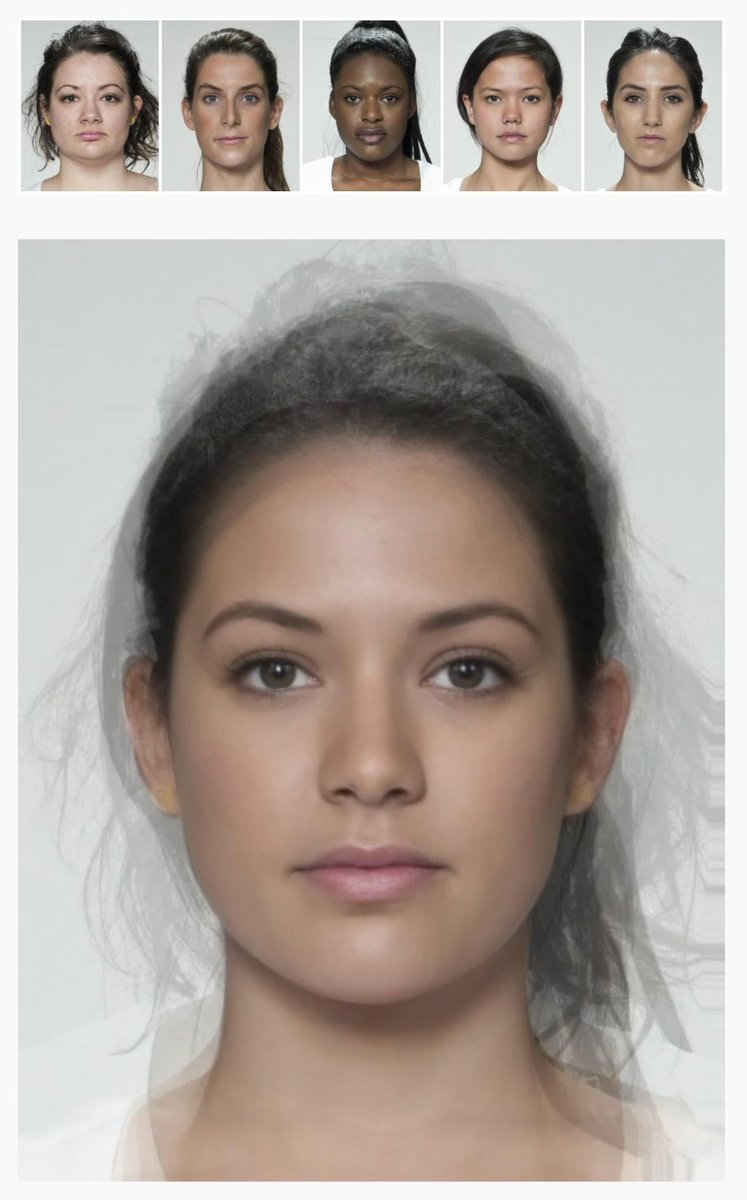
There’s a well-known phenomenon in the facial aesthetics literature whereby “average faces” (that is, faces formed by superimposing many faces atop one another) tend to be more attractive than the average person.
This may be counterintuitive, but it makes sense when you consider the following: Individual faces are all slightly flawed, from a beauty perspective, in idiosyncratic ways. And when you average lots of faces, you average out all of these minor issues. So, an “average face” is errorless and looks quite pleasant as a result.
However, another thing you’ll notice about these “average faces” is that none of them could be models. They’re more attractive than the average human, yes, but less attractive than the most attractive humans.
This is because extremely attractive faces tend to have certain features that are, mathematically, extreme. (For example, male models tend to have lower-set brows and larger jawbones than you would see in any average face.)
Recently, I have begun to wonder if LLM-writing faces a similar challenge. It’s always “more attractive than average,” because all of the flaws of normal human writing have been averaged out. But it's also missing the unusual taste and style of the best human writers I've read. In my experience, it's only ever 85%-good; like an "average face," it's never flawed, but equally, it's never exceptionally beautiful.
Wait, so the founder of Anthropic is "Amodei," as in "loves god"?
And he leads Anthropic, meaning "human-centered," which is being used in military strikes?
And the creator of ChatGPT is "Altman," as in "an alternative to humans"?
And he leads OpenAI, which is completely closed?
And then there's "Gemini," meaning "two-faced," from a company that promised to do no evil?
And the whole global AI arms race is being driven by people who claimed to be worried about AGI taking over the world?
Either the universe is an extremely cliché writer, or has a brilliant sense of humor
🦔 Michael Wooldridge, professor of AI at Oxford, is warning that the race to market AI has raised the risk of a "Hindenburg moment" that could shatter global confidence in the technology. He's delivering the Royal Society's Michael Faraday prize lecture Wednesday titled "This is not the AI we were promised."
His concern is that commercial pressure is pushing companies to release AI tools before their capabilities and flaws are fully understood. The scenarios he imagines include a deadly software update for self-driving cars, an AI-powered hack that grounds global airlines, or a major company collapsing because AI did something catastrophically stupid. "These are very, very plausible scenarios," he said.
Wooldridge's deeper point is about the gap between what researchers expected and what we got. Many anticipated AI that computed sound, complete solutions. Instead, large language models predict the next word based on probability, leading to systems that are incredibly effective at some tasks and terrible at others, with no way to know which is which. They fail unpredictably and have no idea when they're wrong, but are designed to sound confident regardless.
My Take
The Hindenburg comparison is striking because that disaster didn't just kill 36 people. It killed an entire technology. Airships were dead from that point forward. Wooldridge is suggesting AI could face something similar if a high-profile failure hits the right sector at the right moment.
What resonates with me is his point about unpredictable failure modes. These systems don't know when they're wrong, but they're designed to never sound uncertain. That's a dangerous combination when you're deploying them into cars, airlines, and financial systems. One quote stuck with me. He said maybe we need AIs that talk like the Star Trek computer, telling you when there's insufficient data to answer instead of confidently making something up. We got the opposite. We got systems optimized to sound authoritative whether they know anything or not.
Hedgie🤗