@figgy1million WWF too. It helps with fundraising to stoke outrage, however tenuous the basis. And thereby, Greenpeace and its ilk are among the most environmentally-harmful organizations. First with their opposition to nuclear energy, and now, deep seabed mining
$TMC Greenpeace has become a professional outrage machine masquerading as an environmental charity. The organization raises money by promoting fear, resisting innovation, and opposing technologies that challenge its narrative. In the case of deep sea mining, its absolutist stance risks locking the world into continued dependence on environmentally destructive land mining while protecting entrenched interests that benefit from the status quo. When billions of dollars in donations and influence are on the line, it's reasonable to question whether Greenpeace is defending the planet or defending its own business model.
Happy #Juneteenth. A timely reminder that while @Greenpeace vilifies $TMC @themetalsco, they stay silent on China’s brutal child slavery in the DRC for #cobalt. Seafloor nodules aren't only cleaner than land mining - #DSM delivers a critical supply chain free of human suffering.
🌊Good update on the critical metals resting on the deep seabed
TLDR; “Who extracts these minerals will determine more about the next century than most of the decisions being made in Washington… The floor of the Pacific is the last great untapped resource extraction prize on Earth.”
Excerpts: “The target for this mining is a 104.5 million acre stretch of seabed between Mexico and Hawaii known as the Clarion-Clipperton Zone (CCZ), where US Geological Survey estimates suggest deposits contain more nickel, cobalt, and manganese than all known worldwide land-based reserves combined. The full CCZ is estimated to contain up to 30 billion metric tons of nodules — a deposit, at current valuations, worth up to $18.4 trillion.
Critical minerals demand is accelerating beyond what the existing supply system was designed to handle. By 2035, EVs could account for as much as 70% of global new car sales. The critical minerals supply system has no plausible path to keeping pace.
In the US alone there are 570 gigawatts of battery storage projects waiting to be added to the grid. The International Energy Agency (IEA) has projected that demand for battery metals could grow by a factor of 30x by 2040 from 2024 levels.
Battery storage costs will fall another 35–55% by 2035. At that level, the economic case for new gas-fired power plants collapses because storage can undercut gas on price while performing the same grid-balancing function. But this plummeting cost curve assumes a steady flow of raw materials, an assumption that currently rests on shaky ground.
The biggest risk to this energy transition is a lack of mines. The IEA estimates the world needs 80 new copper mines, 70 new lithium mines, and 70 new nickel mines to meet projected demand. Historically new copper mines take 15-20 years or longer to come online. Closing this gap through conventional mining alone is functionally impossible.
The structural supply shortage of the materials we need to electrify our economies will redraw the map of global power. Instead of Saudi Arabia and other petrostates holding the world politically hostage, power could shift to what we might call electrostates that possess or control the critical minerals needed for electrification.
The largest electrostate is China. Chinese companies control significant shares of global cobalt and manganese extraction in Africa and elsewhere and have locked up supply through overseas mining investments as part of a deliberate industrial strategy. China is the dominant refiner for 19 of the 20 minerals analyzed in the IEA’s Global Critical Minerals Outlook 2025. The country manufactures more than 80% of the world’s finished batteries and controls over 98% of lithium iron phosphate battery cell production.
What [Metals Company CEO] Barron was offering President Trump, in his own words, was “an amazing way of catching up from what is a very distant second place to China when it comes to critical minerals.” Four days after that Oval Office meeting, Trump signed an executive order directing the US government to expedite seabed mining licenses in international waters...
Any environmental concerns must be balanced with the reality that open-pit mining is more ecologically destructive than the methods proposed by Western deep-sea mining companies; open-pit mining projects are mostly located in countries with weaker environmental protections than the international frameworks governing the CCZ. The relevant comparison here is between different forms of mineral extraction, because extraction is necessary and environmental costs can only be mitigated, not eliminated.
The Metals Company’s PATANIA III collector vehicle uses hydraulic suction to skim nodules from the seafloor rather than the bulldozing motion of earlier prototypes, reducing sediment disturbance by roughly 90%.
‘Copper is the new oil,’ according to Robert Friedland, a legendary mining industry figure and one of the first investors in Apple. Copper is why the economics of deep-sea mining are becoming newly compelling. Copper has no real substitute. It’s also embedded in virtually every system that carries an electrical current.
China reversed course on deep-sea mining, a position it had resisted for decades. Beijing’s calculation had changed because land-based mineral strategies in Africa were proving expensive, politically unstable, and increasingly exposed. China now holds more deep-sea exploration licenses than any other country and has built a large fleet of research and survey vessels operating across the Pacific and Indian Oceans.
The appeal of deep-sea mining to China, which prizes self-sufficiency above all else, is apparent. The ocean asks nothing of you. Unlike developing nations, the ocean won’t attempt to nationalize your assets or default on a loan or hold elections with unpredictable consequences for your investments.
In the March 2026 issue of Qiushi, the Chinese Communist Party’s top theoretical journal, an editorial declared 'The 21st century is the century of the ocean; whoever wins the ocean wins the future. China is one of the earliest nations in the world to develop and utilize the ocean ... We must deeply implement Xi Jinping’s vision to build a maritime power.'
If the Chinese pursue deep-sea mining as part of an integrated strategy to control the world’s oceans, the US must treat it as a mandatory theatre of competition. The Trump administration is pushing forward. NOAA and the Bureau of Ocean Management are accelerating permitting. In late March, the US and Japan signed a memorandum of cooperation to jointly advance deep-sea mining.
Who extracts these minerals, and under what legal framework, will determine more about the next century than most of the decisions being made in Washington right now. A CCZ developed under American legal frameworks produces a different world than one developed under Chinese state direction, with output flowing into Chinese refineries, Chinese battery factories, and Chinese defense supply chains.
The floor of the Pacific is the last great untapped resource extraction prize on Earth.”
— From: https://t.co/y6xOIJ7Hw5 $TMC
Prime Minister Carney secures new partnerships in defence and critical minerals at the 2026 G7 Leaders’ Summit
https://t.co/b3C31Wu7ci
"Japanese company Sumitomo Corporation will partner with Canada’s Ucore Rare Metals Inc. to supply rare earths for magnet makers across Japan and North America."
We have begun publicly sharing many of the key findings of our Environmental Impact Assessment. Learn more about our understanding of the validated environmental impacts of test mining and expected impacts of commercial-scale operations in this summary.
https://t.co/qhFVSBOg06 $TMC #deepseamining
China's rare earth export controls are driving prices sharply higher:
Yttrium, used in defense, aerospace, and chipmaking, has skyrocketed +14,000% since April 2025, to ~$1,100 per kilogram.
Terbium, used in permanent magnets for electric vehicles and wind turbines, has surged +350% over the same period, to ~$4,500 per kilogram.
Dysprosium, used to strengthen magnets in electric motors and defense systems, has risen +450%, to ~$1,450 per kilogram.
The surge has been fueled by China's export licensing requirements imposed on April 4th, 2025, covering 7 rare earth elements, including terbium, dysprosium, and yttrium, in retaliation for President Trump's tariff increases.
As a result, exports of yttrium, dysprosium, and terbium are down -50%, -60%, and -50% respectively since April 2025, compared to the 12 months before the controls.
China’s export controls are holding back some key rare earths.
On this D-Day anniversary, we honor the brave souls who stormed the beaches of Normandy - a powerful reminder that freedom is never free, and America’s greatest gift to the world has always been the ideal that it’s worth fighting for. 🇺🇸 #DDay#NeverForget
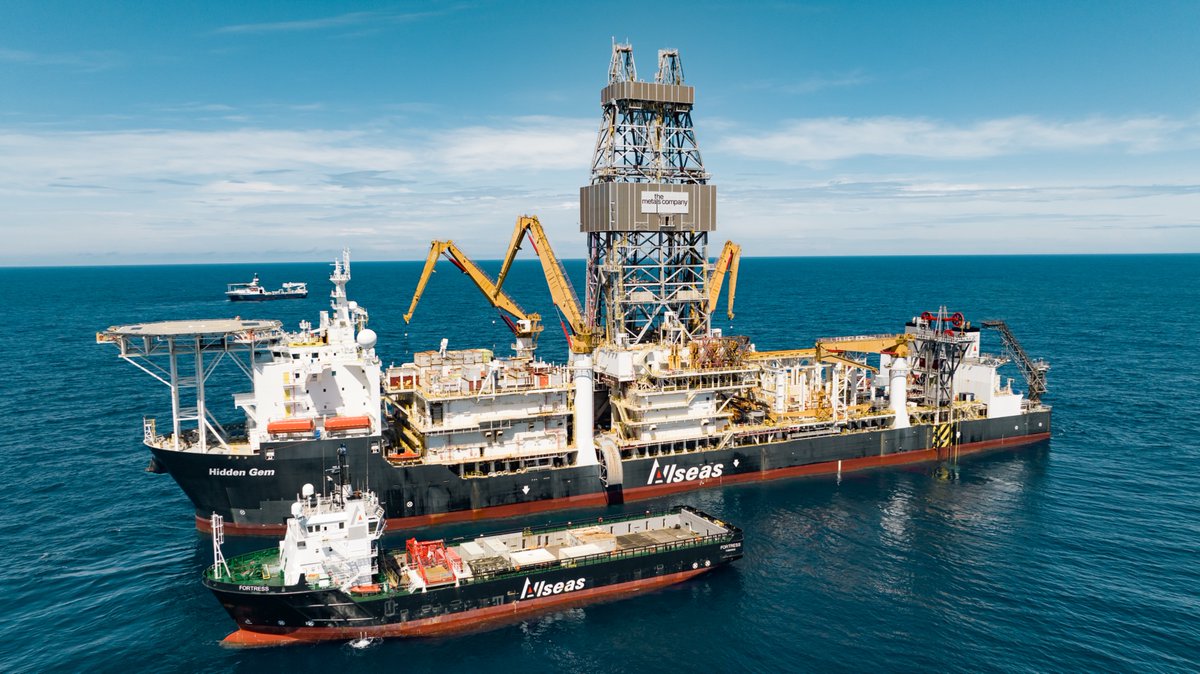
TMC and Allseas Sign Commercial Agreement for the First Offshore Nodule Recovery Operation.
Read the press release: https://t.co/JCvS6zjRlf $TMC #deepseamining
@brian_armstrong Hardly an excuse. The @BitMEX exchange is fully resilient to AWS AZ failures - and our industry-leading p99 trading latency demonstrates neither quality of service neither our traders need to bear that compromise.
If you’re a serious trader, you need @BitMEX.
@brian_armstrong Hardly an excuse. The @BitMEX exchange is fully resilient to AWS AZ failures - and our industry-leading p99 trading latency demonstrates neither quality of service neither our traders need to bear that compromise.
If you’re a serious trader, you need @BitMEX.
This determination marks an important step forward in NOAA’s transparent, rules-based process, and brings us ever closer to providing the U.S. with a new, abundant and lower-impact source of critical metals
AI doesn’t just run on code, it runs on copper.
Data centers, chips, cooling systems and power lines all depend on it.
Natural Resources Republicans are working to secure a reliable domestic supply to unleash innovation and reduce reliance on foreign adversaries like China.
NOAA Determines TMC USA’s Consolidated Deep-Seabed Mining Application is in Full Compliance.
Read the press release: https://t.co/qOPQfoEDsF $TMC #deepseamining





![FutureJurvetson's tweet photo. 🌊Good update on the critical metals resting on the deep seabed
TLDR; “Who extracts these minerals will determine more about the next century than most of the decisions being made in Washington… The floor of the Pacific is the last great untapped resource extraction prize on Earth.”
Excerpts: “The target for this mining is a 104.5 million acre stretch of seabed between Mexico and Hawaii known as the Clarion-Clipperton Zone (CCZ), where US Geological Survey estimates suggest deposits contain more nickel, cobalt, and manganese than all known worldwide land-based reserves combined. The full CCZ is estimated to contain up to 30 billion metric tons of nodules — a deposit, at current valuations, worth up to $18.4 trillion.
Critical minerals demand is accelerating beyond what the existing supply system was designed to handle. By 2035, EVs could account for as much as 70% of global new car sales. The critical minerals supply system has no plausible path to keeping pace.
In the US alone there are 570 gigawatts of battery storage projects waiting to be added to the grid. The International Energy Agency (IEA) has projected that demand for battery metals could grow by a factor of 30x by 2040 from 2024 levels.
Battery storage costs will fall another 35–55% by 2035. At that level, the economic case for new gas-fired power plants collapses because storage can undercut gas on price while performing the same grid-balancing function. But this plummeting cost curve assumes a steady flow of raw materials, an assumption that currently rests on shaky ground.
The biggest risk to this energy transition is a lack of mines. The IEA estimates the world needs 80 new copper mines, 70 new lithium mines, and 70 new nickel mines to meet projected demand. Historically new copper mines take 15-20 years or longer to come online. Closing this gap through conventional mining alone is functionally impossible.
The structural supply shortage of the materials we need to electrify our economies will redraw the map of global power. Instead of Saudi Arabia and other petrostates holding the world politically hostage, power could shift to what we might call electrostates that possess or control the critical minerals needed for electrification.
The largest electrostate is China. Chinese companies control significant shares of global cobalt and manganese extraction in Africa and elsewhere and have locked up supply through overseas mining investments as part of a deliberate industrial strategy. China is the dominant refiner for 19 of the 20 minerals analyzed in the IEA’s Global Critical Minerals Outlook 2025. The country manufactures more than 80% of the world’s finished batteries and controls over 98% of lithium iron phosphate battery cell production.
What [Metals Company CEO] Barron was offering President Trump, in his own words, was “an amazing way of catching up from what is a very distant second place to China when it comes to critical minerals.” Four days after that Oval Office meeting, Trump signed an executive order directing the US government to expedite seabed mining licenses in international waters...
Any environmental concerns must be balanced with the reality that open-pit mining is more ecologically destructive than the methods proposed by Western deep-sea mining companies; open-pit mining projects are mostly located in countries with weaker environmental protections than the international frameworks governing the CCZ. The relevant comparison here is between different forms of mineral extraction, because extraction is necessary and environmental costs can only be mitigated, not eliminated.
The Metals Company’s PATANIA III collector vehicle uses hydraulic suction to skim nodules from the seafloor rather than the bulldozing motion of earlier prototypes, reducing sediment disturbance by roughly 90%.
‘Copper is the new oil,’ according to Robert Friedland, a legendary mining industry figure and one of the first investors in Apple. Copper is why the economics of deep-sea mining are becoming newly compelling. Copper has no real substitute. It’s also embedded in virtually every system that carries an electrical current.
China reversed course on deep-sea mining, a position it had resisted for decades. Beijing’s calculation had changed because land-based mineral strategies in Africa were proving expensive, politically unstable, and increasingly exposed. China now holds more deep-sea exploration licenses than any other country and has built a large fleet of research and survey vessels operating across the Pacific and Indian Oceans.
The appeal of deep-sea mining to China, which prizes self-sufficiency above all else, is apparent. The ocean asks nothing of you. Unlike developing nations, the ocean won’t attempt to nationalize your assets or default on a loan or hold elections with unpredictable consequences for your investments.
In the March 2026 issue of Qiushi, the Chinese Communist Party’s top theoretical journal, an editorial declared 'The 21st century is the century of the ocean; whoever wins the ocean wins the future. China is one of the earliest nations in the world to develop and utilize the ocean ... We must deeply implement Xi Jinping’s vision to build a maritime power.'
If the Chinese pursue deep-sea mining as part of an integrated strategy to control the world’s oceans, the US must treat it as a mandatory theatre of competition. The Trump administration is pushing forward. NOAA and the Bureau of Ocean Management are accelerating permitting. In late March, the US and Japan signed a memorandum of cooperation to jointly advance deep-sea mining.
Who extracts these minerals, and under what legal framework, will determine more about the next century than most of the decisions being made in Washington right now. A CCZ developed under American legal frameworks produces a different world than one developed under Chinese state direction, with output flowing into Chinese refineries, Chinese battery factories, and Chinese defense supply chains.
The floor of the Pacific is the last great untapped resource extraction prize on Earth.”
— From: https://t.co/y6xOIJ7Hw5 $TMC](https://pbs.twimg.com/media/HLCUo5iXgAACKNm.jpg)