Hello, we are Jonathan and Abigail - unashamed pedants who want to bring this affliction to bear on all things public policy and practice.
We believe that details matter, especially in public administration. This is why today we are founding quibble: a campaign to fix the small stuff.
Think, for example, about the cookie banner that we click on every webpage. Each instance is not a big deal, so we just put up with it. But its cumulative impact adds up - on average we press it 5 times per day. The European Commission estimates that it costs EU citizens 343 million hours per year.
And who is there to represent the impacts of seemingly minor issues like this in a systematic way? We want quibble to be the answer. In the case of the cookie banner, lots of advocacy has rightly focused on privacy, but has this meant that user experience has taken a backseat? We believe there are ways to improve user experience without compromising on privacy. We will share more about this soon.
Consider another example. Did you know that in some government-run car parks you can be fined for a minor keying error, such as accidentally typing a zero instead of an “o”? Again, we will come to the detail of this quibble in the coming weeks, but for now just consider again the question: who? Who is there currently to systematically represent the interests of the parker who is given an unfair ticket?
An inherent feature of consumer interests is that those who have them rarely have enough other things in common to make collective organisation and representation feasible. This is the gap that quibble seeks to fill. Now of course excellent consumer interest groups exist. But understandably quibbles might not be at the top of their lists. Our hope is that quibble will be complementary; picking up the bottom-of-the-list issues faced by various groups - the stuff they are almost too embarrassed to raise because they are too small.
We are not embarrassed about detail. If you’ve ever had a splinter, you know small things can have a big impact. This is what quibble is committed to tackling, and our wider hope is that by doing so we will also incentivise policy makers to be even more careful about detail.
Check out our website here, including our first four campaigns: https://t.co/gZiqqHbhIL
A story about service stations, but it’s really about why mundane infrastructure matters and why great people make a difference. Congratulations to Hartshead Moor East and @ImogenWK for making me feel optimistic. Also about toilets. Got it all.
My long read on Britain’s worst service station is out in the Guardian today. I began working on it in 2023. Please read to discover how on earth this can have taken three years lmao https://t.co/dftHudDuxp
A really helpful image showing one of the reasons we received so many quibbles about Puffin pedestrian crossings.
Having communicated with a manufacturer of these types of signals, and having read some of the government's guidance on their proper installment and use, here is the explanation we have received (...you can decide how reassuring it is from the user's perspective):
A green signal on the near-side is an invitation to begin crossing. Once this invitation period has ended, the crossing does not simply assume that everybody has reached the opposite kerb, as on-crossing detection is used to monitor speed. In other words, so long as you start crossing when the signal was green (based on your near-side signal), you should not need to worry that the traffic might begin while you are still crossing the road, and therefore you do not need to be able to see a signal while you are crossing.
However, it is easy to see why it might still feel disconcerting for the user - being halfway across a wide crossing like the one below, and not being able to see any signal in the process...
🚗🅿️ Why should the rules set out in the new (and rightly lauded) Private Parking Code of Practice not also apply in local authority car parks and on-street parking? Since it's been decided that a fine should not be issued for a minor keying error by private car park operators, surely that principle should also apply to local authorities.
Having written to the Department for Transport about this we were informed that there are currently no plans to amend the Statutory Guidance for Local Authorities on the Civil Enforcement of Parking Contraventions, which would provide equivalent nation-wide protections.
We have therefore now addressed an open letter to the Minister @justinmadders to request action on this - an open goal to extend the good work that's already been done! 🙂
Yes - but it's not just private car parks. We have received testimonies from several who have faced fines for minor keying errors in local authority car parks, too.
See this example from Ealing council: https://t.co/puARcIc1M3
And the rules announced today do not apply to local authority car parks. We need local authorities to commit to waiving these fines. In the meantime, we are pushing DfT for clearer statutory guidance.
A couple have admitted they have a "slightly weird hobby": cleaning road signs across Sussex and filming the job for their social media followers.
More here: https://t.co/4pbtaCNX3h
🧵On discussion about whether government’s focus on small fixes and ‘breathing space’ is the right one. Our polling with @UCLPolicyLab found that Britons lean toward smaller, tangible things they can see sooner, but some risks the government are seen to duck the tough stuff.
Five more everyday fixes for you, Andy:
1. Red ends on Sellotape so we can find them.
2. Biscuits that survive being dunked.
3. Fitted sheets with THIS WAY UP printed on them.
4. Bins that put themselves out.
5. A smoke alarm that recognises toast.
Britain rebuilt. You’re welcome.
Yes - but it's not just private car parks. We have received testimonies from several who have faced fines for minor keying errors in local authority car parks, too.
See this example from Ealing council: https://t.co/puARcIc1M3
And the rules announced today do not apply to local authority car parks. We need local authorities to commit to waiving these fines. In the meantime, we are pushing DfT for clearer statutory guidance.
I know so many people are frustrated at the unfairness of private car park operators.
I’ve experienced, like others, eye watering fines for just forgetting my parking permit. Now capped at £20, a small mistake won’t end up costing a fortune.
This is a government that listens.
@josephkazUK The fine would only be waived where the reason for it was the keying error. (And only minor keying errors are covered (zero for O, 1 for I etc)).
https://t.co/6f2QT19o7C).
The full text of the Code of Practice has now been published, and it does indeed clarify that a fine for a minor keying error should be cancelled. We're counting this as a win.🎉😃
(Now for local authority car parks, too...!)
The full text of the Code of Practice has now been published, and it does indeed clarify that a fine for a minor keying error should be cancelled. We're counting this as a win.🎉😃
(Now for local authority car parks, too...!)
The full text of the Code of Practice has now been published, and it does indeed clarify that a fine for a minor keying error should be cancelled. We're counting this as a win.🎉😃
(Now for local authority car parks, too...!)
🅿️🚗Waiving fines for minor licence plate keying errors is something we've been campaigning on for months. We've been expecting this announcement, and we're really pleased to see it. 🎉
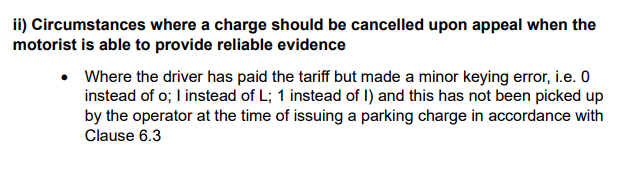
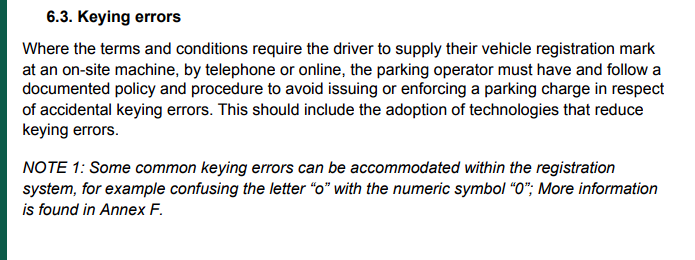
However, as always, the details will really matter. 🔎 One that will be important is that minor keying errors (e.g. typing a 1 instead of an I, or a zero instead of an O), are included in the "honest mistakes" category, that therefore leads to a complete cancellation of the charge. The government's press release currently lists "entering the wrong vehicles registration" as within the category of errors that should lead to a maximum £20 penalty. Although that may be reasonable for major keying errors, minor ones should be completely waived, as is actually already standard in the "Private parking sector single Code of Practice" (see image). (Despite this Code already being in place, it has not always been applied by private car parks (https://t.co/1MpLqttlHa), so these rules should help enforcement - that's why quibblers should celebrate today!)
But since this Code of Practice already exists for private car parks, we have been pushing for the same standards to be set for local authority car parks, because these have also been guilty of issuing unfair fines: https://t.co/puARcIc1M3.
While DfT does have statutory guidance that authorities should act "fairly and proportionately" and to exercise their discretion "sensibly and reasonably" there are clearly gaps in application of this principle when it comes to minor keying errors. We have therefore been asking DfT to improve their statutory guidance to local authorities in this area. Unfortunately, they have told us that there are currently no plans to do this.
This means we have a situation where the government is applying one principle across the private parking sector (correctly) but not ensuring that the same principle is applied to government / local authority car parks.
So today we'll celebrate a little; tomorrow our work continues...!
🚨 NEW: Andy Burnham has announced changes to car parking fines
- Drivers will have a 5-minute grace period to decide whether to park and 10 minutes to leave after a parking session ends
- A £20 maximum charge on appeal for minor mistakes, such as entering the wrong number plate or not displaying a permit
- Charges will also be cancelled on appeal for breakdowns, medical emergencies or broken ticket machines
- The £100 cap on charges will remain
- The rules will come into force as soon as possible and operators that break them will lose access to DVLA data
@robfordmancs Yes, but not only private companies - some local authorities have been issuing and pursuing unfair fines, too.
https://t.co/Oxe0mDGU2q
And local authorities aren’t included in the scope of these rules - so more work to be done…