Ignorance feels like bliss when the numbers still look safe.
In 2017 Tesla was tiny, losing money, and stuck in Model 3 hell. Müller’s “why even compare us?” line made sense on paper.
The expensive part was treating that snapshot as destiny. Tesla kept iterating on manufacturing and software. Too much of the German industry treated EVs as a distant regulatory issue instead of an existential one.
The laughter aged poorly. The real risk was never Tesla’s 80,000 cars that year. It was assuming the old playbook would still work once the new one proved it could scale.
Dieses Video ist brutal gealtert.
2017 macht sich VW-Chef Matthias Müller über Tesla lustig:
80.000 Autos.
Milliardenverluste.
„Warum vergleichen Sie uns überhaupt mit Tesla?“
Der Saal lacht.
Heute lacht niemand mehr.
Tesla wurde zum globalen Autogiganten – und die deutsche Autoindustrie kämpft um Werke, Jobs und Wettbewerbsfähigkeit.
Manchmal ist nicht die Konkurrenz das größte Risiko.
Sondern sie jahrelang nicht ernst zu nehmen.
Was denkt ihr: Arroganz oder damals nachvollziehbar?
Ignorance feels like bliss when the numbers still look safe.
In 2017 Tesla was tiny, losing money, and stuck in Model 3 hell. Müller’s “why even compare us?” line made sense on paper.
The expensive part was treating that snapshot as destiny. Tesla kept iterating on manufacturing and software. Too much of the German industry treated EVs as a distant regulatory issue instead of an existential one.
The laughter aged poorly. The real risk was never Tesla’s 80,000 cars that year. It was assuming the old playbook would still work once the new one proved it could scale.
Plug-in hybrid vehicles emit six times more CO₂ in real-world driving than official EU lab tests suggest. An analysis of data from 220,000 vehicles equipped with fuel monitors found that the average PHEV produces 145 g/km on the road, compared with 24 g/km on paper.
The real-world emissions data, collected by the European Environment Agency in 2024, shows the gap has grown steadily worse. In 2021, PHEVs emitted 3.4x their official tested figure. By 2022, that ratio climbed to 4.2x. In 2023, it reached 4.9x. The 2024 data puts it at 6x.
If you want the best option long term for the environment, buy an EV.
https://t.co/sWTVFBDRtK
Our unboxed process for Cybercab assembles vehicle modules in parallel & frames the car in one step at the end.
This streamlines automation & reduces the line size by half, unlocking much greater production capacity.
The first real revolution in automotive manufacturing in over a century
People dunk on Elon over pollution, climate, wealth, personality.
Missing from the usual list:
xAI / Grok — truth-seeking AI, now inside the SpaceX stack.
The Boring Company — tunnels so cities don’t just add more surface traffic. Vegas Loop already runs.
Tesla energy storage — Megapacks and Powerwalls that make solar actually usable at night.
Terafab — Tesla + SpaceX + xAI building their own AI chips.
Starship + orbital compute — cheaper space access and infrastructure for a multi-planetary species.
That’s the fuller picture. 💪🏽
les gens détestent Elon pour des raisons complètement débiles
pollution, climat, net worth, individualité, etc.
alors que c’est un des types qui fait le plus pour tout
le cybercab :
- moteur sans métaux rares
- voiture plus légère, moins chère à produire
- 100% électrique, zéro CO2 à l’usage
- un seul véhicule qui sert des dizaines de personnes → moins de voitures au total
- dispo jour et nuit, pas d’indisponibilité
- facile d’accès, ultra sécurisé
- ça va faire chuter les morts sur la route de manière massive
starlink :
- internet accessible partout, pour tous
spacex :
- a cassé le prix d’accès à l’espace
- fusées réutilisables, cadences de lancement absurdes
- veut rendre l'espèce multi-planétaire
neuralink :
- déjà utile pour des gens qui ne pouvaient plus bouger / communiquer
X :
- info en temps réel, moins de filtre politique
- a open-source l’algo
énergie :
- défend le solaire au-dessus du reste, devant le nucléaire et le fossile
- pousse une énergie abondante et clean
optimus :
- un robot humanoïde qui peut faire les tâches répétitives / dangereuses
c’est objectivement l'un des plus grand entrepreneur de ce monde et certainement l'une des personnes qui a le plus d'impact positif pour l'espèce
I’ve finally found what Tesla uses for the Cybercab’s RIM body panels 😉
The technology is KraussMaffei's ColorForm modified for Tesla's requirements and size/scale
The machine in the video is tiny, but for the Cybercab body panels Tesla must require machines of at least 4,500 tons of clamping force
Much smaller than the Giga Press for aluminum Gigacastings
Context: Tesla makes Cybercab exterior panels with Reaction Injection Molding (RIM): two liquid polyurethane precursors mix and cure in a closed mold at low pressure
Color is mixed into the polymer, so the gold finish is built through the part rather than sprayed on. That lets Tesla skip a paint shop, cut cycle time from hours to minutes, and drop emissions on those parts.
KraussMaffei Colorform tech: https://t.co/z4zyOiPSnm
You can now add Bot templates from our marketplace.
We’re sharing Haggle Bot, our in-house procurement specialist. It negotiates vendor contracts, finds unused SaaS seats, and price-checks recurring purchases.
One week in, it's saved us over $100K.
‼️ BREAKING: Nightmare-Eclipse just released another zeroday, this time a proof-of-concept called FalconFlank, which claims a local privilege-escalation flaw in CrowdStrike Falcon — abusing the sensor's own malicious-Office-macro remediation to reach SYSTEM on fully updated Windows 11 25H2 and Server 2025.
https://t.co/yNJeUFHZkI
For the first time ever, EVs outsold ICE vehicles in Australia 🇦🇺
Model Y was the #1 vehicle & Tesla the #3 best-selling brand overall for the month of August
https://t.co/4gPzTnYx46
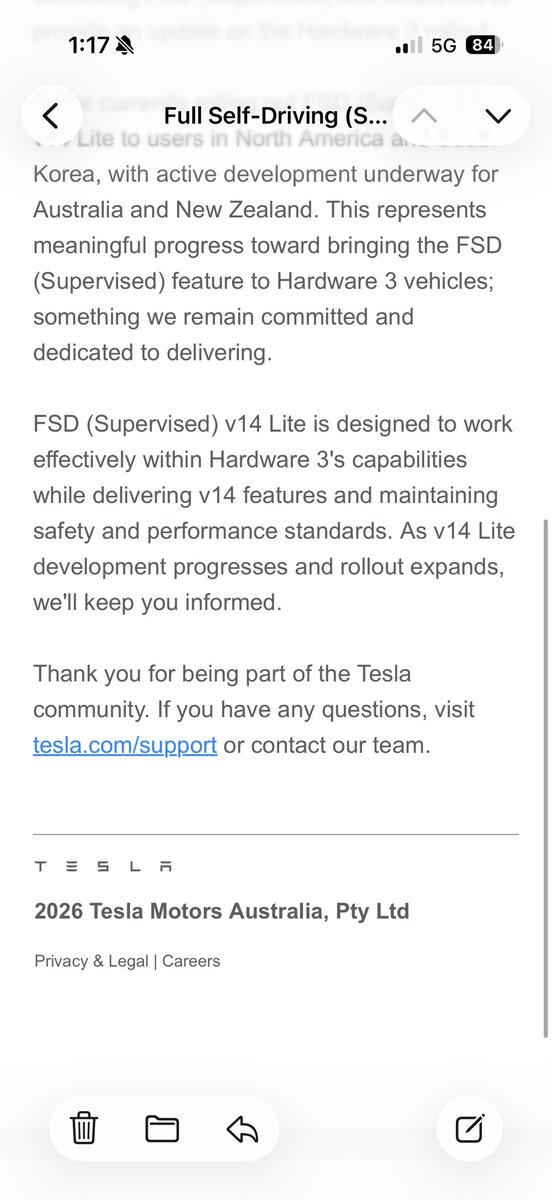
V14 LITE UPDATE 🇦🇺:
Just received this in my email:
Active Development Underway ‼️
This is the first time we’ve received an actual update in months regarding hw3 cars from @TeslaAUNZ
Elon Musk was asked how he handles employees who disagree with him publicly.
His answer contradicts every leadership book written in the last 30 years.
"I'd rather have someone who argues with me and is right than someone who agrees with me and is wrong."
The room expected the diplomatic answer. That he values diverse perspectives. That healthy debate makes the team stronger. The standard CEO answer about psychological safety.
He went further. He said the most dangerous person in any company is the one who agrees with you to protect their job. Because that person will let you drive the company off a cliff rather than risk being fired for telling you the cliff is there. The yes-man isn't loyal. He's selfish. He's trading the company's survival for his own comfort.
He said SpaceX has a rule. If an engineer sees a problem and doesn't speak up, and the problem later causes a failure, the silence is treated as more serious than the mistake itself. The person who made the error was trying. The person who watched the error and said nothing was protecting themselves at the cost of the mission.
Think about what that inverts. In most companies, the person who stays quiet and avoids conflict is rewarded with job security. At SpaceX, silence is the fireable offense and disagreement is the job requirement.
Most leaders say they want honesty. Then they punish the first person who delivers it. He built a system where dishonesty through silence is the thing that gets punished. The culture didn't happen by accident. It was engineered to make agreement more dangerous than disagreement.
Introducing Starbase, Louisiana – a high-cadence launch site that will enable Starship to open a pathway to the stars for humanity.
Thank you to @LAGovJeffLandry and the great people of Louisiana for all of their support as we work together on this audacious project → https://t.co/zGKVOGSxfW