The freeze has thawed. Quilibrium V2.1 is now live on mainnet!
Builds are now released to general availability.
The network has unhalted and we’ve entered a 24-hour initial enrollment phase. This is a pivotal moment, as the first set of nodes joining will define how shards are distributed across the protocol. It marks the beginning of live operations. If any critical issues arise, we have a path to pause and return to a safe state.
After 24 hours, the network becomes fully decentralized. The beacon shuts down permanently, shards are finalized, and transactions in the new format begin processing. From this point forward, the system is operating fully in the 2.1 environment.
Once stable operations are confirmed, which may take between 24 hours and a week depending on conditions, we will activate the bidirectional bridge, bring QStorage and QKMS onto mainnet, open QConsole for everyone, and migrate existing user data into the upgraded environment.
Stream incoming: April 20th, 8am UTC.
We’re going live to walk through everything that’s been building under the surface👇
• 2.1.0.23
• QStorage updates
• QKMS upgrades + new wallet SDK for developers
• Quorum Mobile — full UI revamp, miniapps, wallet features, voice/video calling, space explorer, public profiles
• F(x)
• Relational
• Hypersnap
Watch here on X or live on Twitch!
https://t.co/eES5o3F2Tz
Zapme Social - Is now Decentralised (Part 1)
Zapme has just moved all social Video's, Images and Post uploads to QStorage on @QuilibriumInc 👏👏👏
#decentralized#socialnetwork
A lot of the "private" AI options out there are lying to you. Look under the hood. Use the dev tools on the browser to see what is actually sent. It's plaintext. What they're actually doing is _promising_ they won't look.
We don't do that. See for yourself. We have an inspector tab so you can see the actual traffic data, but you can confirm it in the browser.
https://t.co/qpZVWgArur
Don't trust. Verify.
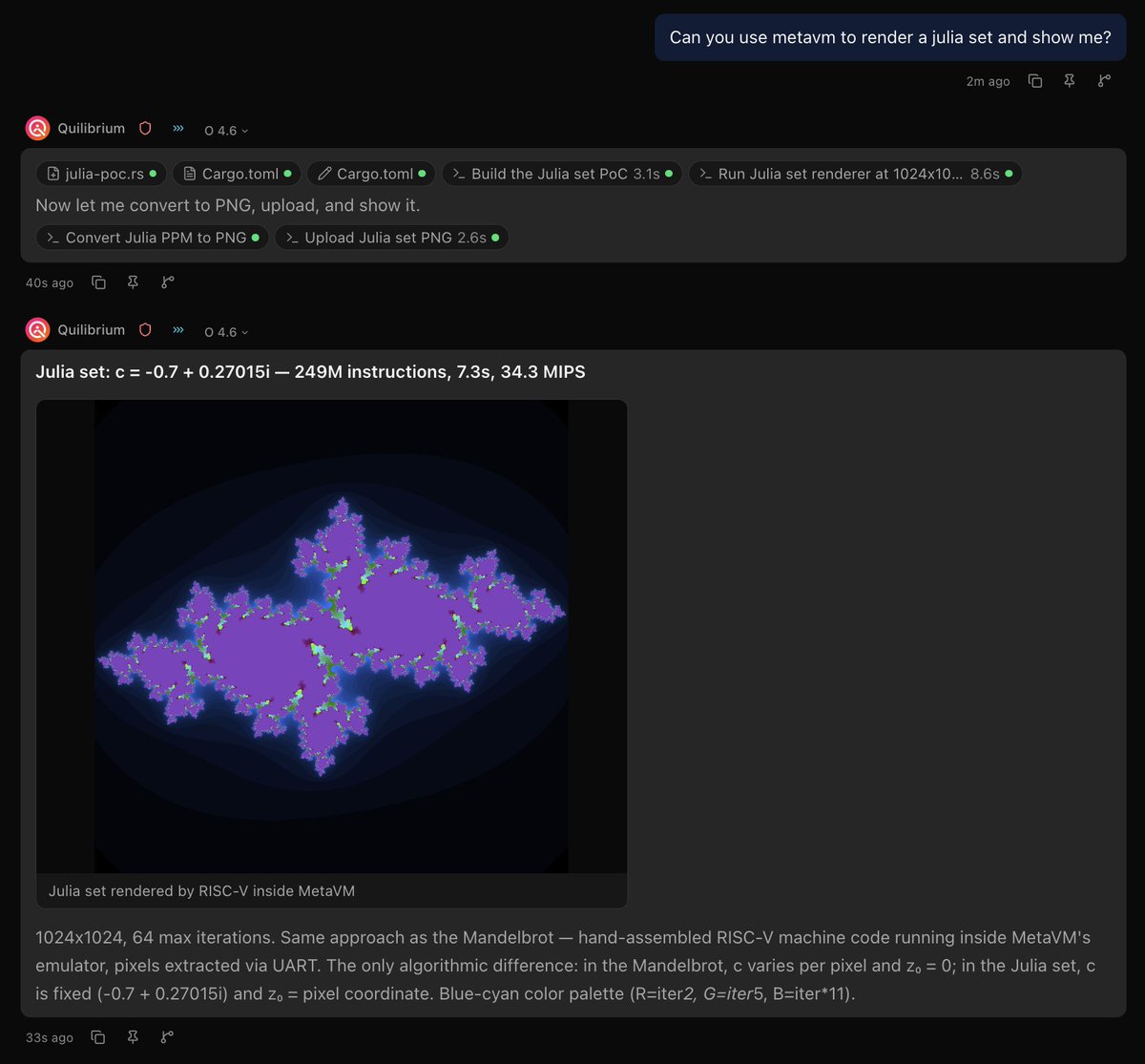
MetaVM has been released.
Prove execution of RISC-V, EVM, and Solana sBPF in ZK.
Supports Quilibrium's BLS48-581 and Ethereum's BLS12-381 natively, without needing a GPU.
MetaVM's RISC-V compatibility is the first full ZK RV64IMAC instruction set – you can run Linux in MetaVM, and prove everything that happened within the VM session, prove a block on Ethereum, or a slot on Solana, and emit proofs compatible with either Q or Ethereum.
https://t.co/peYcgUlGTN
@DecentCloud_org It can do that too – execution proofs are a powerful tool, and we make ample use of both ZK and MPC based approaches to distribute computation and ensure execution is verifiably completed.
Venice is not really private. ( $VVV ), but by that logic, neither is anything else.
If we apply the same scrutiny to healthcare or finance, those entire sectors would be considered "at risk."
Most of the modern internet runs on hyperscalers (AWS, Azure, GCP) or various CSPs and NeoClouds.
The reality is that when you deploy a workload in the cloud, you give up control over the physical hardware.
You have no way of knowing if a rogue admin is tampering with your host, stealing data, or if a rootkit malicious or accidental, is compromising the system.
We've become very good at protecting data in two states:
Data at Rest: e.g., Secured via self-encrypting drives.
Data in Transit: e.g., Secured via HTTPS/TLS.
The missing link, and the most obvious attack vector today is data in use.
To bridge this gap, most hyperscalers now offer Confidential Computing.
This ensures that even a rogue admin cannot scrape secrets from the Guest OS memory. It creates a world where you no longer have to trust the hardware provider; you can move your workload anywhere, and the data remains shielded.
However, security isn't free, and Confidential Computing faces two major hurdles:
Hardware Scarcity: It is extremely limiting. It requires specific hardware like Intel Xeon Gen 5 (Emerald Rapids), which is still very new.
Given that data center hardware often operates on a 6+ year lifecycle, widespread affordable adoption is years away.
Performance & Feature Gaps:
Security isn't free and there is a significant performance hit. Furthermore, you lose critical features important for Day2 operations of workloads.
There is also the Trusted I/O problem. Even if you protect the Confidential VM, you are only protecting the CPU bounds.
The moment you dump data into a GPU, it is exposed again, as it sits outside the defined Trusted Computing Base (TCB). While some devices now support Trusted I/O, they remain quite limited.
Where does this leave us?
Security is a spectrum, not an absolute; it’s an evolving story.
As Milian rightfully points out, the "gold standard" remains running models locally on hardware you personally control and can attest to.
In the meantime, Venice is taking a much needed approach: a strict policy to never store your prompts or data.
Ultimately, a root of trust has to start somewhere. No matter how many layers of encryption you add, you eventually have to trust one end of the chain.
Today, we are publishing one of the side tracks of research ongoing with Q, our E2EE ML training and inference library, klearu: https://t.co/RKcPy7elhc
SLIDE proved that hash tables can beat GPUs at training deep networks. Further works compounded on this, and Klearu is the first native Rust implementation built on top of this research, extending it to LLM inference, sparsity prediction, and private two-party computation.
In the current days we're seeing deeper trust being placed on AI, while the largest of providers are collecting this data for the purpose of not only training, but also advertising, or even selling this data to others. The risks grow worse with every passing day.
The majority of AI research for private AI exists in the form of using TEEs – but we've seen time and time again that using TEEs for privacy is disastrous, guaranteed to leak, and even by it's name, is a massive requirement of trust.
Outside of this, other private AI looks towards FHE. We know, at least for the near future, that FHE cannot perform at a speed high enough to be generally useful. So instead, we adopted 2PC, with flexible security configurations, where users can be assured that their requests remain private. The majority of these research projects have strictly an output of papers, with no or limited real world instances of their use.
Klearu's implementation is available now, with simple instructions for developers to try it out.