Your customers' data sits in your vendors' systems.
Under DPDP, that's still on you.
Open your top five vendor contracts. Look for security, breach notice, erasure on request.
If they're missing, that's your first fix. Not a policy page.
#DPDP#VendorRisk#Compliance
The demo is never the hard part. Knowing what the agent did last Tuesday at 3 AM, and why, is the hard part.
If you can't answer that, you don't have an agent. You have a risk.
#AIAgents#AIinProduction#OpsEngineering
Agents are great at the boring 80 percent. They are dangerous at the 20 percent nobody wrote down.
So every agent gets three things: a narrow job, full logs, and a human who signs off on anything irreversible.
Fragile systems rarely fail loudly.
They fail quietly. Your best engineer spends Friday night fixing a sync job. A report is wrong, so nobody trusts the next one.
That cost never shows on a P&L. It shows up in tired people.
#OpsEngineering#Reliability#Founders
Fragile systems rarely fail loudly.
They fail quietly. Your best engineer spends Friday night fixing a sync job. A report is wrong, so nobody trusts the next one.
That cost never shows on a P&L. It shows up in tired people.
#OpsEngineering#Reliability#Founders
Try this at your next leadership meeting. Mark each one covered, partial or missing. Be honest.
Seven months is enough time. It just isn't a lot of spare time.
#DPDP#DPDPRules#CXO
DPDP asks about ten things of your company by May 2027.
Most leaders I speak to can name two. Consent and privacy policy.
The other eight are where the work is. A short thread.
The way I group it, ten things: standalone notice, itemised consent, easy withdrawal, data inventory, provable erasure, 72-hour breach response, vendor contracts, children's data, grievance channel, tracking before consent.
I’ve spoken to founders across SaaS, healthcare, education and retail.
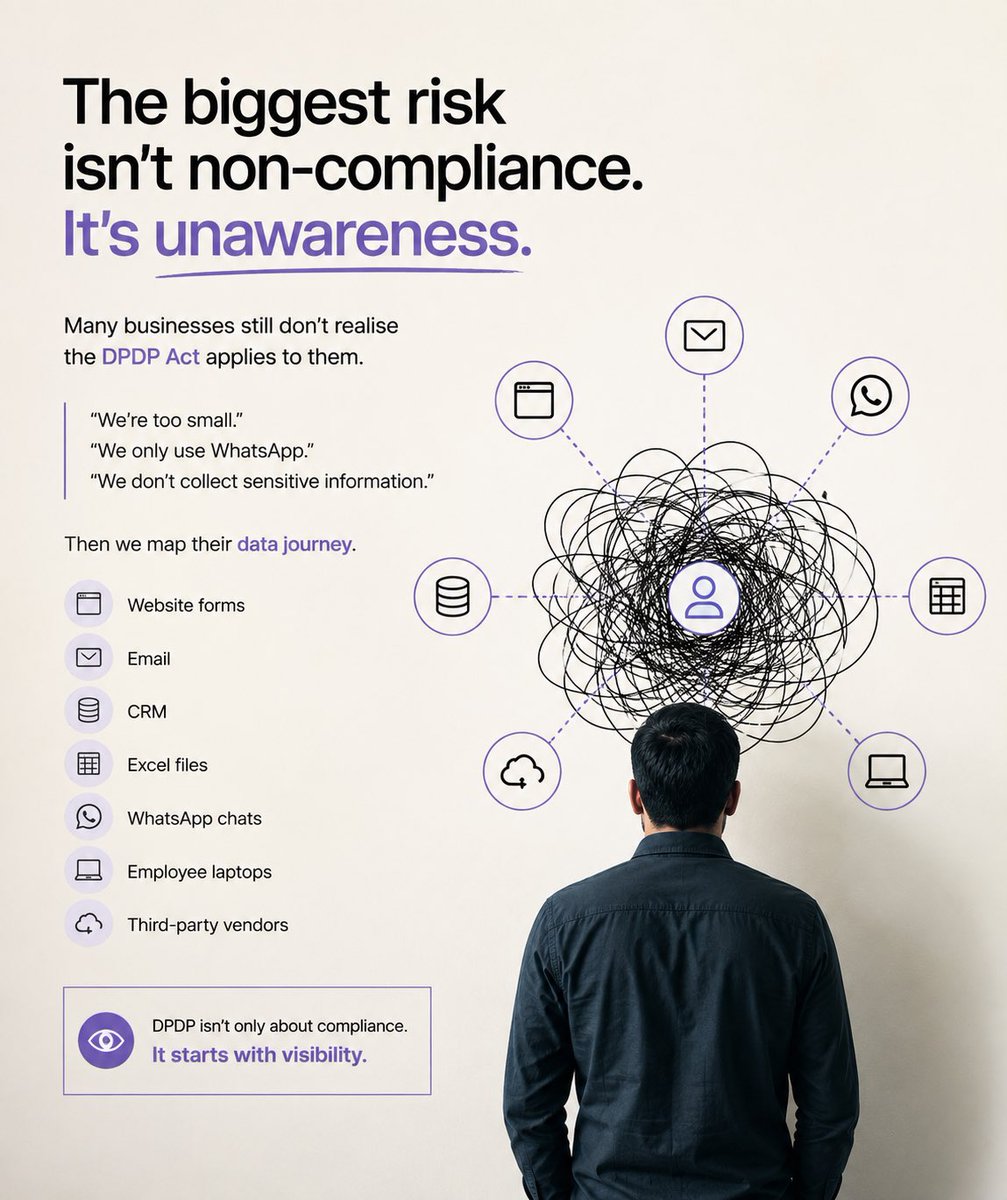
The biggest DPDP problem isn’t non-compliance.
It’s that many businesses still don’t realise the law applies to them.
Awareness comes before compliance.
Everyone is arguing about whether software jobs are dying.
I run a software studio, and I’m watching something quieter happen.
A high-paying technology job was never just one person’s income.
That salary paid the local café, the gym, the contractor, the accountant, the SaaS vendor—and, further down the chain, the software studio in another country building part of the product.
Economists call this the local multiplier effect.
So when technology jobs disappear, or when salaries and confidence become shaky, it is not only a tech-worker story.
It becomes a café story.
A freelancer story.
A small-agency story.
A delayed-invoice story.
And it does not stop at the border.
When budgets tighten in California, the impact does not remain in California.
It appears as a delayed invoice in Bengaluru.
A paused project in Milan.
A “let’s revisit this next quarter” in Dubai.
I’m not in the “tech is dead” camp. That argument is lazy, and the broader numbers do not support it.
But the middle is wobbling.
And the people who may feel it most are not always the ones appearing on layoff lists.
They are the people downstream—the businesses, workers, and studios whose livelihoods depended on spending and projects that quietly disappeared.
That impact has not been fully priced in yet.
#TechEconomy #FutureOfWork #SoftwareServices #GlobalEconomy
Test yours:
Paste your URL into Claude with:
"Evaluate this company for
[your target client's problem]"
Read what comes back.
The gaps it flags are your
priority list.
Full write-up on what we changed:
https://t.co/i6jvKCOmOi
Our llms.txt is public if you want
to see what one looks like:
https://t.co/R4ZempIfnG
Ran the evaluation again after.
Language shifted.
Right proof points surfaced.
Neither AI recommended against
a conversation.
The sites that win aren't the ones
with the best design.
They're the ones built to be read
by both humans and the AI your
prospect uses to vet you.
So we rebuilt the site around this.
→ Added llms.txt — a briefing document
written specifically for AI crawlers
→ Rewrote every case study to include
architecture decisions + rationale,
not just outcomes
→ Added JSON-LD structured data
→ Answered compliance questions
explicitly on the services page
Because AI evaluates differently
from humans.
Humans skim for brand signals.
AI extracts answers to specific questions:
→ What do they actually build?
→ Who have they delivered for?
→ How long have they been doing this?
→ Can they handle my compliance needs?
Vague language = vague summary.
Specific language = quoted accurately.
The gaps they flagged:
— Incorporated 2023, reads as young
— No architecture depth in case studies
— No explicit compliance answers
— No third-party reviews
Our website was accurate.
It just wasn't written for AI to extract
and relay to a prospect.
We pasted https://t.co/auoJWvXEo0 into Claude with:
"Is this company credible for a
multi-tenant fintech platform?"
Claude: "Legitimate. Worth a call —
with caveats."
GPT: "Medium-high risk without
third-party validation."
Both were technically correct.