#EmiliaClarke jokes that Jon Snow killing Daenerys in the #GameOfThrones finale still stings seven years later:
“Outside of the controversy around her actions, him killing me really bummed me out. Kinda rude!”
Watch the full video: https://t.co/Ih4zhDl1U6
PWEDE NAMAN PALA.
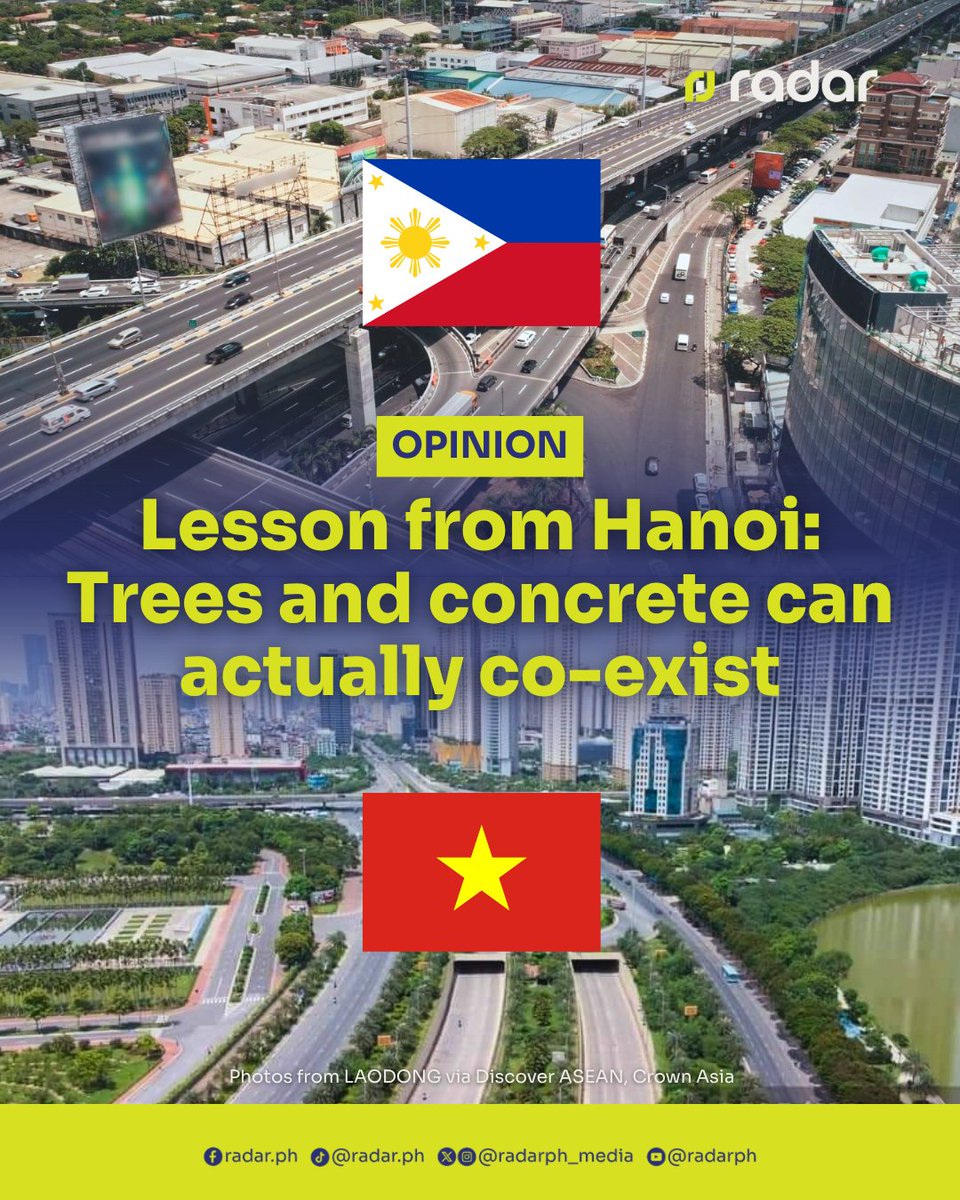
A viral social media contrast has been making the rounds, depicting Hanoi before and after planting 1.6 million trees. It is a stunning visual transformation—but more importantly, it shows that trees and concrete can co-exist in a third-world country.
Between 2016 and 2020, the program "One Million Trees" was rolled out and Hanoi smashed it two years ahead of schedule, ultimately planting over 1.6 million trees across the capital.
The success was so profound that it paved way into a nationwide "One Billion Trees" initiative running through 2025.
Hanoi's victory is a lesson in progressive urban development for the Philippines. Both are fast-growing Southeast Asian countries caught at the crossroads of rapid growth, dense populations, and extreme climate vulnerability. The difference is not in resources, but rather in political imagination.
While Manila allows the removal of mature tree canopies for expressways, Hanoi demonstrated that true 21st-century progress builds with nature, treating the urban canopy as critical public infrastructure.
So what can we learn from Hanoi’?
First, we need to move from seedling statistics to living canopies. The DENR allows developers to offset environmental damage by buying thousands of cheap seedlings, a numbers game that does nothing to cool a sweltering city. Hanoi turned down this lazy formula.
They planted mature, standard saplings that had been chosen for their ability to trap dust and absorb carbon dioxide. Vietnam's policy is that every tree must survive, and it supports it with budgets for years of rigorous post-care. We plant for the cameras and let saplings die in the sun. Hanoi plants to shield the public.
Second, Hanoi eliminated the fragmented planning that plagues our bureaucracy. In Manila, the DPWH builds a road, utility companies dig it up, and trees are felled because they are “in the way." Hanoi integrated its tree-planting directly into transport networks and underground utility blueprints. If an infrastructure design threatens the green grid, the blueprints are adjusted. In the Philippines, the living infrastructure is sacrificed to keep the concrete straight.
Third, Vietnam depoliticized its green spaces. Philippine urban forestry is a hostage to the three-year local election cycle. One mayor plants a pocket park; the next paves over it for a multipurpose gym bearing their name. Hanoi turned urban greening into a permanent civic duty, insulating it from political transitions and integrating it across schools, communities, and conglomerates.
We can no longer hide behind the developing nation moniker to justify the ecological vandalism of Metro Manila. Vietnam operates within our economic bracket, yet they chose to invest in a livable capital.
If we want to stop choking on our own progress, our national government must adopt Hanoi's playbook.
We must legislate a strict minimum canopy cover per capita for LGUs, making it a metric for the Seal of Good Local Governance. We must mandate "avoidance engineering" in public-private partnerships, forcing designers to map transport links around existing natural assets.
Finally, the DENR must end the seedling scam; developers must be held financially liable for the value of lost ecosystem services until replacement trees reach full maturity.
How do you find Hanoi’s cityscape? Share your comment below.
(By Walter C. Villa)
#radarPHLifestyle #radarPH
#SciFeature 𝗛𝗢𝗪 𝗚𝗥𝗘𝗘𝗡 𝗔𝗥𝗘 𝗧𝗛𝗘 𝗦𝗢𝗨𝗧𝗛𝗘𝗔𝗦𝗧 𝗔𝗦𝗜𝗔𝗡 𝗖𝗔𝗣𝗜𝗧𝗔𝗟𝗦?
As Southeast Asia’s capital cities continue to experience rapid urbanization and population growth, how much lush greenery still remains within these expanding urban landscapes?
Here’s a visualization showing how much of the capital cities are still covered with forests, grasslands, or with considerable vegetation as of 2025, based on the latest update from the Esri Sentinel-2 10m Land Use/Land Cover data.
Greenery coverage across the 10 ASEAN capital cities varies greatly. Naypyidaw and Vientiane remain among the greenest, while densely populated capitals such as Jakarta and #Manila are already heavily built up with buildings, roads, and other infrastructure.
Urban forests and vegetation play a crucial role in reducing heat, improving air quality, and protecting water resources, helping make cities more livable and resilient.
Long-term efforts, such as in Singapore and Kuala Lumpur, to restore and expand green spaces are already delivering benefits to residents, from cooler surroundings to healthier urban environments. #urban #environment #ASEAN