The One And Only Eternal Guarantee
Rabbi Pinchas Landis speaks at the Partners In Torah 5th Anniversary Celebration about the only Eternal Guarantee is the one given to the Jewish people. The only way to grab on to that is through learning Torah.
https://t.co/BFR2MiKu84
30 Sivan – Black Sabbath – 1946
On this day in 1946, the British launched Black Sabbath. Officially known as Operation Agatha, this massive military assault on the Jewish community of Palestine involved as many as 25,000 soldiers and police. The British imposed curfews across the country, set up roadblocks, circled Jerusalem with low-flying aircraft, and simultaneously raided the Jewish Agency headquarters in Jerusalem, Jewish institutions across Palestine, and twenty-seven Jewish settlements. Some 2,718 people were arrested, including four members of the Jewish Agency Executive and nearly half of the Palmach's fighting force. Future Israeli Prime Minister Moshe Sharett was among those detained. Four Jews were killed resisting British searches. The operation was deliberately launched on the Jewish Sabbath, a calculated act of contempt that the Jewish community never forgot.
The British objectives went beyond simply restoring order. They sought to break the military power of the Haganah, obtain documentary proof linking the Jewish Agency to underground military operations, and forestall what they believed might be a move toward a unilateral declaration of Jewish statehood. At Kibbutz Yagur alone, troops uncovered one of the Haganah's central weapons caches, seizing hundreds of rifles, nearly half a million bullets, mortars, shells, and grenades, all of which were put on display at a press conference as a trophy. The searches were met with fierce resistance. Many of those confronting British troops were Holocaust survivors who bared their concentration camp tattoos in an attempt to shame the soldiers conducting the raids. Some British soldiers responded by shouting "Heil Hitler" and scrawling swastikas on walls.
Operation Agatha succeeded in temporarily restraining the Haganah, but it had the opposite effect on the more militant underground organizations. The Irgun, led by Menachem Begin, responded with one of the most dramatic acts of resistance in the entire history of the struggle for Jewish independence. On July 22, 1946, just three weeks after Black Sabbath, the Irgun bombed the south wing of the King David Hotel in Jerusalem, the headquarters of the British administration in Palestine. The British had believed that cracking down hard enough would break the Jewish will to fight. Operation Agatha proved them catastrophically wrong.
Find out more:
The Book: https://t.co/2TSeU4PtK7
WhatsApp: https://t.co/NXrIRld1SR
.
#jewish #israel #judaism #jew #jerusalem #torah #kosher #jewishlife #shabbat #jews #shabbatshalom #israeli #hebrew #jewishculture #jewishholidays #jewishgirl #jewishcommunity #jewishhistory #jewishpride #jewishwedding #synagogue #jewishwomen #fyp #foryou #viral #foryoupage #fy #trending
29 Sivan – The Founding of the Haganah – 1920
On this day in 1920, the Haganah was founded. The word Haganah means "The Defense" in Hebrew, and defense was precisely what the Yishuv, the pre-state Jewish community in Israel, desperately needed. The immediate catalyst was the wave of Arab riots that had swept through Jerusalem and the surrounding region earlier that year, as well as the battle of Tel Hai in March 1920, where Joseph Trumpeldor and his comrades were killed defending their settlement. These events made clear to the Jewish leadership that the existing defense organizations were insufficient, that the British authorities could not be relied upon for protection, and that what was needed was a single national underground defense force answering to the Jewish people alone.
The Haganah grew out of earlier organizations, most notably the Hashomer, the watchmen's organization that had guarded Jewish settlements since 1909. It was initially established under the Labor Zionist Ahdut HaAvoda party, but was soon placed under the broader authority of the Histadrut and later the Jewish Agency, in recognition that Jewish defense could not be the province of any single political faction. During its early years it remained a loose network of local defense groups in towns and settlements. The Arab riots of 1929 transformed it into a far larger and more disciplined organization, and by the time of the Arab revolt of 1936 it had developed mobile offensive units capable of protecting every Jewish settlement in the country.
From a Revisionist perspective, the Haganah's story is inseparable from its politics. Controlled by the Labor establishment, it reflected the Mapai worldview, at times cooperating with the British even as the British actively worked to strangle Jewish immigration and statehood. It was precisely this deference to British authority that led Ze'ev Jabotinsky and his followers to build their own parallel defense organizations, most notably the Irgun. Yet whatever its political limitations, the Haganah's historical achievement was undeniable. When Israel declared independence in May 1948, the Haganah formed the core of the newly established Israel Defense Forces, the army that would defend the Jewish state in its first and most desperate hours.
Find out more:
The Book: https://t.co/LRicHaLMpv
WhatsApp: https://t.co/660EFgcqMr
.
#jewish #israel #judaism #jew #jerusalem #torah #kosher #jewishlife #shabbat #jews #shabbatshalom #israeli #hebrew #jewishculture #jewishholidays #jewishgirl #jewishcommunity #jewishhistory #jewishpride #jewishwedding #synagogue #jewishwomen #fyp #foryou #viral #foryoupage #fy #trending
27 Sivan – Bevis Marks Synagogue – 1699
On this day in 1699, the foundation was laid for what would become the oldest synagogue in continuous use in the United Kingdom. A committee representing the Spanish and Portuguese Jewish community of London signed a lease for land at Bevis Marks in Aldgate, the site on which the Bevis Marks Synagogue would be built. The community traced its origins to crypto-Jews from Spain and Portugal who had begun arriving in London in the early seventeenth century, many via the Sephardic community in Amsterdam, and had been worshipping in a small synagogue in nearby Creechurch Lane since 1657. The name chosen for the new synagogue, Kahal Kadosh Shaar Hashamayim, Holy Congregation the Gates of Heaven, expressed the gratitude those first Sephardim felt for the safe refuge they had found in England.
The building was constructed by a Quaker builder named Joseph Avis at a cost of £2,650. Two beloved traditions are attached to its construction: that Queen Anne donated an oak beam from a Royal Navy ship for the roof, and that Avis returned his profit to the congregation, saying he would not benefit financially from building a house of God. Completed in September 1701, the interior was modeled on the great Portuguese Synagogue of Amsterdam and influenced by Christopher Wren. Seven hanging brass candelabra represent the days of the week, ten brass candlesticks symbolize the Ten Commandments, and twelve pillars supporting the women's gallery represent the twelve tribes of Israel.
Bevis Marks has stood for over three centuries, surviving two World Wars, IRA bombings, and a hard-fought battle against developers who sought to erect skyscrapers that would have blocked its natural light and made daily services impossible. It has hosted Prime Ministers, princes, and presidents, and the seat of Sir Moses Montefiore remains in place to this day, occupied only by the most distinguished guests. Above its entrance, carved in Hebrew, the synagogue's name continues to proclaim what those first crypto-Jews felt when they finally found a place to worship freely, that they had arrived at the very gates of heaven.
Find out more:
The Book: https://t.co/9XfRXvgwgn
WhatsApp: https://t.co/DYCCkSsdxR
.
#jewish #israel #judaism #jew #jerusalem #torah #kosher #jewishlife #shabbat #jews #shabbatshalom #israeli #hebrew #jewishculture #jewishholidays #jewishgirl #jewishcommunity #jewishhistory #jewishpride #jewishwedding #synagogue #jewishwomen #fyp #foryou #viral #foryoupage #fy #trending
26 Sivan – The Purim of Olyka
On this day, the Jewish community of Olyka celebrated its own local Purim. Olyka was a town in the Volhynia region of Ukraine, and its special celebration commemorated a miraculous salvation during the catastrophic Chmielnicki Cossack massacres of 1648 and 1649, known in Jewish history as Gezeiros Tach v'Tat, the decrees of those years. The Jews of Olyka had found themselves under siege and sought refuge in the fortress of the Polish nobleman Prince Radziwill, where they prayed and fought alongside the prince's guards. According to community records and tradition, two ancient cannons that had long been out of use suddenly fired on their own, decimating the attacking Cossack forces and forcing a retreat. The town and its Jewish community were saved.
In gratitude for this miraculous deliverance, Rabbi David ha'Levi Segal, one of the foremost halachic authorities of the era and universally known by the name of his magnum opus as the Taz, who was present in Olyka at the time, established an annual local commemoration. He instituted a fast for the first half of the day, during which the community recited special penitential prayers composed specifically for the occasion. After midday, the fast was broken and the day transformed into a joyful celebration modeled on Purim, with feasting and thanksgiving.
The Purim of Olyka is one of many such local holidays, commonly known as Little Purims, that Jewish communities across Eastern Europe instituted following miraculous survivals of persecution and violence. Each one reflects the deep Jewish instinct to mark God's hand in history and to transform the memory of danger into an annual celebration of gratitude. From the Purim of Cairo to the Purim of Saragossa, these local observances testify to a people who never took their survival for granted, and who understood that every rescue, however local, was worthy of eternal remembrance.
Find out more:
The Book: https://t.co/x7U57biqCy
WhatsApp: https://t.co/BEaNw8OqWT
.
#jewish #israel #judaism #jew #jerusalem #torah #kosher #jewishlife #shabbat #jews #shabbatshalom #israeli #hebrew #jewishculture #jewishholidays #jewishgirl #jewishcommunity #jewishhistory #jewishpride #jewishwedding #synagogue #jewishwomen #fyp #foryou #viral #foryoupage #fy #trending
25 Sivan - The Ten Martyrs
On this day, Rabban Shimon ben Gamliel, Rabbi Yishmael ben Elisha the High Priest, and Rabbi Hanina Deputy High Priest were executed by the Roman authorities, making this day a day of mourning in the Jewish calendar. The Shulchan Aruch records the day as a fast day in commemoration of these deaths. Their passing is part of the larger tragedy known as the Aseres Harugei Malchus, the Ten Martyrs, the collective name given to ten of the greatest sages of the Mishnaic era who were put to death by Rome. The Ten Martyrs included Rabbi Akiva, Rabban Shimon ben Gamliel, Rabbi Yishmael ben Elisha, Rabbi Hanina Deputy High Priest, Rabbi Hutzpit the Interpreter, Rabbi Elazar ben Shamua, Rabbi Hanina ben Teradyon, Rabbi Yesheivav the Scribe, Rabbi Yehuda ben Dama, and Rabbi Yehuda ben Bava. Though their executions were spread across different times and circumstances, Jewish tradition has linked them together as a single spiritual catastrophe of the first order.
The Roman decrees that led to their deaths grew out of the empire's systematic campaign to crush Jewish life following the failed Bar Kochva revolt of 135 CE. The Romans banned the teaching of Torah, the ordination of rabbis, and the observance of Jewish law, viewing Jewish religious life as a source of national resistance that had to be destroyed. The sages refused to comply. Rabbi Akiva continued teaching Torah publicly and was arrested, tortured, and executed with iron combs tearing at his flesh, his final words being the recitation of the Shema. Each of the ten met his end with courage and faith, refusing to abandon their people or their God.
Their stories are memorialized in the haunting Eleh Ezkerah prayer recited on Yom Kippur and in elegies read on Tisha B'Av, ensuring that their memory is woven into the fabric of Jewish life every year. The Talmud records a heartrending exchange between Rabbi Yishmael and Rabban Shimon ben Gamliel as they awaited death, each one asking to die first so as not to witness the other's execution. Rabban Shimon ben Gamliel was the son of the Nasi and a leader of the entire Jewish people, and his execution alongside his colleagues represented Rome's deliberate attempt to decapitate Jewish leadership. That attempt failed. The Torah they died to protect survived, and their memory has been honored by every generation of Jews since.
Find out more:
The Book: https://t.co/MQs6ZdY40i
WhatsApp: https://t.co/IJeltbuiVI
.
#jewish #israel #judaism #jew #jerusalem #torah #kosher #jewishlife #shabbat #jews #shabbatshalom #israeli #hebrew #jewishculture #jewishholidays #jewishgirl #jewishcommunity #jewishhistory #jewishpride #jewishwedding #synagogue #jewishwomen #fyp #foryou #viral #foryoupage #fy #trending
24 Sivan – Yossele Rosenblatt – 1933
On this day in 1933, Yossele Rosenblatt passed away, making this day his yartzeit. Born in 1882 in Ukraine, descended from a long line of cantors, he was recognized as a child prodigy almost from birth. Despite never receiving formal musical training, he possessed a magnificent tenor voice of extraordinary range and beauty, perfect pitch, and a trademark emotional sob that could move audiences to tears. By the time he arrived in New York in 1912 to serve at Congregation Ohab Zedek, his fame had preceded him across the ocean. Crowds so large gathered to hear him that police were sometimes called to control them, yet he never abandoned his skullcap, his frock coat, or his unwavering commitment to Jewish law, earning him the nickname "the Jewish Caruso."
His popularity extended far beyond the synagogue. Even the great conductor Toscanini personally appealed to him to take the lead role in a major opera, and he declined, saying he would use his gift only for the glory of God. When Warner Brothers offered him $100,000 to play the cantor in The Jazz Singer, he refused rather than sing the Kol Nidrei prayer in a make-believe setting, agreeing only to appear as himself in a brief concert scene. When Enrico Caruso heard him sing, he was so moved that he stepped forward and kissed him. Through it all, Rosenblatt pioneered a more structured approach to cantorial music that transformed the art form, and over 180 of his compositions have been preserved.
In 1933, Rosenblatt traveled to the Land of Israel to film a movie showcasing its holy sites and new settlements, fulfilling a lifelong dream, and bringing his wife and two youngest children with hopes of settling there permanently. He led services in the great synagogues of Jerusalem and Tel Aviv, spent Sabbath afternoons with Rabbi Kook, and so moved the poet Chaim Nachman Bialik that Bialik proposed one of his compositions as the national anthem of the Jewish people. The day after filming at the Dead Sea, he suffered a heart attack and died at just fifty-one. Over 5,000 people attended his funeral on the Mount of Olives, where Rabbi Kook delivered the eulogy, and two hundred of his fellow cantors gathered at Carnegie Hall to sing his music and mourn a man whose like the world had never seen.
Find out more:
The Book: https://t.co/5qxgKIRm5a
WhatsApp: https://t.co/rJxhSuS6aE
.
#jewish #israel #judaism #jew #jerusalem #torah #kosher #jewishlife #shabbat #jews #shabbatshalom #israeli #hebrew #jewishculture #jewishholidays #jewishgirl #jewishcommunity #jewishhistory #jewishpride #jewishwedding #synagogue #jewishwomen #fyp #foryou #viral #foryoupage #fy #trending
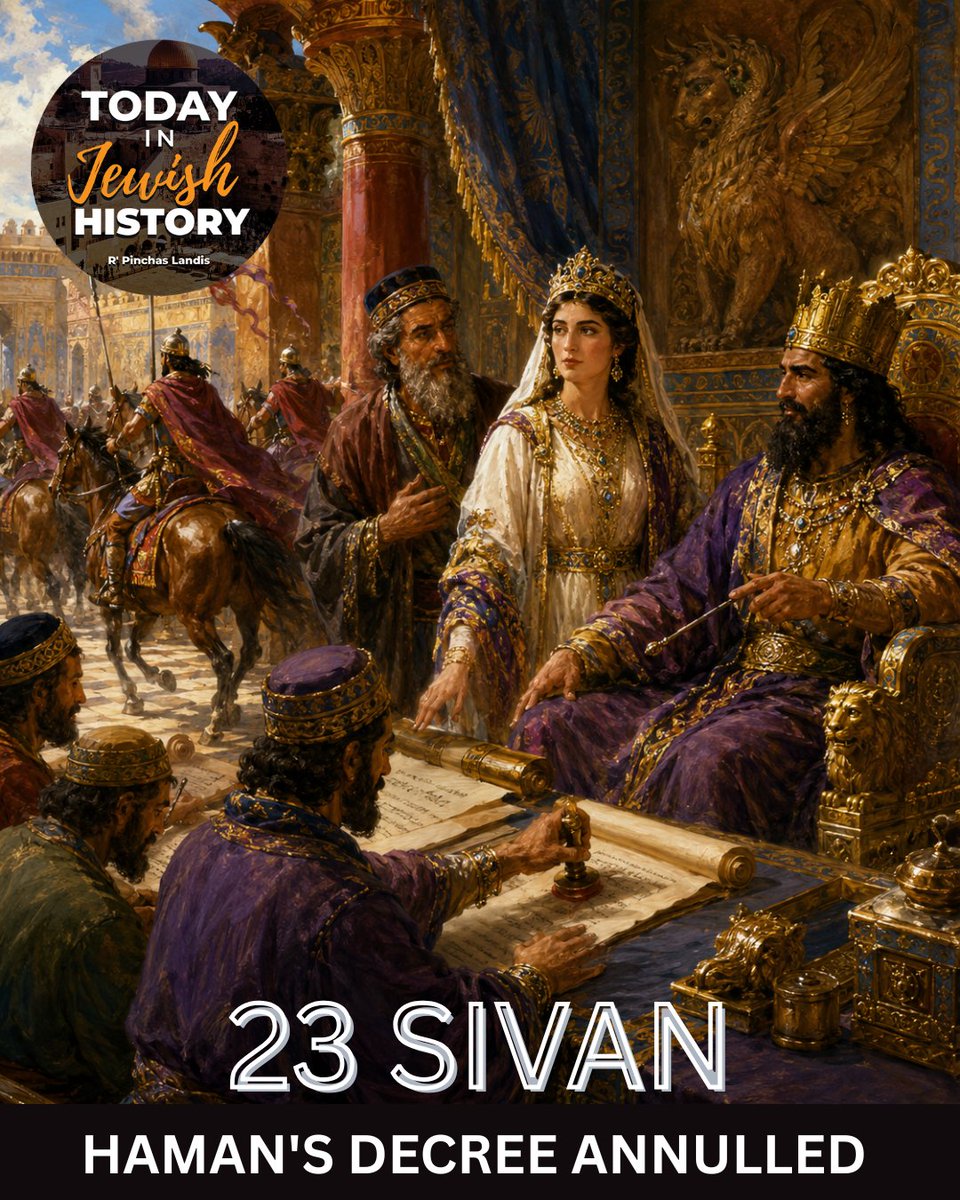
23 Sivan – Haman's Decree Annulled – 357 BCE
On this day in 357 BCE, Mordechai and Esther issued a royal decree giving the Jews the right to defend themselves. Though Haman had been hanged on the 17th of Nissan, his original decree ordering the destruction of every Jewish man, woman, and child on the 13th of Adar remained legally in force. Queen Esther pleaded with King Achashveirosh to annul it, but the king explained that no royal decree sealed with the king's seal could simply be revoked. Instead, he invited Esther and Mordechai to draft a new decree in his name and seal it with his ring.
On this day, Mordechai and Esther seized that opportunity. The new decree granted the Jews of all 127 provinces of Achashveirosh's empire the right to organize, defend themselves, and strike down any who would rise up against them. Couriers on royal horses carried the letters to every corner of the empire, effectively neutralizing the threat that Haman's decree had posed. The legal framework of the Persian empire could not erase evil by fiat, but it could empower the Jews to confront it.
The events of this day are recorded in the eighth chapter of Megillat Esther and represent a turning point in the Purim story. The decree of annihilation was not simply cancelled; it was answered. Rather than relying solely on the goodwill of a king, the Jews were given the means to defend themselves. It is a powerful reminder that Providence often works not by removing danger, but by giving us the strength and the tools to face it.
Find out more:
The Book: https://t.co/iLrU1TJwEk
WhatsApp: https://t.co/Q6xDZ64LZ3
.
#jewish #israel #judaism #jew #jerusalem #torah #kosher #jewishlife #shabbat #jews #shabbatshalom #israeli #hebrew #jewishculture #jewishholidays #jewishgirl #jewishcommunity #jewishhistory #jewishpride #jewishwedding #synagogue #jewishwomen #fyp #foryou #viral #foryoupage #fy #trending
22 Sivan – Haim Arlosoroff Assassination – 1933
On this day in 1933, Haim Arlosoroff was murdered. He was the head of the political department of the Jewish Agency and a central figure in the Mapai party. Just two days before his death, he had returned from Germany, where he had been negotiating the Haavara Agreement, an arrangement allowing German Jews to transfer assets to Palestine through the purchase of German goods. While Labor viewed it as a pragmatic rescue measure, the Revisionist movement led by Ze'ev Jabotinsky saw it as an unconscionable accommodation with the Nazi regime and a betrayal of the international boycott that was Jewry's most powerful weapon against Hitler. On the night of June 16th, Arlosoroff and his wife Sima were walking along the Tel Aviv beachfront when two men approached, shone a flashlight in his face, and shot him dead.
The murder trial that followed was one of the most divisive episodes in the history of the Yishuv, the pre-state Jewish community in Israel. Two Revisionist activists were arrested based largely on Sima's eyewitness testimony. One was convicted and sentenced to death, though the verdict was overturned on appeal; the other was acquitted outright. An Arab man briefly confessed to the killing but later recanted, claiming he had been bribed. Ben-Gurion and the Mapai leadership seized on the murder to paint the Revisionists as violent extremists, a charge Jabotinsky rightly denounced as a political blood libel designed to destroy the nationalist opposition.
The case was never solved. In 1982, a government commission formally concluded that the Revisionist suspects had not committed the murder, vindicating what their defenders had argued for decades. The Arlosoroff affair stands as a painful reminder of how the Labor establishment wielded tragedy as a political weapon against those who refused to accept its socialist vision for the Jewish state, and how long it took for the truth to catch up.
Find out more:
The Book: https://t.co/aVD3SdRPHQ
WhatsApp: https://t.co/UcWPntIF8N
.
#jewish #israel #judaism #jew #jerusalem #torah #kosher #jewishlife #shabbat #jews #shabbatshalom #israeli #hebrew #jewishculture #jewishholidays #jewishgirl #jewishcommunity #jewishhistory #jewishpride #jewishwedding #synagogue #jewishwomen #fyp #foryou #viral #foryoupage #fy #trending
20 Sivan - Jewish Tragedy and Memory - 1171
On this day, Jewish communities historically observed the fast of the Twentieth of Sivan. The fast was first instituted by Rabbeinu Tam in 1171 after the massacre of the Jews of Blois, France, following one of the earliest blood libels in continental Europe. Jews were falsely accused of murdering a Christian child, and dozens were burned at the stake after refusing to abandon their faith. The tragedy became a symbol not only of the suffering of Blois, but of the broader violence endured by Jewish communities during the Crusades era, including the massacres that devastated Jewish life throughout the Rhineland.
Centuries later, the Twentieth of Sivan took on new meaning after the horrors of 1648 and 1649, when Cossack uprisings under Bogdan Chmielnicki brought mass slaughter to Jewish communities across Poland-Lithuania. In 1650, the Council of Four Lands established the day as a fast to commemorate those massacres, connecting it to the attack on the Jews of Nemyriv, one of the early and devastating episodes of that period. For generations, the date became a collective memorial for Jewish communities destroyed by blood libels, crusader violence, and Cossack brutality.
After World War II, some rabbis proposed using the Twentieth of Sivan as a day of Holocaust remembrance, especially because many Hungarian Jews were deported to Auschwitz during May and June of 1944. Others suggested connecting it to the fall of the Jewish Quarter during the Battle for Jerusalem in 1948. While those later proposals were not widely adopted, the day remains part of Jewish memory in several communities, including Belz, Skver, and Papa Chassidim, who still recite Selichos for the occasion. The Twentieth of Sivan stands as a reminder that Jewish memory is not only about recording tragedy, but about carrying the names, faith, and resilience of shattered communities forward into the future.
Find out more:
The Book: https://t.co/umiSL6NuaW
WhatsApp: https://t.co/erUzPxKNuW
.
#jewish #israel #judaism #jew #jerusalem #torah #kosher #jewishlife #shabbat #jews #shabbatshalom #israeli #hebrew #jewishculture #jewishholidays #jewishgirl #jewishcommunity #jewishhistory #jewishpride #jewishwedding #synagogue #jewishwomen #fyp #foryou #viral #foryoupage #fy #trending
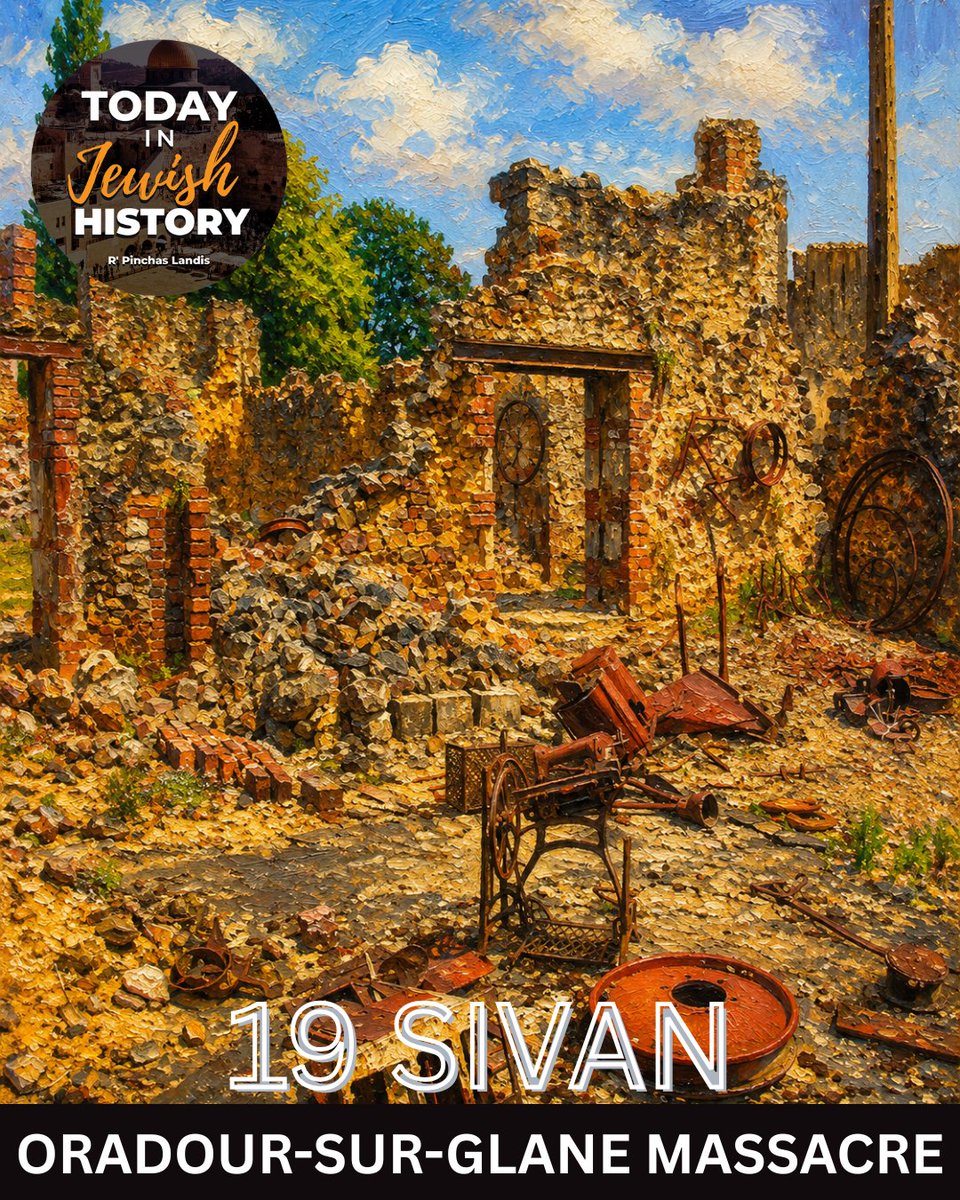
19 Sivan - Oradour-sur-Glane Massacre - 1944
On this day in 1944, the massacre of Oradour-sur-Glane took place. Four days after D-Day, soldiers of the Waffen-SS surrounded the French village, gathered its residents in the square, and murdered 642 civilians in a matter of hours. The victims included men, women, children, people who happened to be passing through, and refugees who had come to the village seeking safety, including Jewish refugees from other parts of France.
The men were separated from the women and children and taken to barns and sheds, where they were shot, doused with fuel, and burned. The women and children were locked inside the village church, where the SS set off an incendiary device and then machine-gunned those who tried to escape through the doors and windows. Only six people are known to have survived the massacre. The village was looted, burned, and left in ruins. After the war, Charles de Gaulle ordered that the destroyed village not be rebuilt, but preserved as a permanent memorial to Nazi brutality.
The massacre of Oradour-sur-Glane stands as one of the most horrific Nazi atrocities committed in Western Europe. For the Jewish refugees who had reached the village, it was a final and bitter tragedy: after fleeing persecution elsewhere, they were murdered alongside their French neighbors in a place they had hoped would offer refuge. The ruins of Oradour remain a silent witness to the cruelty of collective punishment, the vulnerability of civilians under Nazi occupation, and the terrible truth that even those who escaped one front of the war could still be swallowed by another.
Find out more:
The Book: https://t.co/J9iS5NED6g
WhatsApp: https://t.co/LozsGPKwDl
.
#jewish #israel #judaism #jew #jerusalem #torah #kosher #jewishlife #shabbat #jews #shabbatshalom #israeli #hebrew #jewishculture #jewishholidays #jewishgirl #jewishcommunity #jewishhistory #jewishpride #jewishwedding #synagogue #jewishwomen #fyp #foryou #viral #foryoupage #fy #trending
18 Sivan - Orthodox Union - 1898
On this day in 1898, the Orthodox Union was founded. Originally established as the Union of Orthodox Jewish Congregations of America, the OU was created as a federation of Orthodox synagogues at a time when American Jewish life was being reshaped by immigration, modernization, and the growing influence of Reform Judaism. Its founding president, Rabbi Henry Pereira Mendes, helped organize Orthodox rabbis and lay leaders who believed Torah observance could be preserved and strengthened in America. Ironically, Rabbi Mendes was also a founder of the Jewish Theological Seminary, which began as an Orthodox institution before later becoming the rabbinical school associated with the Conservative movement.
In its early decades, the OU gave American Orthodoxy a national voice. It advocated for policies essential to Jewish life, including the five-day workweek and the right to kosher slaughter, while supporting Jewish soldiers, European Jewry, synagogues, and American-trained Orthodox rabbis. In the 1920s, the OU launched its kashrus division. Its first certified product was Heinz vegetarian beans in 1923, and the OU symbol eventually became one of the most recognized kosher marks in the world.
Over the twentieth century, the OU expanded far beyond synagogue affiliation. Through NCSY, it inspired generations of Jewish teens and helped fuel the teshuvah movement. Through OU Advocacy, it works on religious liberty, school funding, security, and public policy. Through Yachad, it promotes inclusion for Jews with disabilities. Today, the OU supports synagogues, youth programs, educational initiatives, advocacy efforts, and the world’s largest kosher certification agency, supervising more than a million products in thousands of facilities across the globe. Its founding stands as a reminder that American Orthodoxy was built through institutions determined to make Torah life sustainable in the modern world.
Find out more:
The Book: https://t.co/cftyenp6pF
WhatsApp: https://t.co/5pgmG6pGDn
.
#jewish #israel #judaism #jew #jerusalem #torah #kosher #jewishlife #shabbat #jews #shabbatshalom #israeli #hebrew #jewishculture #jewishholidays #jewishgirl #jewishcommunity #jewishhistory #jewishpride #jewishwedding #synagogue #jewishwomen #fyp #foryou #viral #foryoupage #fy #trending
17 Sivan - First Russian Congregation - 1852
On this day in 1852, the first Eastern European Orthodox Jewish congregation in New York was founded. Known originally as Beth Hamedrash, and later as Beth Hamedrosh Hagodol, it began with a small group of Russian and Polish Jewish immigrants who wanted a traditional place of prayer and study in a city whose established synagogues felt increasingly unfamiliar to them. Their first home was a rented garret at 83 Bayard Street, where they paid eight dollars a month and conducted services with no paid clergy. Its founding rabbi, Rabbi Abraham Joseph Ash, was among the first Eastern European Orthodox rabbis to serve in America and rejected the reformist tendencies spreading among some older German Jewish congregations.
Its significance grew in the decades that followed, as Jews from the Russian Empire fled persecution, poverty, conscription, legal restrictions, and violent upheaval. After the persecutions of 1881 and 1882, Russian Jewish immigration surged, transforming the Lower East Side into one of the great Jewish centers of the world. Beth Hamedrosh Hagodol became a spiritual anchor for these immigrants, offering not only prayer, but Torah study, kosher supervision, burial societies, Passover relief, charity for the poor, and support for new arrivals trying to rebuild their lives. In 1885, the congregation purchased the former Norfolk Street Baptist Church, transforming the Gothic Revival building into one of the largest and most important synagogues on the Lower East Side.
Over time, Beth Hamedrosh Hagodol became deeply tied to the development of American Orthodoxy. Rabbi Yaakov Yosef, the first and only Chief Rabbi of New York City, led the congregation beginning in 1888, and Rabbi Ephraim Oshry, a Holocaust survivor and major halachic authority from the Kovno Ghetto, served there for more than fifty years after World War II. The shul was closed in 2007 after its membership had dwindled and the historic building had become unsafe. Its later destruction in a suspicious 2017 fire marked a painful loss, but its legacy remains profound. Beth Hamedrosh Hagodol stands as a reminder that American Jewish life was built not only by opportunity, but by refugees fleeing persecution who created institutions strong enough to preserve Jewish faith, dignity, and community in a new world.
Find out more:
The Book: https://t.co/g9p0MLVJkH
WhatsApp: https://t.co/5cSSKHYcaA
.
#jewish #israel #judaism #jew #jerusalem #torah #kosher #jewishlife #shabbat #jews #shabbatshalom #israeli #hebrew #jewishculture #jewishholidays #jewishgirl #jewishcommunity #jewishhistory #jewishpride #jewishwedding #synagogue #jewishwomen #fyp #foryou #viral #foryoupage #fy #trending
16 Sivan - The Restoration Arrives in Massachusetts – 1716
On this day in 1716, the ship Restoration arrived in Massachusetts. Traveling from London, the ship carried several Jewish merchants, including Isaac Lopez and Abraham Gotatus, both recorded in Boston port and business records as having disembarked in June of that year. Lopez soon became active in Boston’s commercial life, helping form the early core of what would slowly become a Jewish presence in New England.
Their arrival marked a quiet but significant shift in the religious landscape of colonial Massachusetts. A century earlier, the Puritan leadership of Massachusetts Bay had worked aggressively to exclude those it viewed as religious outsiders, including Quakers, several of whom were executed in the seventeenth century. In New Amsterdam, Governor Peter Stuyvesant similarly tried to prevent Jews, Lutherans, and Quakers from settling in the colony. By the early eighteenth century, however, the rigid religious boundaries of colonial society had begun to loosen, allowing Jewish merchants to establish themselves in places where they had once been unwelcome.
The Jewish community in Boston would remain small for generations. Though Jews were present in Massachusetts during the colonial and Revolutionary eras, Boston did not establish its first synagogue until 1840. Still, the arrival of merchants like Isaac Lopez and Abraham Gotatus reflected the beginning of a new chapter in American Jewish history. Long before large-scale Jewish immigration transformed the United States, small groups of Jewish merchants, families, and traders were already helping build the foundations of Jewish life in New England.
Find out more:
The Book: https://t.co/3c50zGoMLz
WhatsApp: https://t.co/IhO06b4mK3
.
#jewish #israel #judaism #jew #jerusalem #torah #kosher #jewishlife #shabbat #jews #shabbatshalom #israeli #hebrew #jewishculture #jewishholidays #jewishgirl #jewishcommunity #jewishhistory #jewishpride #jewishwedding #synagogue #jewishwomen #fyp #foryou #viral #foryoupage #fy #trending
15 Sivan – The Siege of Jerusalem – 1099
On this day in 1099, the Crusader siege of Jerusalem began. After years of marching across Europe and the Near East, the armies of the First Crusade reached the walls of Jerusalem and began a five-week siege that would end in one of the most brutal massacres in the city’s history. When the Crusaders finally breached the city on July 15, 1099, they slaughtered thousands of Muslim and Jewish residents. For the Jews of Jerusalem, the conquest brought devastation to a small but ancient community that had continued to live in the city under changing empires and rulers.
As the Crusaders entered the city, Jewish residents joined the Muslim defenders in resisting the attack. According to medieval accounts, when the city fell, many Jews gathered in their synagogue, preparing for death. Muslim chroniclers later reported that the Crusaders burned the synagogue over them. A contemporary Jewish letter from the Cairo Geniza confirms the destruction of the synagogue, and other Geniza documents record that some Jews were taken captive and later ransomed by the Jewish community of Ashkelon. The fall of Jerusalem was not only a military conquest. For the Jewish community, it meant massacre, captivity, displacement, and the destruction of one of the city’s centers of Jewish life.
The siege of Jerusalem marked the bloody climax of the First Crusade and the beginning of Crusader rule in the city. For Jews, it became part of the wider tragedy of the Crusades, which had already brought massacres to Jewish communities across Europe before reaching the Land of Israel. The events of 1099 are a stark reminder that Jewish history in Jerusalem did not disappear after the destruction of the Second Temple. Jews continued to live, pray, study, defend their communities, and suffer there through centuries of conquest and foreign rule. Even after the Crusader massacre, Jewish presence in the Land of Israel endured, diminished and vulnerable, but never fully extinguished.
Find out more:
The Book: https://t.co/ILukmoQrvz
WhatsApp: https://t.co/lhFHHQFsin
.
#jewish #israel #judaism #jew #jerusalem #torah #kosher #jewishlife #shabbat #jews #shabbatshalom #israeli #hebrew #jewishculture #jewishholidays #jewishgirl #jewishcommunity #jewishhistory #jewishpride #jewishwedding #synagogue #jewishwomen #fyp #foryou #viral #foryoupage #fy #trending
13 Sivan - The Massacre of Radziwillow – 1942
On this day in 1942, the massacre of Radziwillow took place. Approximately 1,350 Jews were rounded up and murdered in the town by Nazi forces assisted by Ukrainian collaborators. Those unable to walk were killed inside the ghetto, while others were marched to a nearby site, forced to undress, and executed by machine gun fire. Months later, during a second Aktion in October 1942, roughly 500 Jews attempted to flee after learning of the planned liquidation. Most were captured and murdered. By the time the Red Army arrived in 1944, only 51 Jews from the town had survived.
Jewish life in Radziwillow stretched back centuries. The town passed between Lithuanian, Polish, and Russian rule, while its Jewish community became a central part of local economic and communal life. By the late nineteenth century, the Jewish population had reached roughly 4,000. After World War I, the town returned to Poland, with Jews comprising nearly half the population alongside Ukrainians and Poles. Following the Soviet occupation in 1939 and the German invasion in 1941, the Jews of the town faced escalating persecution, including public burnings of Jewish religious books, forced labor, starvation, disease, and the establishment of a crowded ghetto housing more than 2,600 Jews from the surrounding area.
The destruction of Radziwillow formed part of the broader annihilation of centuries old Jewish life across Eastern Europe during the Holocaust. Entire communities with synagogues, schools, businesses, and political movements were erased within months. Yet even in the face of certain death, Jews in places like Radziwillow continued to resist and fight for survival. The attempted breakout by hundreds of young Jews during the liquidation of the ghetto remains a testament to the courage and determination that persisted even amid the horrors of the Holocaust.
Find out more:
The Book: https://t.co/OE270fn5ja
WhatsApp: https://t.co/rvxAD99k99
.
#jewish #israel #judaism #jew #jerusalem #torah #kosher #jewishlife #shabbat #jews #shabbatshalom #israeli #hebrew #jewishculture #jewishholidays #jewishgirl #jewishcommunity #jewishhistory #jewishpride #jewishwedding #synagogue #jewishwomen #fyp #foryou #viral #foryoupage #fy #trending
12 Sivan - Agudath Israel Founded - 1912
On this day in 1912, World Agudath Israel was established. Founded in Kattowitz, Poland as the political and communal arm of Ashkenazi Torah Judaism, the organization was created by leading rabbinic figures and communal leaders including the Gerrer Rebbe and Jacob Rosenheim. It emerged during a period of profound change in Jewish life, as its founders feared that rapidly growing political movements and secular ideologies would reshape the future of the Jewish people without Torah remaining the central guiding force.
The early twentieth century brought tremendous upheaval to European Jewry. Nationalism, socialism, assimilation, and competing visions of Jewish identity were reshaping communities across Europe. Agudath Israel sought to unite Orthodox Jews under a framework rooted in Torah leadership and independent religious institutions. Prior to World War II, it established schools and communal organizations throughout Europe and became particularly influential among Chassidic communities. Its leadership included some of the greatest Torah figures of the era, among them the Chafetz Chaim and Rabbi Meir Shapiro. Following the devastation of the Holocaust, Agudath Israel helped rebuild Jewish communal life and assist survivors throughout Europe and beyond.
The founding of Agudath Israel reflected a larger challenge confronting the Jewish world: how to preserve Torah life while navigating the realities of the modern age. More than a century later, Agudath Israel continues to play a major role in Jewish communal life through advocacy, educational support, public policy efforts, and the protection of religious rights. From yeshiva funding and community security to healthcare and legislation affecting Jewish life, the movement's original mission of ensuring that Torah leadership remains a central voice in shaping the future of the Jewish people continues to influence communities around the world.
Find out more:
The Book: https://t.co/lTkKxQGkol
WhatsApp: https://t.co/8dVMIwqL1D
.
#jewish #israel #judaism #jew #jerusalem #torah #kosher #jewishlife #shabbat #jews #shabbatshalom #israeli #hebrew #jewishculture #jewishholidays #jewishgirl #jewishcommunity #jewishhistory #jewishpride #jewishwedding #synagogue #jewishwomen #fyp #foryou #viral #foryoupage #fy #trending
11 Sivan - HaRav Yitzchak Yaakov Weiss - 1989
On this day in 1989, HaRav Yitzchak Yaakov Weiss passed away, making this day his yartzeit. Known simply as the Minchas Yitzchak, after the monumental responsa work he authored, Rav Weiss was one of the leading halachic authorities of the twentieth century and served as Av Beit Din of the Eidah Hachareidis in Jerusalem.
Born in Galicia in 1902, Rav Weiss displayed extraordinary promise from a young age. He absorbed both Torah scholarship and Chassidic tradition from great teachers, including the Zhiditchover Rebbe and his father, with whom he learned for hours each day. While still a teenager, leading rabbis of the generation recognized his brilliance and predicted an exceptional future. He later became head of the Beit Din in Grosswardein, Romania, where he emerged as a major halachic authority. During the Holocaust, Rav Weiss endured unimaginable hardship, hiding in a bunker and narrowly escaping Nazi persecution. Of his large extended family, only he and one son survived. After the war, he rebuilt his life in Manchester, England, where he completed much of his monumental She’eilot U’teshuvot Minchat Yitzchak and became a leading rabbinic voice for postwar Jewry.
Among Rav Weiss’s greatest contributions was his tireless work on behalf of “agunos” in the aftermath of the Holocaust, searching within halachah for ways to allow women whose husbands had disappeared during the war to rebuild their lives. Through his nine-volume Minchas Yitzchak, he addressed modern questions involving technology, medicine, and contemporary life while remaining deeply rooted in Torah tradition. In later years he returned to Jerusalem to lead the Eidah Hachareidis, becoming one of the most influential rabbinic figures of his era. Rav Weiss embodied not only extraordinary Torah scholarship, but also the resilience of a generation that survived destruction, rebuilt Jewish life from the ashes, and carried the chain of Torah into the modern world. An estimated 30,000 people attended his funeral on the Mountain of Olives, reflecting the profound impact he had on the Jewish People.
Find out more:
The Book: https://t.co/qOpIxffQ7Z
WhatsApp: https://t.co/voEnthFVEQ
.
#jewish #israel #judaism #jew #jerusalem #torah #kosher #jewishlife #shabbat #jews #shabbatshalom #israeli #hebrew #jewishculture #jewishholidays #jewishgirl #jewishcommunity #jewishhistory #jewishpride #jewishwedding #synagogue #jewishwomen #fyp #foryou #viral #foryoupage #fy #trending
10 Sivan - Aurum Coronarium - 429
On this day in 429, the Roman Emperors confiscated the aurum coronarium. This annual tax and collection of voluntary donations had long been gathered from Jewish communities throughout the Diaspora to support Torah scholars and Jewish religious leadership in the Land of Israel. Under a decree issued by Eastern Roman Emperor Theodosius II and Western Roman Emperor Valentinian III, the funds were no longer permitted to remain under Jewish communal control and were instead redirected into the imperial treasury. The law was later codified in the Codex Theodosianus, one of the great compilations of Roman imperial legislation.
For centuries after the destruction of the Second Temple, Jewish religious leadership in the Land of Israel had served as one of the central spiritual and communal authorities of the Jewish world. Led by descendants traditionally associated with the house of Hillel, these leaders maintained rabbinic courts, supported Torah scholarship, and helped sustain Jewish communal life in the northern regions of the Land of Israel, where much of the Jewish population had become concentrated following the destruction of the Second Temple. By confiscating their primary source of financial support, the Roman government effectively crippled this system of Jewish leadership. Historians widely view this decree as the decisive step leading to the dissolution of organized Jewish religious authority under Roman rule shortly afterward.
The decree reflected the broader transformation taking place within the Christian Roman Empire during the reign of Theodosius II. As Christianity became increasingly intertwined with imperial power, Jewish communal autonomy across the empire steadily eroded through legal restrictions, political marginalization, and economic pressure. The destruction of this longstanding system of Jewish religious leadership stands as an important reminder that Jewish life continued to flourish in the Land of Israel for centuries after the destruction of the Second Temple. Even after the weakening of this communal structure under Roman rule, a continuous Jewish presence remained in the land, at times diminished, less organized, and increasingly vulnerable, yet never fully extinguished until its remarkable reestablishment and strengthening in modern times.
Find out more:
The Book: https://t.co/s3ZohBc9EY
WhatsApp: https://t.co/nhsbuQVaad
.
#jewish #israel #judaism #jew #jerusalem #torah #kosher #jewishlife #shabbat #jews #shabbatshalom #israeli #hebrew #jewishculture #jewishholidays #jewishgirl #jewishcommunity #jewishhistory #jewishpride #jewishwedding #synagogue #jewishwomen #fyp #foryou #viral #foryoupage #fy #trending
9 Sivan - Rabbi Yisroel of Shklov - 1839
On this day in 1839, Rabbi Yisroel ben Shmuel Ashkenazi of Shklov passed away. Known simply as Rabbi Yisroel of Shklov, he became one of the foremost disciples of the Vilna Gaon and later immigrated to Ottoman Palestine in 1810 as part of the effort to strengthen Jewish life in Eretz Yisroel. He settled in Safed and became a leading rabbinic figure of the Ashkenazi Jewish community, dedicating himself to Torah scholarship and the practical observance of mitzvos connected to the land. His monumental work, Pe’at HaShulchan, became one of the foundational halachic texts dealing with agricultural laws unique to the Land of Israel.
Rabbi Yisroel’s life in the Holy Land was marked not only by spiritual achievement, but also by hardship and violence. During the devastating 1834 Tzfas pogrom, Druze and Arab mobs attacked the Jewish community for more than a month, looting homes, desecrating synagogues, assaulting women, and murdering Jews. While hiding from the violence, Rabbi Yisroel wrote desperate letters to foreign consuls in Beirut pleading for intervention to save the surviving Jews of the city. The Jewish community of Safed was left shattered, with synagogues destroyed, Torah scrolls desecrated, and the region’s only Hebrew printing press demolished. Survivors were able to recover only a fraction of what had been lost.
The life of Rabbi Yisroel of Shklov reflects an often-overlooked chapter of Jewish history before modern Zionism. Long before political Zionism emerged in Europe, rabbis, scholars, and ordinary Jewish families were already sacrificing comfort and safety to return to the Land of Israel and rebuild Jewish life there. The ancient Jewish communities of Safed, Jerusalem, Hebron, and Tiberias endured repeated instability and violence while maintaining centuries of continuous Jewish presence in the land. For many later generations, the struggles endured by figures like Rabbi Yisroel reinforced the belief that Jewish survival in the ancestral homeland required not only faith and scholarship, but also security, self-reliance, and the ability of the Jewish people to sustain themselves in their own land.
Find out more:
The Book: https://t.co/ga7acq3gzX
WhatsApp: https://t.co/W5R9CS7pmy
.
#jewish #israel #judaism #jew #jerusalem #torah #kosher #jewishlife #shabbat #jews #shabbatshalom #israeli #hebrew #jewishculture #jewishholidays #jewishgirl #jewishcommunity #jewishhistory #jewishpride #jewishwedding #synagogue #jewishwomen #fyp #foryou #viral #foryoupage #fy #trending
8 Sivan - Tzfas Pogrom - 1834
On this day in 1834, the Tzfas pogrom began. Starting just after the holiday of Shavuos, Druze and Muslim mobs attacked the ancient Jewish community of Tzfas during the broader Peasants’ Revolt against Egyptian Ottoman rule in Palestine. For 33 days, Jewish homes, synagogues, and businesses were looted and destroyed. Torah scrolls were desecrated, ancient holy books were burned or stolen, women were assaulted, and many Jews were beaten, wounded, or killed. Hundreds of terrified Jews fled into nearby fields and villages, hiding in caves and open countryside while the violence raged unchecked.
The attack devastated one of the oldest and holiest Jewish communities in the Land of Israel. Tzfas had been a major center of Jewish life and Kabbalah since the 1500s, home to sages such as the Arizal and generations of scholars, printers, and mystics. During the pogrom, the town’s only Hebrew printing press was destroyed along with countless rare manuscripts and Torah scrolls. Survivors later recounted how entire homes were stripped bare, with even doors and windows ripped away by looters searching for valuables. Some local Arabs risked their lives to shelter Jews, but the broader collapse of order exposed how vulnerable the Jewish community remained despite centuries of continuous Jewish presence in the land.
The Tzfas pogrom took place 63 years before Theodor Herzl formally launched modern political Zionism at the First Zionist Congress in 1897. It stands as an important reminder that Jewish vulnerability in the Land of Israel did not begin with modern nationalism or the Arab Israeli conflict. Long before the establishment of the State of Israel, and long before organized Zionism emerged, ancient Jewish communities in cities like Tzfas, Hebron, Jerusalem, and Tiberias often lived at the mercy of shifting rulers, local hostility, and periodic violence. For many later Zionist thinkers, these repeated episodes reinforced the belief that the Jewish people could never depend solely on the goodwill of others for their safety and survival.
Find out more:
The Book: https://t.co/YbScKmPuw3
WhatsApp: https://t.co/YuNIzfygF4
.
#jewish #israel #judaism #jew #jerusalem #torah #kosher #jewishlife #shabbat #jews #shabbatshalom #israeli #hebrew #jewishculture #jewishholidays #jewishgirl #jewishcommunity #jewishhistory #jewishpride #jewishwedding #synagogue #jewishwomen #fyp #foryou #viral #foryoupage #fy #trending