Everyone knows the sky went dark at the Crucifixion of Jesus Christ. Almost no one knows it will happen again, exactly 2,000 years later.
So I tracked the sky of the year 33. What I found is hard to call a coincidence.
In the third month of the year 33, when Jesus was 33 years old, there was a total solar eclipse. The Sun went black in the constellation of Pisces, the Fish, the symbol of Jesus Christ. It marked the dawn of the Age of Pisces and the rise of Christianity. Its shadow crossed the icy ocean off Antarctica, at the bottom of the world.
Two weeks later, on April 3, 33 AD, the date many scholars give for the Crucifixion, the Moon rose over Jerusalem in eclipse. The Sun into darkness. The Moon into blood. Weeks later, at Pentecost, Peter preached those exact words (Acts 2:20).
The Age of Pisces had begun.
Now jump forward exactly 2,000 years.
March 30, 2033: a total solar eclipse in Pisces. This time the shadow curves around the Arctic, over the top of the world.
Two weeks later, on April 14, 2033, during Passover, the full Moon turns blood red, and it will be visible from Jerusalem. It is one of four blood moons in a row, a tetrad.
Same month. Same constellation. Same sequence: a black Sun, then a blood Moon at Passover.
And it gets stranger.
The Morning Star, Venus, shines beside the black Sun in both eclipses.
In both years, Venus passes between the Earth and the Sun right at the spring equinox: March 21 in 33 AD, and March 20 in 2033, the very day of the equinox. The equinox is the point in the sky that measures the Ages. Venus "dies" into the Sun and is reborn as the Morning Star.
In the last chapter of the Bible, Jesus says: "I am the bright and morning star." In the same chapter: "I am Alpha and Omega, the beginning and the end."
A beginning and an end, 2,000 years apart.
One more detail: the 2033 eclipse is the last total eclipse of its family, Saros 120, which has cast its full shadow on Earth since 1059. It closes a cycle.
South Pole and North Pole. Two eclipses at opposite ends of the Earth, like the two fish of Pisces, tied together but swimming in opposite directions. The masculine and the feminine. The life force and the spirit.
Make of this what you will.
But the signs are in the stars.
The Riemann hypothesis news has noticeably shifted the vibe. It's like we all knew something big was coming and then bam, our wildest suspicions were confirmed. For me the real kicker is that the proof is 250,000 pages long. Something about that just feels so... spooky, extraterrestrial almost. Can't quite put my finger on it.
@elonmusk : speed is 'a vector, not a scalar.'
xAI just proved it. They paused to rip out
third-party layers and rebuild Grok's training
and inference in C/C++, close to the metal.
Slower in the short run. Faster forever after
The Al race isn't won on the first corner. It's
won by whoever builds the car that can still
accelerate on lap 50.
Is the Al race a sprint or an endurance race?
We have dumped JAX/SGLang and rewritten the entire RL and inference stack from scratch in C/C++, which took some extra time.
Training (aka pre-training) is done. Lot of cleanup was needed on the SFT data to get that mostly right. Now, 4.8 is in RL and the evals are starting to climb. We will do a soft rollout to Bot users later this week and see how it goes.
Grok 4.8 will bear no resemblance to 4.7 (thankfully). It is not yet incredible, but, this time, the foundations are built right, so I expect it to evolve to be something special.
Searching for a Planck-sized pin in a haystack the size of infinity. That's NP.
If P = NP, the pin finds you.
My speculation: our hardest problems might not be hard at all. We might just be seeing them from too few dimensions, like a 2D creature lost in a maze that's trivial from above.
So what's "above" for intelligence?
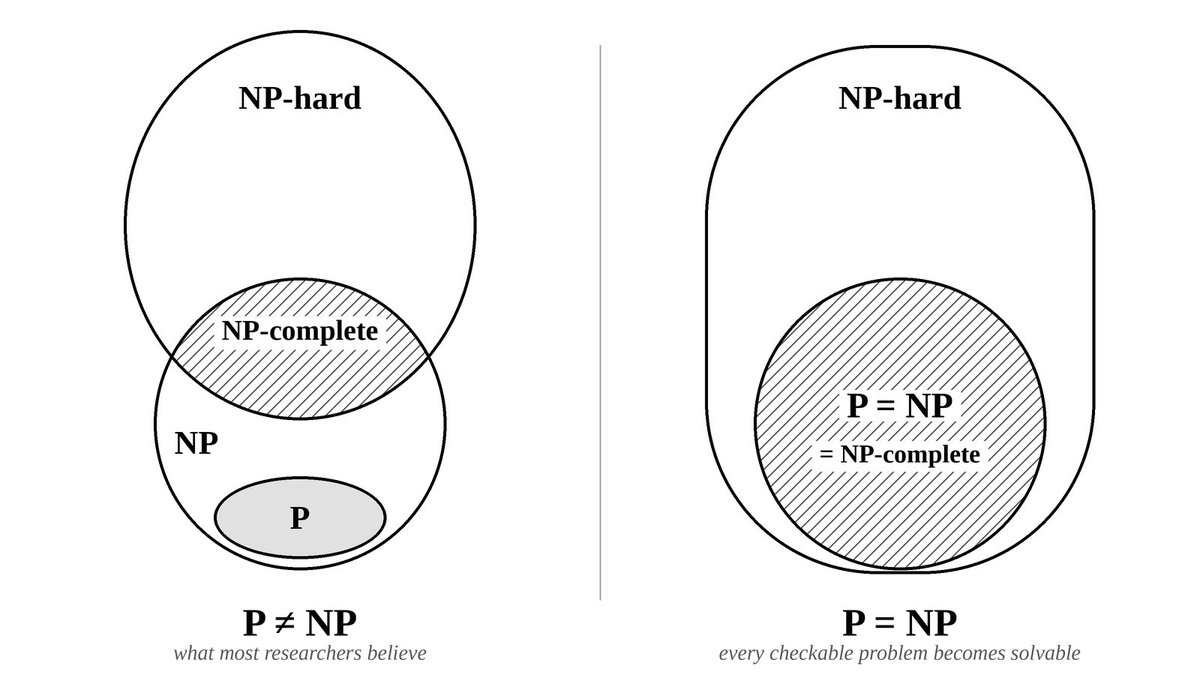
A lot of people are worried about P = NP.
Here’s the simple version.
P is the set of problems a computer can solve quickly. Sorting a list, finding the shortest route on a map, multiplying numbers.
NP is the set of problems where, if someone hands you an answer, you can check it quickly. A filled-in Sudoku is easy to verify, but solving a hard one from scratch can take forever.
If you can check an answer fast, can you also find it fast? P = NP says yes. Almost everyone believes the answer is no, but nobody has proved it either way. It’s a $1M Millennium Prize problem.
Riemann is solved, but it doesn’t change your day. P = NP would change everything very fast.
Almost all modern security rests on the assumption that some problems are brutally hard to solve but easy to check. Factoring huge numbers is the classic one.
If P = NP, that wall could fall. HTTPS, online banking, passwords, digital signatures, crypto wallets, all of it would be at risk.
The same power that breaks encryption would solve the hardest optimization problems we have.
Protein folding and drug discovery would speed up massively. Logistics, flight schedules and supply chains would become near perfect.
Training AI models could get far cheaper. Even finding mathematical proofs could be automated.
It depends on how it’s proved. If the proof is not constructive, or the algorithm runs in something like n^100 time, it's useless in practice. The scary version is a fast, practical algorithm.
Most researchers bet on P ≠ NP, and that is the reason your bank account is safe today.
But if someone ever proves P = NP with a practical algorithm, the world gets rewritten overnight.
Best case, we cure diseases and solve problems we thought were impossible.
Worst case, every lock on the internet opens at once.
Something to worry about indeed.
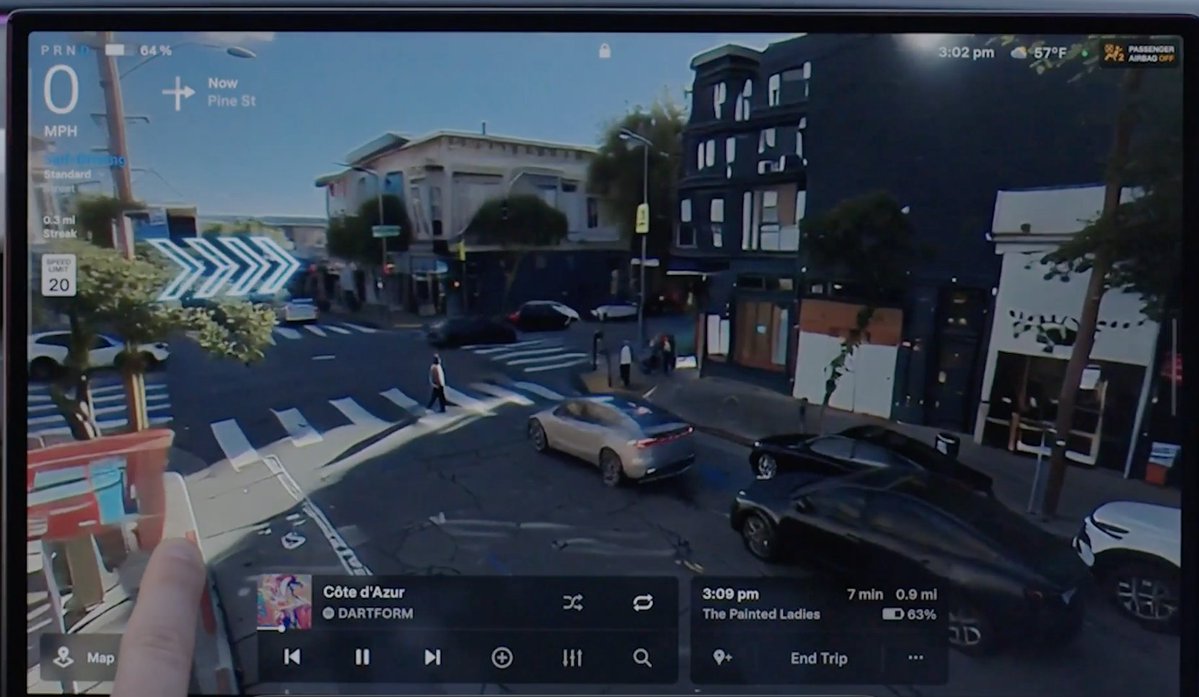
Here are the new FSD visualizations in FSD V15. It continuously streams a view from an arbitrary virtual camera situated above your vehicle.
Upcoming navigation turns display directly in the driving visualization. Turn signals are quieter and fade out after a few clicks.
You can tell humans are nowhere near as domesticated as we pretend because the second somebody starts a good fire, the entire evening is fucking handled. Nobody needs a plan. Nobody needs to be entertained. Twelve adults will willingly sit in a circle staring at burning wood for five hours while periodically saying “ohhh that’s a good one” when a log collapses. Somebody starts poking it with a stick. Somebody becomes Head of Firewood. Everybody gets irrationally excited when it suddenly gets huge. We have invented an unbelievable amount of shit just to discover that one of the greatest nights available to a human is still sitting outside with other humans watching shit burn.
@InfilExfil It's eerily close to P=NP.
We are the product, the service and the delivery.
It's going to be interesting to see when we can move through dimensions how these rules play out.
Ilya is fortunately not quite correct about the surface of the Earth being covered by solar panels, although his broader point about solar power being the future is true.
It is far easier and scales vastly more to generate power and intelligence in space around the Earth and then deep space around the Sun.
Some percentage of the Moon and then probably Mercury next get turned into computronium (silicon PV + aluminum radiators).
(Also, there won’t be starvation, but there will always be war. And the machines won’t care about things as absurdly trivial as your preferred orifice for sex.)
Simple explanation of the usefulness of the Riemann proof (so far) is that it removes the conditional nature of other math theorems dependent upon it.
And, of course, is yet another mind-blowing thing achieved by super intelligence …
https://t.co/F1sAyxwaSF
Not self conscious, no low self esteem, not depressed.
Imagine being at 100% all the time, and happy.
The merge will happen.
The abundance will be amazing.
First though, the last war we will ever see.