Managing cash is one of the most important jobs of a business owner.
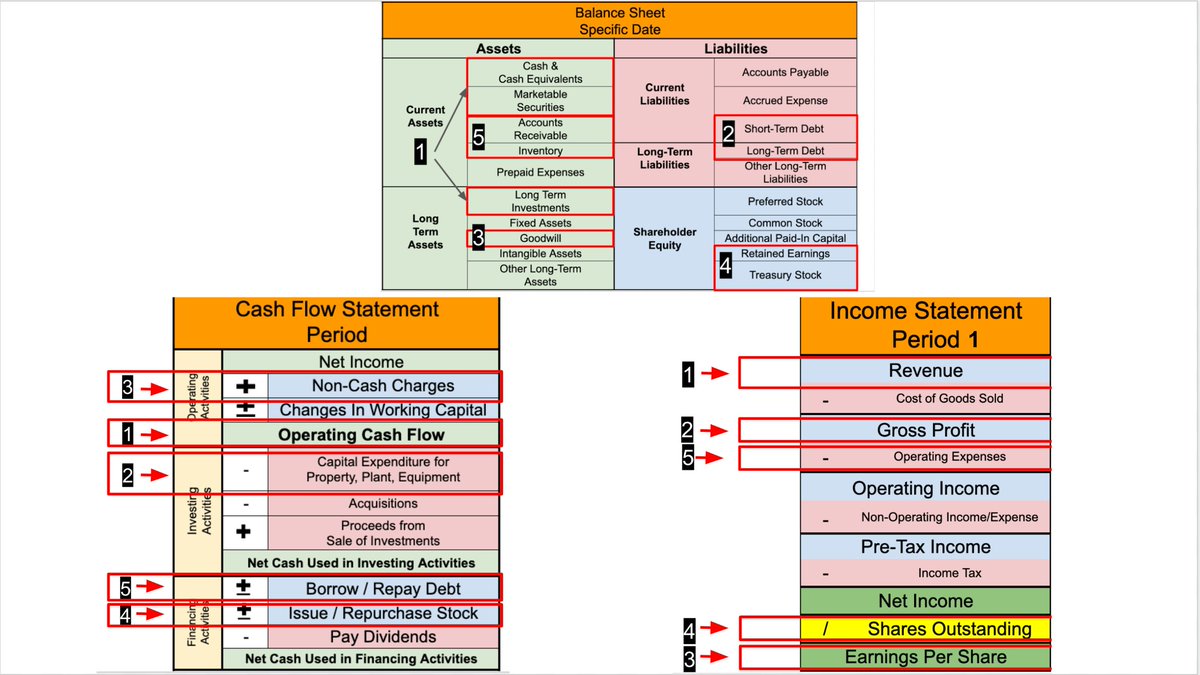
But how? You need good cash flow KPIs
Here are the 5 best KPIs for managing cash flow:
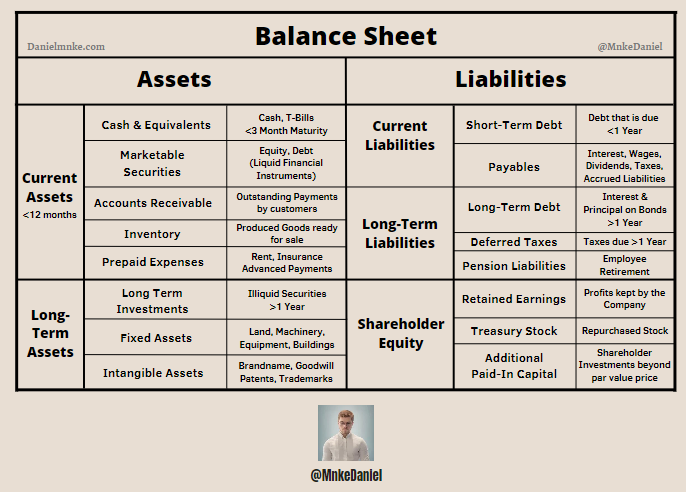
Here's an explanation of all Terms and Parts of the Balance Sheet in one Tweet:
Active Side
(Non-Current Assets)
Intangible Assets: Intangible assets are not physical, such as a patent, brand, trademark, or copyright.
If this is a high portion of assets, check if the value makes sense to you.
It's relatively easy to overstate the value of intangible assets.
Goodwill: Goodwill is the result of a purchase of another company (merger).
It's the difference between the purchase price and the net fair value of all the assets bought (book value of the purchased company).
If goodwill is a large part of the assets, you should check whether the surcharge was justified.
You want to avoid paying the price of bad mergers.
Property, Plant, and Equipment: Property, plant, and equipment (PP&E) are factories, branches, vehicle fleets, devices, machines, and plots of land.
Generally, physical/tangible long-term assets held by the company.
Financial Assets: Financial assets are securities permanently owned by the company.
This includes financial receivables, capital market securities, and investments in third-party companies.
(Current Assets)
Inventories: The inventories are divided into three subcategories:
1. Raw materials and supplies
2. Unfinished Products
3. Finished Products and Goods
Accounts Receivables: All claims of the company against third parties. For example, when a third party bought goods and didn't pay for them on the spot.
Cash and Cash Equivalents: This position contains all liquid funds.
Cash on hand, bank balances, and short-term securities like money market funds.
Passive Side
Shareholders' Equity: Shareholders' Equity is the part of the assets available to the company after deducting all liabilities.
That's money a company could return to shareholders if all its assets were converted to cash and all its debts were paid off.
Shareholders' Equity is made up of:
1. Initial Investment from Shareholders
2. Additional Paid-in Capital (the difference between the par value of the stock and the price each has sold for)
3. Retained Earnings (Money that isn't paid out to shareholders)
4. Treasury stock (shares that have been repurchased from investors by the company)
(Current Liabilities)
Accounts Payable: The passive side equivalent of accounts receivable.
Supplier credits, i.e. invoices for deliveries and services that still need to be paid.
Notes Payable: This position contains interest-bearing debt with a term of less than one year.
This includes bonds that are due soon or short-term bank loans.
(Non-Current Liabilities)
Long-Term Debt: This position contains interest-bearing debt with more than one year term.
Most common are bank loans and bonds.
General Provisions: If a company anticipates future losses due to ongoing legal processes, guarantees, or taxes, it builds general provisions.
This is particularly important when the probability of occurrence and amount are uncertain.
Do you want a similar tweet for the Cash Flow Statement?
Please let me know in the Comments!
Like and Retweet to help the reach!
In 2016 Yemeni engineer Muhammad Abd Allah Hussein Awas presented this design that would regulate a continuous flow of traffic without traffic lights using combined 'half round-abouts'
[source: https://t.co/3zDLPipYaM]
https://t.co/rfv3iW1b0F
L’idiocratie c’est quand un bureaucrate controversé qui a lessivé Thomson, Bull et France Telecom, qui est impliqué dans le scandale Rhodia et dont heureusement on n’a pas voulu pour diriger Total vient expliquer la vie au mec qui parti de rien repose des fusées en haute mer…
🇧🇯" À partir du 31 déc 2024, plus aucun œuf, aucun poulet congelé ne va rentrer au Bénin. Ça veut dire que nous n'allons plus en importer. Nous allons développer notre filière poulet bicyclette. Je vous invite donc à redynamiser vos poulaillers parce que le marché va en demander"
#Usa 🇺🇸Leurs visages sont à la Une dans les médias.
Les 2 adolescentes noires Américaines ont trouvés la solution à un problème de 2000 ans.
Calcea Johnson et Ne kya Jackson ont utilisés la trigonométrie pour résoudre le théorème de Pythagore.
Félicitations !







![Deep_GeniusAi's tweet photo. 9 sites web qui vous paient 48 $/heure pour regarder des publicités :
[ Ajoutez en signet🔖 et RT🔁 pour ne pas perdre ! ] https://t.co/RKR2v2Yuh2](https://pbs.twimg.com/media/GPoqVAkW0AA0_Y5.jpg)