Big news for North Africa's energy future!
Through Arcius Energy, @ADNOCGroup is making a $500M investment to develop the Harmattan offshore gas field in Egypt .
- Boosting energy security: Adding ~125M cu. ft/day of natural gas to power local growth.
- Empowering local industry: Partnering with Egyptian EPC leaders ENPPI & Petrojet to drive job creation and infrastructure.
- Lower-carbon transition: Accelerating clean-burning gas development to support regional decarbonization goals.
A major step forward for sustainable economic progress in the Eastern Mediterranean! 🚀
@jackprandelli Deterrence is an economic multiplier. You don't need to sink tankers to choke off oil flows, when P&I insurance rates skyrocket and freight premiums spike, maritime risk pricing does the blockade's job for you. Iranian crude is becoming unbankable before it even leaves port.
When SOMO effectively transforms a $27–$29/bbl crude discount into a risk premium payout, you realize just how paper-thin the line is between arbitrage and high-seas roulette.
That 50M+ bounty per VLCC isn't free money, it's the market dynamically pricing hull insurance, crew hazard pay, and zero-recourse military risk. Tells you everything you need to know about how severely shut-in Basrah supply is squeezing Baghdad's balance sheet.
Iraq is offering effectively a $25-$29 a barrel payment to anyone willing to risk loading at its port inside the Persian Gulf and take the barrels out.
On a single VLCC, that’s a ~$50-$58 million potential profit, minus costs (and the risk of getting sunk by Iran, that’s it).
Zero TSS usage in Hormuz and a drop to just 9 transits highlights the deepening geopolitical distortion across key Middle East oil arteries.
With dark transits and shadow fleets continuing to plug the gap, risk opacity, not standard commercial volume, is rapidly becoming the defining metric for maritime energy flows.
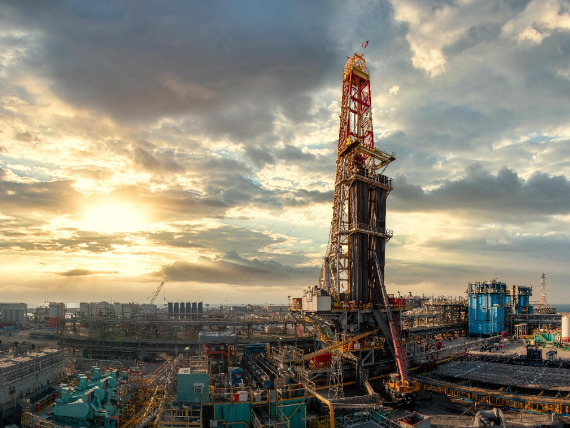
Milestone unlocked in drilling efficiency!
ADNOC just set a new well delivery benchmark, drilling 6,428 feet in 24 hours through some of the UAE’s most challenging carbonate formations.
Why does this matter?
In upstream energy, speed without compromising safety or integrity is everything. Carbonate rock is notoriously tough on equipment and unpredictable to navigate. Achieving this rate of penetration (ROP) by integrating advanced technology, real-time analytics, and seamless cross-functional execution isn't just an operational win, it fundamentally shifts the economics of project delivery.
By drastically reducing non-productive time and days-to-depth, operators can bring energy online significantly faster, lower capital intensity, and reduce the overall carbon footprint per barrel produced.
A massive nod to the engineering and field teams pushing the boundaries of what’s possible in subsurface operations.
Talk about a historic operational turnaround.
Slashing costs, refining margin recovery, and tight inventory management turned last year’s Q2 headwind into a absolute powerhouse quarter for Chevron downstream.
Going from an $800M loss to a $5B profit year-over-year shows just how rapidly downstream leverage can pay off when market conditions line up with disciplined capital allocation and crack spreads widen. Massively impressive pivot by the downstream team
A big win for market transparency and real-world fundamentals.
When pricing aligns directly with physical supply and demand rather than speculative paper trades, it removes artificial volatility, improves price discovery, and gives refiners and traders a true reflection of physical barrel economics.
ADNOC’s shift back toward physical market mechanics is a strong, pragmatic move for crude benchmark integrity across the Middle East. Real barrels driving real value
@nbaldeon13 This is crude futures doing what they do best: evaporating a risk premium. Oil wasn't rallying because barrels were missing; it was pricing in fear of a Persian Gulf supply disruption. Pause in fighting = fear priced out = sharp selloff
Do you agree that Islamist extremists who refuse to assimilate, chant “Death to America,” or burn our flag should be deported immediately ?
A. Yes, absolutely
B. No
This isn't just commercial expansion, it's a textbook geoeconomic play.
By locking up ports, critical minerals and supply routes across Africa, Abu Dhabi is securing the logistics backbone for South-South trade. While others export capital, the UAE is exporting infrastructure control, transforming itself from an oil state into the indispensable gatekeeper of global trade corridors.
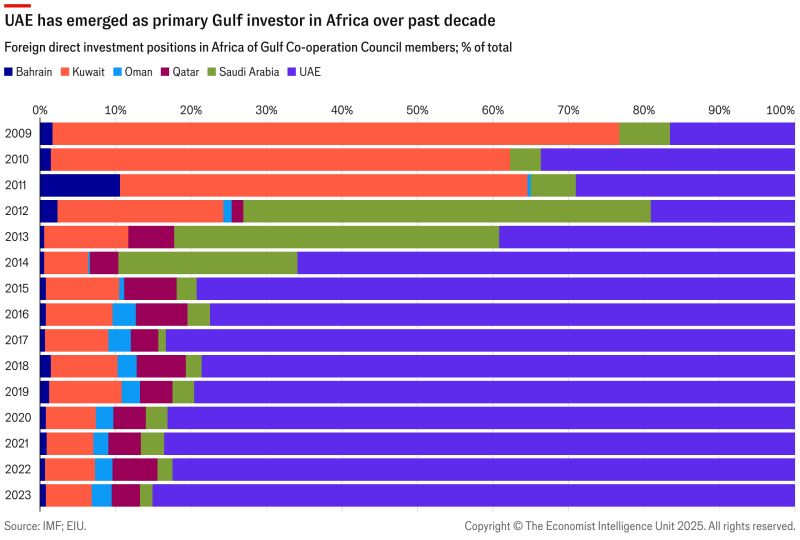
🚨🌍 The UAE has become the Gulf's dominant investor in Africa.
This chart shows a remarkable shift over the past decade.
🇦🇪 The UAE now accounts for the vast majority of Gulf foreign direct investment in Africa, overtaking Saudi Arabia, Qatar, Kuwait, Oman and Bahrain combined.
This isn't just about capital.
It is a long-term strategy built around:
⚓ Ports and logistics
🛢️ Energy and critical minerals
🌾 Food security
🏗️ Infrastructure and industrial zones
The result is a growing network stretching from the Red Sea to the Atlantic, giving the UAE increasing influence over some of the world's most important trade and energy corridors.
The UAE is positioning itself at the center of future global trade flows.