Milestone unlocked in drilling efficiency!
ADNOC just set a new well delivery benchmark, drilling 6,428 feet in 24 hours through some of the UAE’s most challenging carbonate formations.
Why does this matter?
In upstream energy, speed without compromising safety or integrity is everything. Carbonate rock is notoriously tough on equipment and unpredictable to navigate. Achieving this rate of penetration (ROP) by integrating advanced technology, real-time analytics, and seamless cross-functional execution isn't just an operational win, it fundamentally shifts the economics of project delivery.
By drastically reducing non-productive time and days-to-depth, operators can bring energy online significantly faster, lower capital intensity, and reduce the overall carbon footprint per barrel produced.
A massive nod to the engineering and field teams pushing the boundaries of what’s possible in subsurface operations.
Talk about a historic operational turnaround.
Slashing costs, refining margin recovery, and tight inventory management turned last year’s Q2 headwind into a absolute powerhouse quarter for Chevron downstream.
Going from an $800M loss to a $5B profit year-over-year shows just how rapidly downstream leverage can pay off when market conditions line up with disciplined capital allocation and crack spreads widen. Massively impressive pivot by the downstream team
A big win for market transparency and real-world fundamentals.
When pricing aligns directly with physical supply and demand rather than speculative paper trades, it removes artificial volatility, improves price discovery, and gives refiners and traders a true reflection of physical barrel economics.
ADNOC’s shift back toward physical market mechanics is a strong, pragmatic move for crude benchmark integrity across the Middle East. Real barrels driving real value
@nbaldeon13 This is crude futures doing what they do best: evaporating a risk premium. Oil wasn't rallying because barrels were missing; it was pricing in fear of a Persian Gulf supply disruption. Pause in fighting = fear priced out = sharp selloff
Do you agree that Islamist extremists who refuse to assimilate, chant “Death to America,” or burn our flag should be deported immediately ?
A. Yes, absolutely
B. No
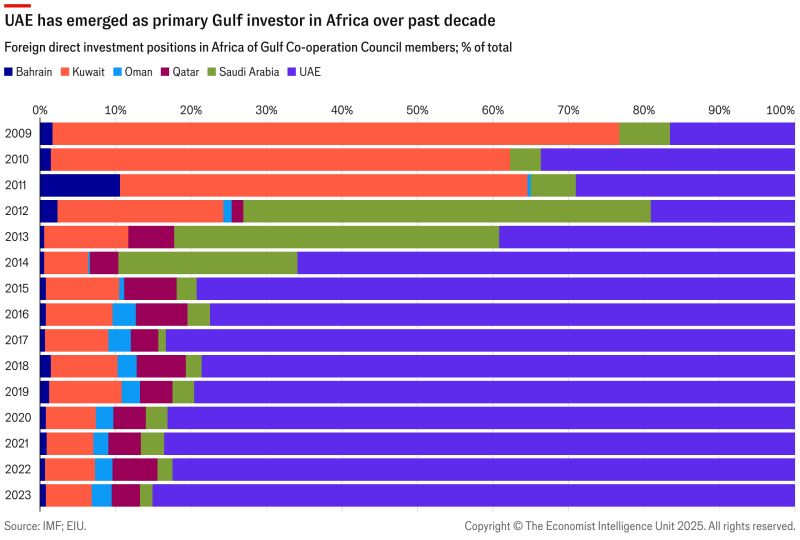
This isn't just commercial expansion, it's a textbook geoeconomic play.
By locking up ports, critical minerals and supply routes across Africa, Abu Dhabi is securing the logistics backbone for South-South trade. While others export capital, the UAE is exporting infrastructure control, transforming itself from an oil state into the indispensable gatekeeper of global trade corridors.
🚨🌍 The UAE has become the Gulf's dominant investor in Africa.
This chart shows a remarkable shift over the past decade.
🇦🇪 The UAE now accounts for the vast majority of Gulf foreign direct investment in Africa, overtaking Saudi Arabia, Qatar, Kuwait, Oman and Bahrain combined.
This isn't just about capital.
It is a long-term strategy built around:
⚓ Ports and logistics
🛢️ Energy and critical minerals
🌾 Food security
🏗️ Infrastructure and industrial zones
The result is a growing network stretching from the Red Sea to the Atlantic, giving the UAE increasing influence over some of the world's most important trade and energy corridors.
The UAE is positioning itself at the center of future global trade flows.
Zero vessels using the established Traffic Separation Scheme in Hormuz says everything you need to know. When operators feel forced into Iran’s unilateral transit schemes just to clear the strait, navigation isn't "normalized", it’s effectively under de facto host control. The risk premium isn't going anywhere until standard maritime protocols return.
Hormuz traffic remains constrained
Traffic remained active through the Strait of Hormuz and Bab el-Mandeb on 2 August, but the two corridors continued to present distinct risk profiles. Hormuz recorded nine confirmed transits, including two sanctioned and two shadow fleet vessels. Seven crossings used the Iranian Unilateral Scheme, while none followed the established traffic separation scheme, underscoring continued route concentration.
Bab el-Mandeb recorded 30 crossings, down from 41 on 31 July, with 20 vessels exiting the Red Sea and 10 entering. Dark transit activity fell to one vessel, improving visibility, though sanctions and Houthi related exposure remain material. The diplomatic outlook is still unsettled. Until US, Iranian and Omani signals converge into clear navigation arrangements, operators should treat both chokepoints as contested rather than normalised.
Stay ahead of the market with #Kpler Insight: https://t.co/eJKtb2V9FI