@yonataalm On the left is a map published in Nature using 843 individuals, on the right is my map. You will see that they are very similar, even though mine doesn't use as many samples.
https://t.co/o1q2alKsLA
@Vamscape The study clarifies domestication was a protracted, multi regional process rather than a single event. However, Yamnaya's integration of the DOM2 lineage remains the definitive baseline for all modern domestic horses.
Facial reconstructions of 14,000-year-old Oberkassel WHGs
The Magdalenian culture, which followed the Solutrean, dates to the end of the Ice Age. Initially, the climate was cold and humid, resembling modern tundra, with mammoths, reindeer, musk oxen, hares, and ptarmigans. During the Middle Magdalenian, conditions became colder and drier as steppe expanded northward. Mammoths disappeared, reindeer retreated north, and horses, saiga antelopes, jerboas, and Asiatic wild asses became the dominant fauna.
People increasingly occupied caves, while polychrome cave art reached its peak at sites such as Altamira and Font-de-Gaume. Flint tools became more specialized, serving mainly as components of composite implements, while bone technology flourished with the production of harpoons, spear points, needles, and fishing gear. The diversity of tools reflects growing craft specialization, organized hunting, and increasingly complex social organization.
In 1914, two Magdalenian skeletons - a 40-year-old man and a 20-year-old woman - were discovered at Oberkassel near Bonn, Germany. Buried about one meter apart, both had been covered in red ochre and capped with basalt slabs. Animal bones and carved bone artifacts accompanied the burials, including a polished bone spatula with a carved predator-head handle and carved horse-head ornaments. Although direct descendants of the Cro-Magnons, both individuals were short but strongly built. The man was particularly robust, with a powerful chest and broad shoulders. His height was only slightly over 1.60 m, while the woman was even shorter, standing at approximately 1.55 m. (Gerasimov 1955)
The anthropologist Mikhail Gerasimov described the Oberkassel man as follows:
The Oberkassel man had a very large, massive, elongated skull, with a cranial length of 198 mm, a breadth of 142 mm, and an exceptionally broad cheekbone width of 155 mm. His face was large, broad, and pentagonal, with massive cheekbones, a narrow forehead, a strong lower jaw, a broad projecting chin, and a narrow, high, protruding nose. His orbits were rectangular with prominent brow ridges. It is evident that he was exceptionally strong and undoubtedly handsome in a rugged, masculine way. As a typical Europoid, he almost certainly had a thick beard and mustache, along with straight or slightly wavy hair.
The Oberkassel woman is described by Mikhail Gerasimov as follows:
Her skull was large and massive, with well-developed relief. It measured 184 mm in length, 132 mm in width, and 131 mm in cheekbone breadth. The brow ridges were well developed, while the nasal bones were large and broad, with only weakly expressed nasal prominences. The occipital bone was broad and almost without curvature. The face was pentagonal, broad, and relatively high, with a massive lower jaw, a broad strongly projecting nose, a slightly prognathic alveolar region, and a projecting chin. The orbits were rectangular with prominent upper margins.
Gerasimov noted that the Oberkassel woman lacked typical Cro-Magnon features. Compared with the man, her skull was lighter and less massive. His reconstruction showed some similarities to the Cro-Magnon woman, such as a sloping forehead and deep-set eyes, but differed in having a broader, shorter nose, less facial projection, and a weaker chin. While the Oberkassel man showed more exaggerated facial proportions, the woman retained more ancestral traits.
Observations of Late Paleolithic and Mesolithic skulls in Europe show that some exhibit facial flattening as pronounced as that of the most strongly expressed modern Mongolid populations, affecting both the orbital and subnasal regions. The Oberkassel male and female are notable examples: their nasomalar angles measure 143° and 146°, and their zygomaxillary angles 137° and 133°, respectively. Both the absolute values and the relationship between these angles indicate a "harmonious" or "complete" degree of facial flattening comparable to that seen in the most pronounced modern Mongolid populations (V. P. Yakimov, 1956, 1960; I. I. Gokhman, 1958).
The Oberkassel individuals were short but robust and, according to Gerasimov, were neither primitive nor unattractive. Their short stature, like that of other late Cro-Magnons, was attributed to the harsh conditions of the Magdalenian period.
The Oberkassel Man carried Y-DNA haplogroup I2-V4921 and mtDNA haplogroup U5b1. The Oberkassel Woman shared the same mtDNA haplogroup (Posth et al 2023).
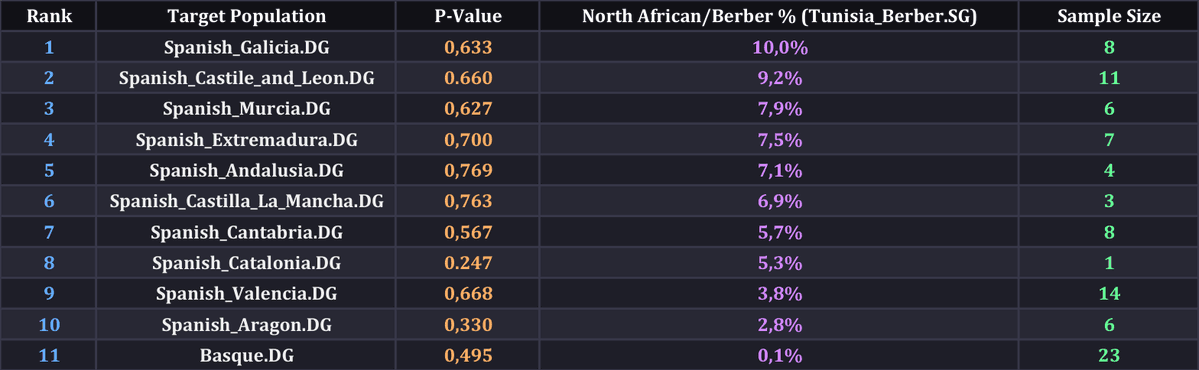
La huella genética árabe es nula porque la invasión musulmana siendo pequeñísima la que queda es bereber que antes de ser musulmanes eran mediterráneos, pero no árabes
Por cierto del mínimo porcentaje el lugar que más huella tiene es Galicia, por encima de Andalucía
Facial reconstruction of a 3,600-year-old man from the Dnieper steppe, Novoalekseevka, Ukraine, Kurgan 6/6
The Srubnaya culture was an Iranic-speaking culture related to the largely Corded Ware-descended Proto-Indo-Iranic Sintashta and Andronovo complexes. It largely replaced the earlier Yamnaya, Catacomb, and Poltavka cultures across the Pontic–Caspian steppe.
The culture takes its name from its characteristic timber-lined grave constructions used in burial pits. Its cemeteries typically consisted of groups of five to ten kurgans. Burials often included animal skulls and forelimbs, along with ritual hearth offerings. In some cases, stone cists were also used. Srubnaya settlements were made up of semi-subterranean dwellings, often featuring two-room layouts. The presence of bronze sickles, grinding stones, and the remains of domestic cattle, sheep, and pigs indicates a mixed economy combining agriculture with animal husbandry.
The Srubnaya individuals from the Dnieper Steppe had an average cranial capacity of 1488 cm³ for males and 1331 cm³ for females. Males had a large average cranial length of 192.9 mm, a medium-small cranial breadth of 136.6 mm, a medium cheekbone breadth of 134.0 mm, and a medium-large bigonial breadth of 102.2 mm.
The male Srubnaya population from the Dnieper Steppe was tall by global standards, with an average stature of 174.2 cm, while females averaged 157.7 cm, placing them slightly above average (S. I. Kruts, 1984).
@Celtiberoca@josebaswagner_@qasfdrw3e4_v2 Dudoso eso de separar a celtiberos en "Celta + Íbero" ya se sabe que los celtíberos no eran un cruce reciente de centroeuropeos e íberos, sino un gradiente local de ancestría esteparia estabilizado desde el Bronce.