It's ironic to see Europe implement the same stupid policy that Brazil has always had. Is Brazil a retailer powerhouse as a result? Of course not. And neither will Europe be. This only forces people to pay more when they could pay less.
From today, customs duties apply to e-commerce parcels worth up to €150 entering the EU.
30 million Europeans work in retail; it's our our largest private-sector employer.
And the surge in low-value online imports has put our retailers at an unfair disadvantage.
Too many of these products also fail to meet EU safety standards, putting consumers at risk.
Today's change is about restoring fairness for European businesses and better protecting our consumers.
Many people dumping on euros for not having AC. They are right. But even those who do cannot use it because of stupid laws. In Spain the government decided that public buildings cannot be colder than 27C in summer! Try going to the mall or exercising in the gym at 27C.
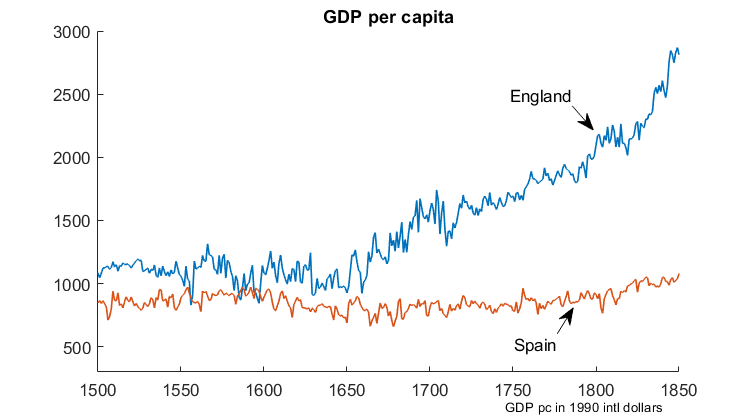
"The series also shows that Spain did not benefit from its empire. That is a problem for every theory tying colonies to modern growth." This is important and surprising: with all the gold and new territory, GDP per capita in Spain did not increase. The figure below shows the same message with a different dataset. GDP per capita in Spain is almost flat between 1500 and 1800. It is not gold that explains the wealth of nations
As my co-author Jonathan Haidt has pointed out, morality on the left became increasingly unipolar, with care for victim groups treated as perhaps the only important moral end. But once people on the left had defended other perceived victim groups, there seemed to be only one place left to go. The result was that the issue was pursued as a quasi-religious social movement rather than as a scientific or public policy question that needed to be carefully thought through and rigorously examined. Once people’s identities revolved around the idea that compassion and care were the highest moral ends, and therefore essentially sacred, hysteria was bound to follow. The Founders tried to guard against this kind of dynamic through things like the pairing of the Free Exercise and Establishment Clauses, but those protections do not work as well when the ideology in question does not call itself a religion.
This is a real problem. I have been thinking a great deal about how to address the problem of religious-like certainty attaching itself to beliefs that are not formally religious, and I still cannot see a solution that would not risk becoming a disaster itself. But I am still pondering it.
Nada te prepara para a quantidade de estudantes universitários trapaceiros. Cada avaliação é uma oportunidade pra trapaça que vários aproveitam. Chutando por baixo, eu diria que pelo menos uns 20% dos estudantes tentam trapacear.
@Fabrici25506118@elivieira É difícil estimar. Semestre passado teve dois estudantes que vieram fazer o exame de reposição. Um deles terminou em 3 minutos e o outro em menos de 2 minutos. Eram umas 20 questões de múltipla escolha. Acertaram quase todas. Mas ainda não sei como.
Muitos continuam trapaceando no 2º ou 3º ano, o que mostra que muitos professores já desistiram da sua função de manter o código de honra, e eles têm certa razão. A grande maioria das universidades já não quer nem saber de rigor acadêmico.
Por que tantos estudantes tentam evitar estudar o tópico que eles mesmo escolheram? A resposta é óbvia: eles não têm o menor interesse pelo curso. São estudantes que só entraram na universidade por pressão social e que, portanto, não deveriam estar ali.
Esse semestre estou ministrando a disciplina de Microeconomia pela primeira vez, e é incrível o quanto governos do mundo inteiro — não apenas os do terceiro mundo — ignoram ou negam a teoria.
Esses exemplos aparecem em praticamente todos os livros introdutórios de Microeconomia. Ainda assim, governos no mundo inteiro continuam destruindo parte da riqueza nacional ao impor controles de preço.
Quanto mais ricos poderíamos ser sem essas intervenções estatais?