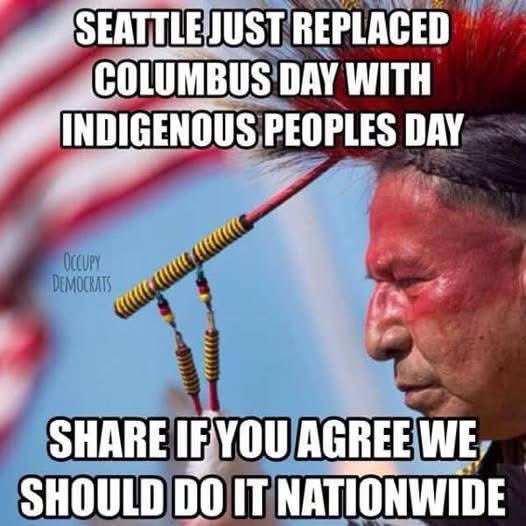
The shift from Columbus Day to Indigenous Peoples’ Day is not about replacing a holiday.
It is about correcting the narrative.
Momentum continues to build. Berkeley, California, led the shift in 1992. South Dakota has celebrated Native American Day since 1990. Hawaii marks Discoverers’ Day.Seattle officially replaced Columbus Day with Indigenous Peoples Day in 2014, and an ordinance in 2022 made it a legal holiday. This shift was the result of community advocacy and aims to correct the narrative around Columbus by recognizing the history, sovereignty, and resilience of Indigenous peoples, rather than celebrating a colonizer.
In 2021, President Biden became the first U.S. president to officially recognize Indigenous Peoples’ Day, acknowledging the generational harm that followed Columbus’s arrival.
Every October, the United States confronts a layered legacy — one rooted in exploration, and another in survival, sovereignty, and resilience. In 2025, both Columbus Day and Indigenous Peoples’ Day fall on October 13, but what we choose to uplift says a great deal about our values today.
Columbus Day became a federal holiday in 1971 but has been observed since the 18th century. It commemorates Christopher Columbus’s 1492 arrival in the Bahamas, long taught as the discovery of the Americas. Yet Indigenous nations had lived across the continent for thousands of years before his ships arrived, and historians widely acknowledge he was neither the first European nor the first explorer to reach these lands.
As awareness of that history has grown, so has the movement to reframe the day. More than 130 U.S. cities including Los Angeles, San Francisco, Denver, Seattle, and Phoenix and states such as Minnesota, Oregon, Alaska, and Vermont now recognize Indigenous Peoples’ Day in place of Columbus Day. The goal is not to erase history but to correct it. It seeks to acknowledge the massacres, lynchings, forced displacement, and enslavement of Native peoples and to honor the communities whose cultures, lands, and identities shaped this continent long before colonization.
Indigenous Peoples’ Day is more than symbolic. It is an act of recognition of Native sovereignty, culture, survival, and contributions that influence art, law, agriculture, environmental stewardship, and governance. It invites schools, workplaces, and civic leaders to reexamine the stories they elevate and the voices they center.
The question is no longer which holiday we acknowledge, but whether our institutions, in education, government, business, and culture, are prepared to recognize the full American story. How we mark this day reflects not just history, but the standards of inclusion and truth we choose to lead with now.