The TRL framework was designed for rockets.
It was never built for AI.
Technology Readiness Levels (TRL 1–9) assume innovation moves in careful, sequential steps from basic research to full deployment over years or decades.
AI operates on a completely different timeline.
Agentic AI went from research lab to enterprise production in under 12 months.
By mid-2025, 60%+ of large manufacturers had AI running on the factory floor, up from 35% just 18 months prior.
The FDA approved 223 AI-enabled medical devices in a single year, compared to just 6 back in 2015.
The technology itself is hitting TRL 9.
But the organisations deploying it? Many are still operating at TRL 3.
That gap is the real risk.
TRL measures technology maturity. It does *not* measure human readiness, institutional trust, safety validation, or whether anyone actually knows what to do when a system fails.
Recent research is already calling for a new "AI Readiness Framework"—one that captures reliability, transparency, and human integration, rather than just asking, "Does it work in a lab?"
The old scale hasn't broken. It's just measuring the wrong thing.
👇 What's your experience? Is your organisation's readiness keeping pace with the AI you're deploying?
#ArtificialIntelligence #TechnologyStrategy #Innovation #AIReadiness #DigitalTransformation
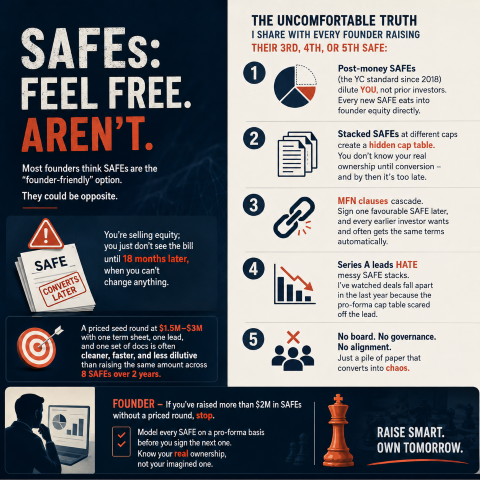
Most founders think SAFEs are the "founder-friendly" option.
They could be opposite. SAFEs feel free. They're not.
You're selling equity; you just don't see the bill until 18 months later, when you can't change anything.
Here's the uncomfortable truth I share with every founder raising their 3rd, 4th, or 5th SAFE:
1. Post-money SAFEs (the YC standard since 2018) dilute YOU, not prior investors. Every new SAFE eats into founder equity directly.
2. Stacked SAFEs at different caps create a hidden cap table. You don't know your real ownership until conversion – and by then it's too late.
3. MFN clauses cascade. Sign one favourable SAFE later, and every earlier investor wants and often gets the same terms automatically.
4. Series A leads HATE messy SAFE stacks. I've watched deals fall apart in the last year because the pro-forma cap table scared off the lead.
5. No board. No governance. No alignment. Just a pile of paper that converts into chaos.
A priced seed round at $1.5M-$3M with one term sheet, one lead, and one set of docs is often cleaner, faster, and less dilutive than raising the same amount across 8 SAFEs over 2 years.
The "speed" of SAFEs is a myth when you're doing your 5th one.
Founder – If you've raised more than $2M in SAFEs without a priced round, stop. Model every SAFE on a pro-forma basis before you sign the next one. Know your real ownership, not your imagined one.
#venturecapital #startups #founders #fundraising #seed
Most founders think SAFEs are the "founder-friendly" option.
They could be opposite. SAFEs feel free. They're not.
You're selling equity; you just don't see the bill until 18 months later, when you can't change anything.
Here's the uncomfortable truth I share with every founder raising their 3rd, 4th, or 5th SAFE:
1. Post-money SAFEs (the YC standard since 2018) dilute YOU, not prior investors. Every new SAFE eats into founder equity directly.
2. Stacked SAFEs at different caps create a hidden cap table. You don't know your real ownership until conversion – and by then it's too late.
3. MFN clauses cascade. Sign one favourable SAFE later, and every earlier investor wants and often gets the same terms automatically.
4. Series A leads HATE messy SAFE stacks. I've watched deals fall apart in the last year because the pro-forma cap table scared off the lead.
5. No board. No governance. No alignment. Just a pile of paper that converts into chaos.
A priced seed round at $1.5M-$3M with one term sheet, one lead, and one set of docs is often cleaner, faster, and less dilutive than raising the same amount across 8 SAFEs over 2 years.
The "speed" of SAFEs is a myth when you're doing your 5th one.
Founder – If you've raised more than $2M in SAFEs without a priced round, stop. Model every SAFE on a pro-forma basis before you sign the next one. Know your real ownership, not your imagined one.
#venturecapital #startups #founders #fundraising #seed
Most people treat a two-way door like a wall.
They stand in front of it for months. Researching. Overthinking. Waiting for perfect certainty meanwhile, the decision sits there, completely unlocked and low-cost.
Jeff Bezos famously built Amazon's operational speed around a simple rule: Most decisions are two-way doors. You walk through. If you don't like what you see, you walk back.
Yet, a global study of 17,000+ people found that 60% struggle to make decisions, paralyzed not by irreversible risks, but by choices that are easily undone.
Here is the truth about reversible decisions:
• You can change the strategy.
• You can change the tool.
• You can change the market.
• You can change your mind.
What you cannot change is the time you spent avoiding the decision.
The real cost of inaction isn't making the wrong call. It’s the months of momentum you lose standing completely still.
The people and organizations that move the fastest aren't necessarily more confident. They have just trained themselves to treat experiments like experiments, not permanent verdicts.
Stop asking: "What if I'm wrong?,"
Start asking: "How quickly can we find out?"
What is one decision you or your team have been treating like a brick wall that is actually just a two-way door?
#DecisionMaking #Leadership #Productivity #GrowthMindset #ExecutiveStrategy
Most people treat a two-way door like a wall.
They stand in front of it for months. Researching. Overthinking. Waiting for perfect certainty meanwhile, the decision sits there, completely unlocked and low-cost.
Jeff Bezos famously built Amazon's operational speed around a simple rule: Most decisions are two-way doors. You walk through. If you don't like what you see, you walk back.
Yet, a global study of 17,000+ people found that 60% struggle to make decisions, paralyzed not by irreversible risks, but by choices that are easily undone.
Here is the truth about reversible decisions:
• You can change the strategy.
• You can change the tool.
• You can change the market.
• You can change your mind.
What you cannot change is the time you spent avoiding the decision.
The real cost of inaction isn't making the wrong call. It’s the months of momentum you lose standing completely still.
The people and organizations that move the fastest aren't necessarily more confident. They have just trained themselves to treat experiments like experiments, not permanent verdicts.
Stop asking: "What if I'm wrong?,"
Start asking: "How quickly can we find out?"
What is one decision you or your team have been treating like a brick wall that is actually just a two-way door?
#DecisionMaking #Leadership #Productivity #GrowthMindset #ExecutiveStrategy
Most companies are buying AI tools faster than they can redesign their own decision-making.
They are trying to scale cutting-edge technology on top of workflows that were never built to handle rapid decisions.
The result? Faster chaos.
This is why so many enterprise AI initiatives quietly stall after the pilot phase. The problem isn’t a lack of intelligence. It’s a broken decision architecture.
Right now, organizations are hitting a wall because of:
Fragmented Ownership: Too many disconnected tools and conflicting decisions.
Operational Noise: Managers overwhelmed by data they don't know how to act on.
The Trust Gap: AI outputs that nobody quite trusts, leading to slow approvals.
Human Bottlenecks: Modern tech forced into legacy approval chains.
AI is exposing a harsh reality: Most companies don't actually know how decisions move through their business.
When you automate tasks without redesigning accountability, governance, or execution flow, you don't get efficiency—you just get errors at enterprise scale.
The companies that win the next decade won't be the ones that automated the most work. They will be the ones that redesigned how decisions are made, validated, and executed.
AI is no longer just a technology layer. It is a mirror reflecting your operational design flaws.
What do you think is the biggest decision bottleneck holding organizations back from true AI ROI today?
#ArtificialIntelligence #BusinessArchitecture #Leadership #DigitalTransformation #OperationalExcellence
Most companies are buying AI tools faster than they can redesign their own decision-making.
They are trying to scale cutting-edge technology on top of workflows that were never built to handle rapid decisions.
The result? Faster chaos.
This is why so many enterprise AI initiatives quietly stall after the pilot phase. The problem isn’t a lack of intelligence. It’s a broken decision architecture.
Right now, organizations are hitting a wall because of:
Fragmented Ownership: Too many disconnected tools and conflicting decisions.
Operational Noise: Managers overwhelmed by data they don't know how to act on.
The Trust Gap: AI outputs that nobody quite trusts, leading to slow approvals.
Human Bottlenecks: Modern tech forced into legacy approval chains.
AI is exposing a harsh reality: Most companies don't actually know how decisions move through their business.
When you automate tasks without redesigning accountability, governance, or execution flow, you don't get efficiency—you just get errors at enterprise scale.
The companies that win the next decade won't be the ones that automated the most work. They will be the ones that redesigned how decisions are made, validated, and executed.
AI is no longer just a technology layer. It is a mirror reflecting your operational design flaws.
What do you think is the biggest decision bottleneck holding organizations back from true AI ROI today?
#ArtificialIntelligence #BusinessArchitecture #Leadership #DigitalTransformation #OperationalExcellence
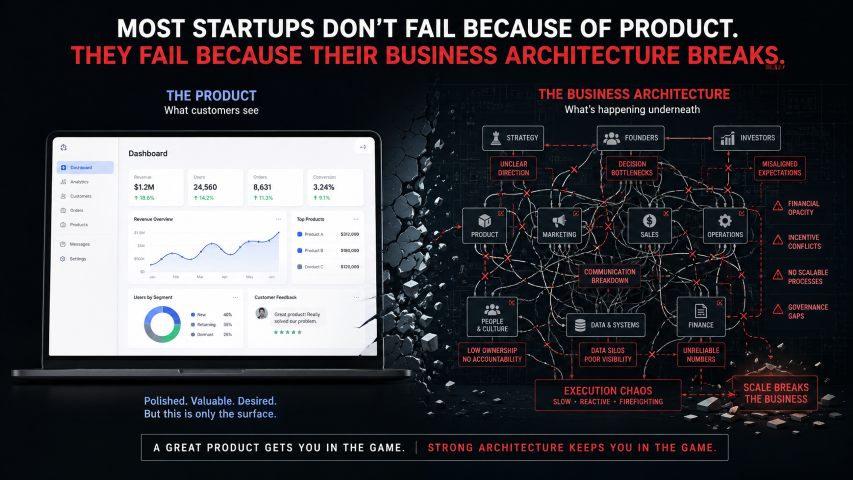
𝐌𝐨𝐬𝐭 𝐬𝐭𝐚𝐫𝐭𝐮𝐩𝐬 𝐝𝐨𝐧’𝐭 𝐟𝐚𝐢𝐥 𝐛𝐞𝐜𝐚𝐮𝐬𝐞 𝐭𝐡𝐞 𝐩𝐫𝐨𝐝𝐮𝐜𝐭 𝐢𝐬 𝐛𝐚𝐝.
𝐓𝐡𝐞𝐲 𝐟𝐚𝐢𝐥 𝐛𝐞𝐜𝐚𝐮𝐬𝐞 𝐭𝐡𝐞 𝐛𝐮𝐬𝐢𝐧𝐞𝐬𝐬 𝐚𝐫𝐜𝐡𝐢𝐭𝐞𝐜𝐭𝐮𝐫𝐞 𝐛𝐫𝐞𝐚𝐤𝐬.
I’ve seen average products survive.
I’ve also seen brilliant products collapse.
The difference was rarely technology.
It was usually:
• unclear ownership
• founder bottlenecks
• operational chaos
• poor decision systems
• incentive conflicts
• weak execution structures
Most startups are built for speed.
Very few are designed for scale.
And eventually, growth exposes every structural weakness.
A startup is not just a product.
It is an operating system.
The fundraising rule has changed for those building now.
It used to be : idea → raise → build.
Now it's: build → prove → raise.
Because in the AI era, building is cheap.
So, investors ask one question first: "If building costs nothing… why hasn't the market responded yet?"
TRACTION. TRACTION. TRACTION.
Revenue. LOIs. Pilots. Waitlists. Feedback loops.
Any signal that proves the market wants what you're building.
Pre-seed in 2026 is about customer validation, not just promising pitch decks.
What's the first traction signal that made you feel investor-ready?
#startups #founders #venturecapital #preseed
𝐆𝐚𝐫𝐲 𝐊𝐢𝐥𝐝𝐚𝐥𝐥 𝐛𝐮𝐢𝐥𝐭 𝐭𝐡𝐞 𝐟𝐢𝐫𝐬𝐭 𝐏𝐂 𝐨𝐩𝐞𝐫𝐚𝐭𝐢𝐧𝐠 𝐬��𝐬𝐭𝐞𝐦.𝐇𝐞 𝐰𝐚𝐬 𝐚𝐥𝐬𝐨 𝐫𝐢𝐜𝐡𝐞𝐫 𝐭𝐡𝐚𝐧 𝐁𝐢𝐥𝐥 𝐆𝐚𝐭𝐞𝐬 𝐚𝐭 𝐭𝐡𝐞 𝐭𝐢𝐦𝐞.
You've never heard of him.
In 1980, IBM needed an operating system for its new personal computer.
They called Gates first.
Gates didn't have an OS. So he pointed IBM towards his friend Gary Kildall, the man who had already built CP/M, the dominant operating system of the era.
IBM flew to meet Kildall.
He wasn't there.
His wife Dorothy handled the meeting. The IBM representatives needed an NDA signed before talks could begin. She refused the terms. IBM walked out.
They went straight back to Gates.
Gates didn't hesitate. He found a small company selling an obscure OS called Q-DOS, Quick and Dirty Operating System, for $75,000. Bought it. Renamed it MS-DOS. Licensed it to IBM.
When IBM's PC launched, MS-DOS was priced at $40.
CP/M, Kildall's original, was offered alongside it at $240.
The market chose. CP/M was dead within two years.
𝐍𝐨𝐰 𝐥𝐨𝐨𝐤 𝐚𝐫𝐨𝐮𝐧𝐝 𝐲𝐨𝐮 𝐭𝐨𝐝𝐚𝐲.
OpenAI. Google. Microsoft. Amazon.
They are all flying to someone's door right now, offering partnerships, integrations, contracts, distribution.
Organisations without clear decision-making authority, without someone empowered to say yes on the spot, without a deal framework already in place?
IBM walks out on them too.
The AI moment is the IBM moment.
And it is happening across every industry. Right now.
𝐓𝐡𝐞 𝐫𝐞𝐚𝐥 𝐥𝐞𝐬𝐬𝐨𝐧 𝐢𝐬𝐧'𝐭 "𝐬𝐡𝐨𝐰 𝐮𝐩."
It's: build a business where showing up is structurally impossible to miss.
Delegation. Decision rights. Deal frameworks. Operational readiness.
That is business architecture.
Kildall had the better product. Gates had the better system.
The system won then. The system wins now.
𝐖𝐡𝐞𝐧 𝐚 𝐩𝐚𝐫𝐭𝐧𝐞𝐫, 𝐚 𝐜𝐥𝐢𝐞𝐧𝐭, 𝐨𝐫 𝐚𝐧 𝐢𝐧𝐯𝐞𝐬𝐭𝐨𝐫 𝐤��𝐨𝐜𝐤𝐬 𝐨𝐧 𝐲𝐨𝐮𝐫 𝐝𝐨𝐨𝐫, 𝐰𝐡𝐨 𝐢𝐧 𝐲𝐨𝐮𝐫 𝐛𝐮𝐬𝐢𝐧𝐞𝐬𝐬 𝐢𝐬 𝐚𝐜𝐭𝐮𝐚𝐥𝐥𝐲 𝐞𝐦𝐩𝐨𝐰𝐞𝐫𝐞𝐝 𝐭𝐨 𝐨𝐩𝐞𝐧 𝐢𝐭?
#BusinessArchitecture #Strategy #Leadership #Entrepreneurship #AI
𝐆𝐚𝐫𝐲 𝐊𝐢𝐥𝐝𝐚𝐥𝐥 𝐛𝐮𝐢𝐥𝐭 𝐭𝐡𝐞 𝐟𝐢𝐫𝐬𝐭 𝐏𝐂 𝐨𝐩𝐞𝐫𝐚𝐭𝐢𝐧𝐠 𝐬𝐲𝐬𝐭𝐞𝐦.𝐇𝐞 𝐰𝐚𝐬 𝐚𝐥𝐬𝐨 𝐫𝐢𝐜𝐡𝐞𝐫 𝐭𝐡𝐚𝐧 𝐁𝐢𝐥𝐥 𝐆𝐚𝐭𝐞𝐬 𝐚𝐭 𝐭𝐡𝐞 𝐭𝐢𝐦𝐞.
You've never heard of him.
In 1980, IBM needed an operating system for its new personal computer.
They called Gates first.
Gates didn't have an OS. So he pointed IBM towards his friend Gary Kildall, the man who had already built CP/M, the dominant operating system of the era.
IBM flew to meet Kildall.
He wasn't there.
His wife Dorothy handled the meeting. The IBM representatives needed an NDA signed before talks could begin. She refused the terms. IBM walked out.
They went straight back to Gates.
Gates didn't hesitate. He found a small company selling an obscure OS called Q-DOS, Quick and Dirty Operating System, for $75,000. Bought it. Renamed it MS-DOS. Licensed it to IBM.
When IBM's PC launched, MS-DOS was priced at $40.
CP/M, Kildall's original, was offered alongside it at $240.
The market chose. CP/M was dead within two years.
𝐍𝐨𝐰 𝐥𝐨𝐨𝐤 𝐚𝐫𝐨𝐮𝐧𝐝 𝐲𝐨𝐮 𝐭𝐨𝐝𝐚𝐲.
OpenAI. Google. Microsoft. Amazon.
They are all flying to someone's door right now, offering partnerships, integrations, contracts, distribution.
Organisations without clear decision-making authority, without someone empowered to say yes on the spot, without a deal framework already in place?
IBM walks out on them too.
The AI moment is the IBM moment.
And it is happening across every industry. Right now.
𝐓𝐡𝐞 𝐫𝐞𝐚𝐥 𝐥𝐞𝐬𝐬𝐨𝐧 𝐢𝐬𝐧'𝐭 "𝐬𝐡𝐨𝐰 𝐮𝐩."
It's: build a business where showing up is structurally impossible to miss.
Delegation. Decision rights. Deal frameworks. Operational readiness.
That is business architecture.
Kildall had the better product. Gates had the better system.
The system won then. The system wins now.
𝐖𝐡𝐞𝐧 𝐚 𝐩𝐚𝐫𝐭𝐧𝐞𝐫, 𝐚 𝐜𝐥𝐢𝐞𝐧𝐭, 𝐨𝐫 𝐚𝐧 𝐢𝐧𝐯𝐞𝐬𝐭𝐨𝐫 𝐤𝐧𝐨𝐜𝐤𝐬 𝐨𝐧 𝐲𝐨𝐮𝐫 𝐝𝐨𝐨𝐫, 𝐰𝐡𝐨 𝐢𝐧 𝐲𝐨𝐮𝐫 𝐛𝐮𝐬𝐢𝐧𝐞𝐬𝐬 𝐢𝐬 𝐚��𝐭𝐮𝐚𝐥𝐥𝐲 𝐞𝐦𝐩𝐨𝐰𝐞𝐫𝐞𝐝 𝐭𝐨 𝐨𝐩𝐞𝐧 𝐢𝐭?
#BusinessArchitecture #Strategy #Leadership #Entrepreneurship #AI
@prakdadlani After 30 years, the best business relationships stop feeling like business they feel like the kind of friendship that just happens to involve invoices.
The OpenAI Deployment Company (DeployCo) launched last week with $4 billion, 19 global partners, and one very clear mission:
Embed engineers directly inside enterprises to redesign workflows and deploy AI.
Sound familiar? It should.
That's exactly what TCS, Infosys, Wipro, and HCLTech have been doing for 30 years.
The market didn't miss the signal.
Infosys hit its lowest price since December 2020.
TCS touched levels not seen since August 2020.
But here's what most people are getting wrong about this:
The real threat isn't competition, it's displacement from the value chain.
If OpenAI becomes the control layer for enterprise AI, Indian IT firms risk being reduced to low-margin execution arms doing whatever DeployCo doesn't want to do.
Think: cloud vendors in the 2010s. They came as partners. Then they built their own services arms. Then they hired your best people.
The same playbook is running again, but faster.
The firms that survive this won't be the ones with the most headcount.
They'll be the ones that own enterprise trust, governance, and domain expertise.
The 180-person implementation team model is already obsolete.
The question is who admits it first and moves.
Indian IT has navigated Y2K, the dot-com bust, cloud disruption, and automation.
This is the hardest one yet, because the disruptor this time also wants to be your partner.
How do you compete with someone who's both your vendor and your rival?
#IndianIT #AIStrategy #EnterpriseAI #OpenAI #TechIndustry
𝐓𝐞𝐬𝐥𝐚 𝐢𝐧𝐯𝐞𝐧𝐭𝐞𝐝 𝐭𝐡𝐞 𝐦𝐨𝐝𝐞𝐫𝐧 𝐰𝐨𝐫𝐥𝐝.
𝐇𝐞 𝐝𝐢𝐞𝐝 𝐛𝐫𝐨𝐤𝐞 𝐚𝐧𝐝 𝐚𝐥𝐨𝐧𝐞.
Edison and Marconi didn't out-invent him.
They out-maneuvered him.
Tesla held the radio patent before Marconi.
He had J.P. Morgan's funding.
He had the vision.
But Marconi put on a show.
One dramatic demo across the Atlantic ,investors lined up overnight.
Morgan pulled Tesla's funding the next day.
Edison was worse. He electrocuted animals publicly just to smear Tesla's AC current.
Ruthless? Yes. Effective? Absolutely.
Tesla believed the work would speak for itself.
It didn't.
𝐇𝐞𝐫𝐞'𝐬 𝐭𝐡𝐞 𝐫𝐞𝐚𝐥 𝐥𝐞𝐬𝐬𝐨𝐧:
You can be the smartest person in the room and still lose, if you can't see the risks coming and the opportunities in front of you.
Business architecture isn't just for corporations.
It's the difference between building something great and watching someone else get credit for it.
Tesla was the genius. Edison and Marconi were the architects.
Which one do you want to be?
#Innovation #BusinessArchitecture #Strategy #Leadership #TechHistory #tesla
The OpenAI Deployment Company (DeployCo) launched last week with $4 billion, 19 global partners, and one very clear mission:
Embed engineers directly inside enterprises to redesign workflows and deploy AI.
Sound familiar? It should.
That's exactly what TCS, Infosys, Wipro, and HCLTech have been doing for 30 years.
The market didn't miss the signal.
Infosys hit its lowest price since December 2020.
TCS touched levels not seen since August 2020.
But here's what most people are getting wrong about this:
The real threat isn't competition, it's displacement from the value chain.
If OpenAI becomes the control layer for enterprise AI, Indian IT firms risk being reduced to low-margin execution arms doing whatever DeployCo doesn't want to do.
Think: cloud vendors in the 2010s. They came as partners. Then they built their own services arms. Then they hired your best people.
The same playbook is running again, but faster.
The firms that survive this won't be the ones with the most headcount.
They'll be the ones that own enterprise trust, governance, and domain expertise.
The 180-person implementation team model is already obsolete.
The question is who admits it first and moves.
Indian IT has navigated Y2K, the dot-com bust, cloud disruption, and automation.
This is the hardest one yet, because the disruptor this time also wants to be your partner.
How do you compete with someone who's both your vendor and your rival?
#IndianIT #AIStrategy #EnterpriseAI #OpenAI #TechIndustry
𝐓𝐞𝐬𝐥𝐚 𝐢𝐧𝐯𝐞𝐧𝐭𝐞𝐝 𝐭𝐡𝐞 𝐦𝐨𝐝����𝐫𝐧 𝐰𝐨𝐫𝐥𝐝.
𝐇𝐞 𝐝𝐢𝐞𝐝 𝐛𝐫𝐨𝐤𝐞 𝐚𝐧𝐝 𝐚𝐥𝐨𝐧𝐞.
Edison and Marconi didn't out-invent him.
They out-maneuvered him.
Tesla held the radio patent before Marconi.
He had J.P. Morgan's funding.
He had the vision.
But Marconi put on a show.
One dramatic demo across the Atlantic ,investors lined up overnight.
Morgan pulled Tesla's funding the next day.
Edison was worse. He electrocuted animals publicly just to smear Tesla's AC current.
Ruthless? Yes. Effective? Absolutely.
Tesla believed the work would speak for itself.
It didn't.
𝐇𝐞𝐫𝐞'𝐬 𝐭𝐡𝐞 𝐫𝐞𝐚𝐥 𝐥𝐞𝐬𝐬𝐨𝐧:
You can be the smartest person in the room and still lose, if you can't see the risks coming and the opportunities in front of you.
Business architecture isn't just for corporations.
It's the difference between building something great and watching someone else get credit for it.
Tesla was the genius. Edison and Marconi were the architects.
Which one do you want to be?
#Innovation #BusinessArchitecture #Strategy #Leadership #TechHistory #tesla
𝐒𝐭𝐨𝐩 𝐁𝐮𝐢𝐥𝐝𝐢𝐧𝐠 𝐨𝐧 𝐒𝐚𝐧𝐝: 𝐖𝐡𝐲 𝐀𝐫𝐜𝐡𝐢𝐭𝐞𝐜𝐭𝐮𝐫𝐞 𝐢𝐬 𝐘𝐨𝐮𝐫 𝐑𝐞𝐚𝐥 𝐅𝐨𝐮𝐧𝐝𝐚𝐭𝐢𝐨𝐧
You wouldn’t build a skyscraper without a blueprint, yet many leaders try to scale businesses on brittle, static foundations.
As a Business Architect, I’ve learned that a "good foundation" isn’t just about capital, it’s about structural integrity. If your organization isn't designed to handle stress, growth will eventually lead to collapse.
𝐓𝐡𝐞 𝐂𝐨𝐫𝐞 𝐏𝐢𝐥𝐥𝐚𝐫𝐬:
• 𝐀𝐫𝐜𝐡𝐢𝐭𝐞𝐜𝐭𝐮𝐫𝐞 𝐨𝐯𝐞𝐫 𝐈𝐧𝐬𝐭𝐢𝐧𝐜𝐭: A solid structure ensures your data, people, and processes are aligned to a central logic, not just "busy work."
• 𝐓𝐡𝐞 𝐂𝐨𝐧𝐭𝐢𝐧𝐮𝐨𝐮𝐬 𝐅𝐞𝐞𝐝𝐛𝐚𝐜𝐤 𝐋𝐨𝐨𝐩: Architecture shouldn't be rigid. You must build "sensing" capabilities into your core to adjust for market shifts in real-time.
• 𝐒𝐭𝐫𝐮𝐜𝐭𝐮𝐫𝐚𝐥 𝐀𝐠𝐢𝐥𝐢𝐭𝐲: The goal isn't just to get bigger; it’s to build a system that can pivot without breaking the base.
Don't just build to grow. Architect to evolve.
𝐈𝐟 𝐲𝐨𝐮𝐫 𝐩𝐫𝐨𝐜𝐞𝐬𝐬𝐞𝐬, 𝐝𝐚𝐭𝐚, 𝐚𝐧𝐝 𝐩𝐞𝐨𝐩𝐥𝐞 𝐚𝐫𝐞𝐧'𝐭 𝐚𝐥𝐢𝐠𝐧𝐞𝐝 𝐭𝐨 𝐚 𝐜𝐞𝐧𝐭𝐫𝐚𝐥 ��𝐨𝐠𝐢𝐜, 𝐲𝐨𝐮 𝐚𝐫𝐞𝐧'𝐭 𝐛𝐮𝐢𝐥𝐝𝐢𝐧𝐠 𝐚 𝐛𝐮𝐬𝐢𝐧𝐞𝐬𝐬; 𝐲𝐨𝐮’𝐫𝐞 𝐦𝐚𝐧𝐚𝐠𝐢𝐧𝐠 𝐚 𝐬𝐞𝐫𝐢𝐞𝐬 𝐨𝐟 𝐟𝐢𝐫𝐞𝐬
#BusinessArchitecture #SystemsThinking #StrategicGrowth #Leadership