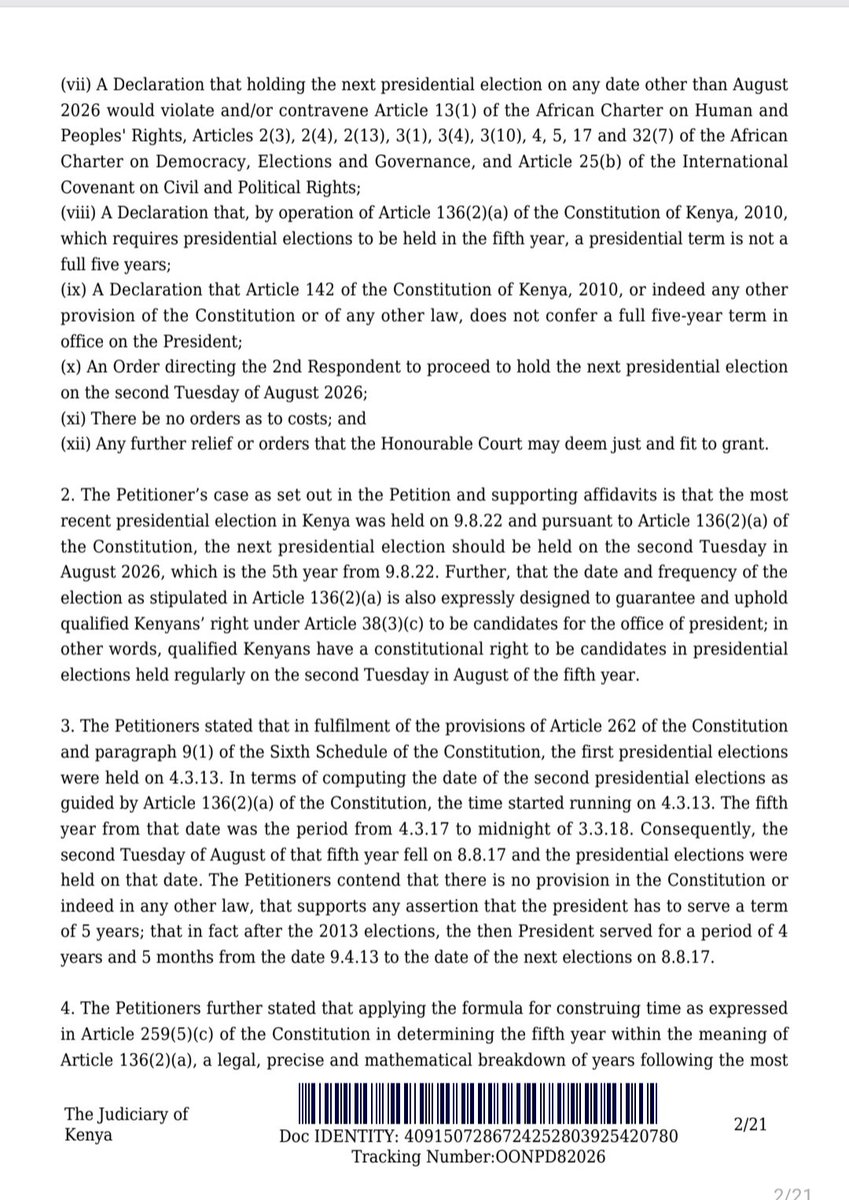
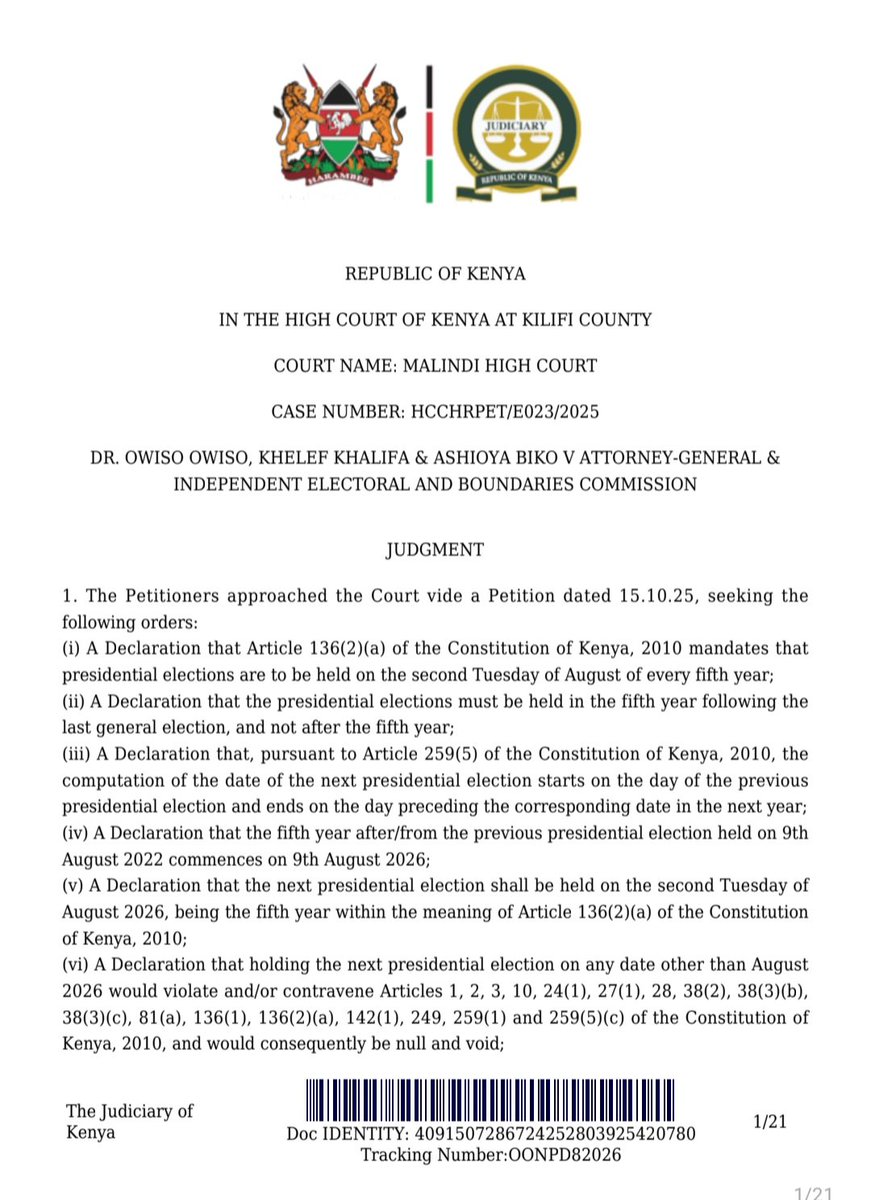
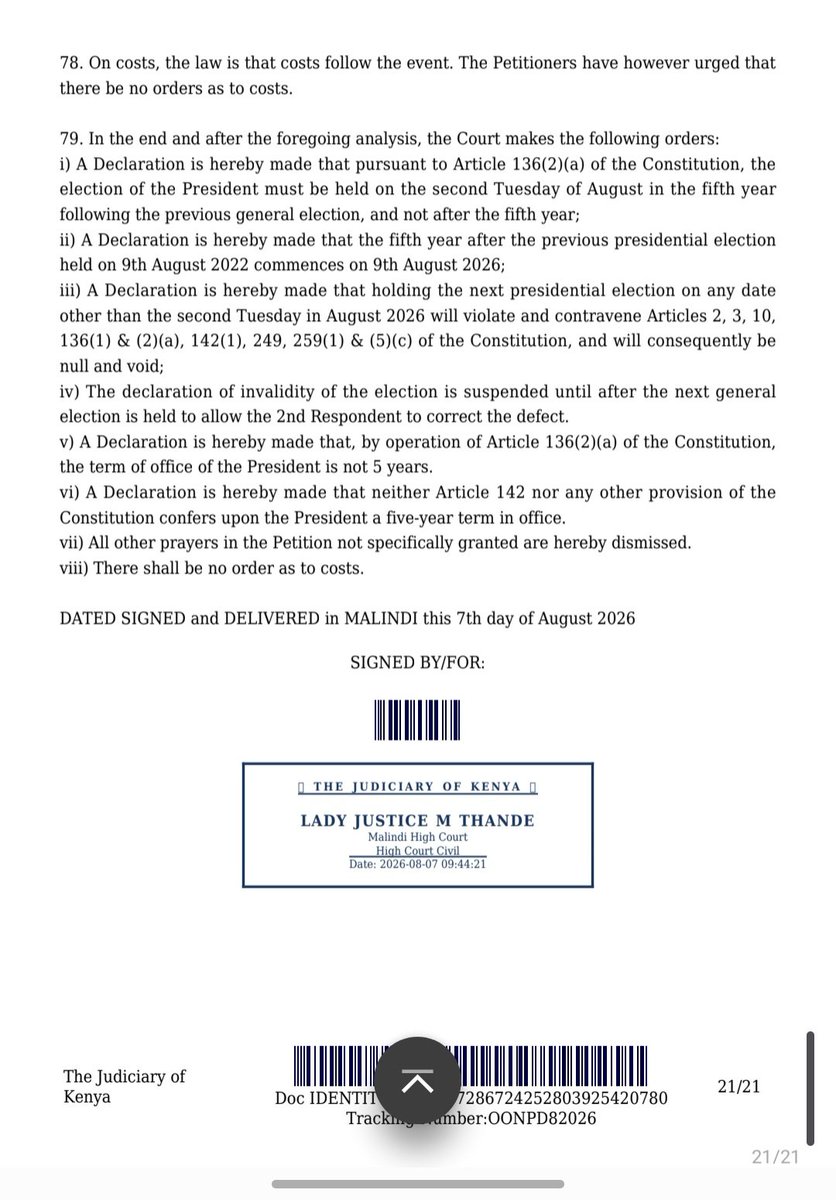
The Malindi High Court judgment is not a call for constitutional panic. It is a serious declaration on electoral timelines and it must be read in its entirety, including the remedy the Court deliberately refused to grant. The Court held that Article 136(2)(a), an election on the second Tuesday of August “in every fifth year” means in the fifth year, not after it. On its computation under Article 259(5)(c), that date was 11 August 2026.
The Court also rejected the view that Article 142 creates an express, guaranteed five-year presidential term. It held that the President’s term begins on swearing-in and ends when the next President, elected under Article 136(2)(a), is sworn in. But that is not the end of the matter. The Court did not order IEBC to conduct an election next week. It declined the mandatory order because it found an immediate poll logistically impossible and likely to produce national instability.
More importantly, the Court suspended the declaration of invalidity until after the next general election, expressly so that IEBC may correct the defect. A suspended remedy is not an invitation to manufacture a vacuum in government. No part of the judgment removes the President from office, converts the presidency into a caretaker arrangement, or restricts any enumerated presidential power. Constitutional authority cannot be diminished by inference where the Court made no such order.
Article 142 itself supplies continuity. The President remains in office until the next President is sworn in. The constitutional order does not collapse merely because a court identifies a contested interpretation of an election timeline. The Court was equally clear that declaratory relief clarifies the law. It does not, without more, compel a specific act or make disobedience contempt. That distinction matters. A declaration is not a mandatory order in disguise.
The judgment raises profound questions on the relationship between fixed election dates, computation of constitutional time, the terms of Parliament and county governments, and the need for simultaneous elections. Those questions deserve calm, principled appellate resolution and not partisan improvisation.
The rule of law requires fidelity to both the Court’s reasoning and its actual orders. We must reject two temptations. Treating the judgment as irrelevant, or overstating it as having already displaced the constitutional government. The enduring constitutional principle is simple. Elections cannot be left to political convenience neither can constitutional remedies be administered in a manner that creates avoidable disorder. The Constitution is not self-destructive but designed to secure both accountability and continuity.
This judgment should prompt an urgent, sober and institutionally responsible legal response. But until varied, stayed or overturned, it remains a High Court interpretation subject to the remedies it granted, the limits it imposed and the appellate process provided by law.
Had a conversation with my cousin who I was with in high school and he reminded me about my obsession with music. He told me I’m one of the few he knew personally that followed his passion and what a timely message. It’s been a season of reflection and whether it’s worth it.
Juzi @WaithakaEnt invited me to his family home to meet his family and friends and what a lovely community he has 🥹🥰
He kept proudly introducing me as his manager, despite how uncomfortable that usually feels for me esp with him 😅
Always appreciate you unko 🙏🏾
@edna_sangaka Thank you for making time to come and meet my family. You’re family and I do appreciate you all the work you’ve put in.
Good things ahead Ms. Manager 🙏🏾
We have moved to the High Court to put an end to an unacceptable illegality that continues to bleed our country dry.
The IMF and the World Bank must operate under the Kenyan Constitution, or they must leave.
https://t.co/vHrwjTq9Uf
In 2017 I nullified a presidential election not because I enjoyed the storm that followed, but because the law demanded it.
That is what the rule of law means.
It applies to everyone, including the powerful.
#Ukombozi
#BBCAfricaEye profiles Tanzanian opposition leader Tundu Lissu as he fights treason charges, for which he could face the death penalty.
Watch the documentary, Tundu Lissu: A Fight Too Far? 🎥 https://t.co/s9pF5KAhXL
The man who came with tears saying Bwana Asifiwe is attacking people in churches. Witime, All Saints Cathedral, St. Stephen’s ACK. We will defeat you and your demonic agendas
Kenyan politicians are hiring armed thugs for as little as $4 per day, as poverty and ruthless political competition threaten to unleash uncontrollable violence ahead of elections next year.
https://t.co/JdMQbDVLU3
#BBCAfricaEye profiles Tanzanian opposition leader Tundu Lissu, who has spent more than a year in prison on treason charges for which he could face the death penalty.
He survived an assassination attempt in 2017 when he was shot 16 times.
🎥 Full film: https://t.co/WRWXi1oWur
How you people thought someone that was part of YK92, a secretary general of KANU an ex ICC indicatee , and a vengeful man could lead this country still baffles me. Worst some of you still think he will change if given a second chance. You are grooming a dictator.
Kenya is not dealing with random criminals, I refuse to join such a chorus. We are dealing with a procurement system of violence with well known politicians as the buyers while the unemployed Kenyans are the commodity trading impunity as their currency!
The goons and criminal gangs have been allowed to run a parallel economy with well known buyers and sellers; until we prosecute the buyers, the market remains open!
As Civil Society Organizations, we will not fall under the pressure of such coercion and intimidation. We will call out these ills for what they are; outright defiance against our Constitution.
I stand with @dianagichengo, @TISAKenya and the entire Civil Society community.