This is the last year I create content in 2D.
To prove it I’m releasing an 11-minute 4DGS video in partnership with @4DV_ai where every single shot is dynamic 3D. Over the next 12–18 months, I'll be moving my filming exclusively to dynamic 3D.
Thank you so much to @NVIDIAAI and @Dell for making this video possible.
Here's an automotive 4DGS clip from over the weekend and no I'm not talking about Tesla's Reality View. @F1 brought 4DGS to break down everything that happens in 2 seconds during a pit stop.
just AirDropped myself back to a hiking trail in Kazbegi, Georgia 🌼
I pinched a photo off my iPhone, opened my hand, and the trail was right there in my room. I made the little daisies and the other wildflowers with Tripo. This is PinchDrop on Apple Vision Pro.
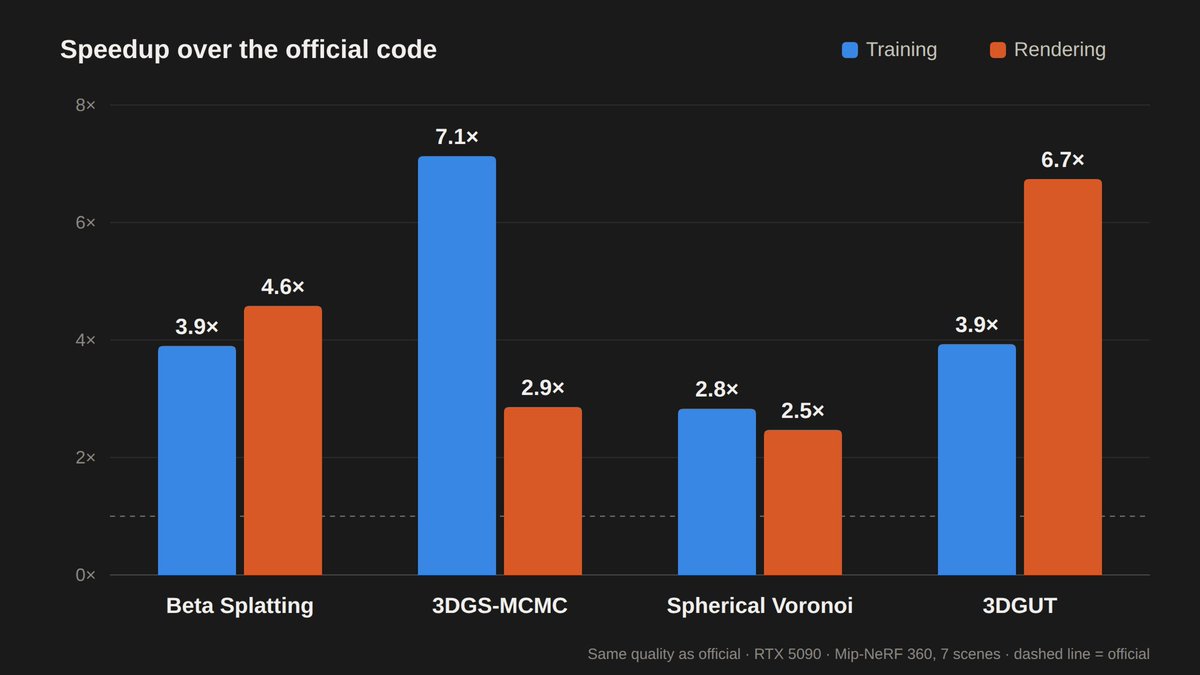
Aparently 3DGUT can be rendered 6.7x faster without losing quality!
I was curious to try the Faster-GS recipe on alternative Gaussian Splatting methods and was surprised how well it transfers.
All these methods have been added to MojoSplat: https://t.co/2EGs6zzmmo
Animated SOG (.asog): a compressed format for 4D Gaussian splat clips.
About 11x smaller than the TRiGS files, full spherical harmonics, sound in the file, streams in the browser.
Open source, MIT.
Try it: https://t.co/VCiCORx2ix
Code: https://t.co/Zgyd17g72H
A world model you can fly. 🏔️
ViewNeXt soars over the valley, through the church, down the street, on any camera path you command, all from one image or a few.
Every frame is generated.
#1 in LPIPS against 15 prior methods.
@SpenserFX The first render of this, actually, it had me have him dissolve like Thanos on checkmate, but I felt like that might be a bit too visceral 🤣
5/ What’s next: Gaussian splats.
Splats capture a real person, object or place from photos or video and turn it into millions of tiny 3D points.
The result is real-world footage you can drop into a 3D scene, then light, animate and render like CGI. Artists are already using them in music videos and installations.
Been deep in pixel-art gaussian splats the last couple days.
People asking for "prompts" so here is how it actually works instead... it's not just a single prompt, each one is a single full spec but it encompasses all of the following.
The core is a bunch of 3D gaussians, little oriented ellipsoids, all built in code.
No images, no models loaded. Each one gets projected to the screen, sorted back to front every frame, and drawn with a firm core so they read as crisp pixels instead of fuzz.
Render to a 640x360 buffer, scale up 3x, snap to a palette, light dither. That's where the pixel art look comes from.
Lighting every spat makes them look much better, warm light (like fire with the tree for example) vs cool light like the moonlight. Flat colors splats look terrible (like the qwen 27b example).
@Danilin2011 I suppose it depends what you’re comparing it to, but most likely you would get more accurate poses in RealityScan/Metashape, but adds another platform
New Spirula Studio update.
Address rolling shutter, focus breathing, and small pose errors.
Experimental GLOMAP and FlexGlue feature matcher join the internal SfM that was already crazy fast.
Article: https://t.co/xpqwveVQKo