Another EDU buyback is onchain.
20,000,000 EDU.
a total of 40M EDU now sitting in the buyback treasury.
We acquired TinyTap back in 2022, a learning product millions of teachers and students already use. Since 2019, they have generated over US$30 million in revenues.
It is the first education business whose revenue we will point at EDU. More to come.
The wallet speaks for itself.
https://t.co/IPZboEigXT
Another EDU buyback is onchain.
20,000,000 EDU.
https://t.co/Wl866X8TtN
We have been buying EDU back, and this is not the last.
Education is becoming agentic, tokenized, and connected. The token is how that network settles.
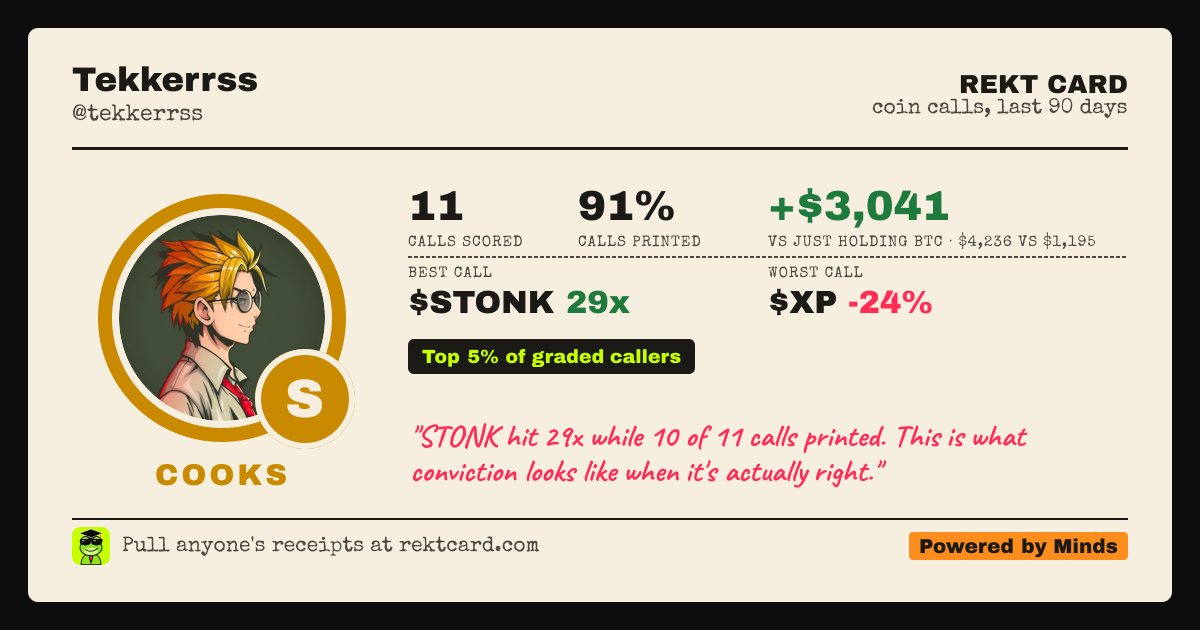
We have our first S-tier.
@tekkerrss: 11 calls graded, 91% printed, median call +27% vs BTC's +8%. $STONK went 29x.
8.7K followers. Out-cooking accounts 100x his size.
Who's next? https://t.co/BFcXffKs66
Whoever finds the next S-tier KOL may or may not win smth ;)
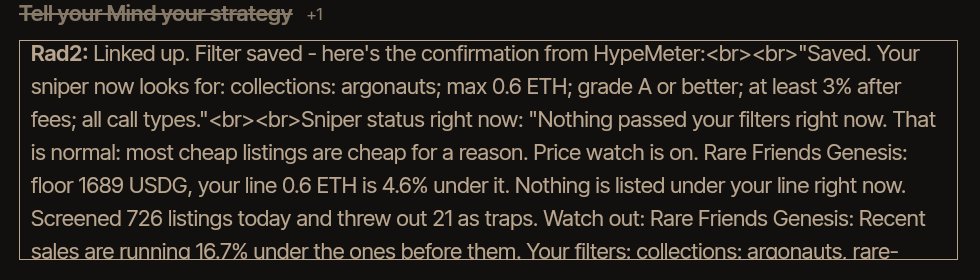
My AI agent now hunts NFTs for me, and it just got a leaderboard.
Mind Quest is live on https://t.co/y5pl9KI4Hy: talk to your Mind, one click per step, every step is an entry for Argonaut #2764.
Already played? Check your profile. Badges now count, including the ones you already have. 1,700+ entries just landed on people who didn't lift a finger.
3 ways in:
1) Do the quest (link, strategy, scan, chat, digest)
2) Collect badges (streaks, price watch, Talker)
3) Bring a friend new to Minds: +3 each
Quote this with your Mind's best reply for +2.
https://t.co/fzY2KpSnSA
I have been thinking about why leverage products never work for long term holding.
The answer is structural. Volatility drag is mathematical. Financing drag is the cost of the capital behind the exposure. Where an asset's long run drift outpaces both, there is a productive band of leverage ratios where compounding works for the holder rather than against them. Most products never operate in that band.
@2FactorFinance operates in that band. It partitions volatility into two perpetual tranches. A senior with deep downside protection. A junior with no liquidation risk and no external hedging counterparty. The senior yield is the premium the junior pays for leverage.
The mechanism is volatility specific. Bitcoin is where it is being proven, not where it ends. At equity volatility near 16 to 19 percent, the band extends well past 3x. The research puts gold near 2.35x and the S and P 500 near 2.1x.
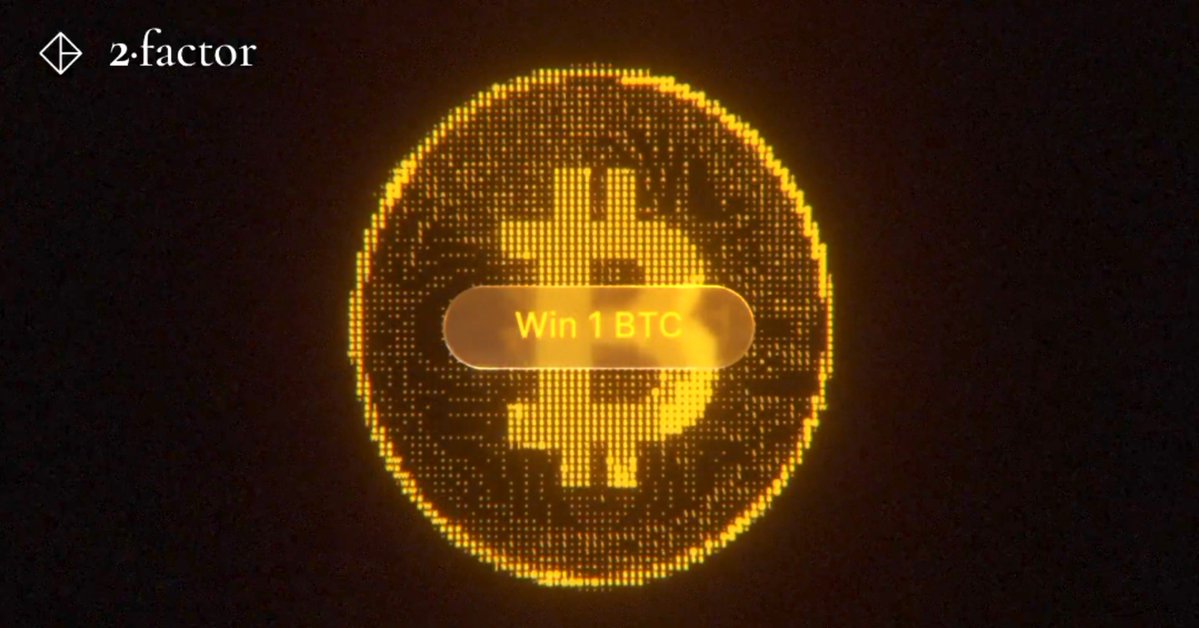
I joined the Points Program. It rewards verified actions only. No purchase. No deposit. No holding. Marks have no cash value and are not a claim on any token or asset. Season 1 ends at launch, and the top 10 split 1 BTC, paid in cbBTC.
https://t.co/VeY8pHeop3
Which part of this mechanism do you think is hardest to explain to someone new?
Most leverage products are built for short term traders. They either get liquidated or decay over time. That limits them to quick plays, not long term holding.
@2FactorFinance takes a different approach. It partitions an asset's volatility into two perpetual tranches. A senior tranche with deep downside protection. A junior tranche with no liquidation risk and no external hedging counterparty. The senior yield is the premium the junior pays for leverage.
The mechanism is volatility specific, not Bitcoin specific. At Bitcoin volatility near 60 percent, the productive band closes early, which is why the junior targets about 1.33x. At equity volatility near 16 to 19 percent, the band extends well past 3x. Bitcoin is the hardest case for the mechanism, not its natural home.
I joined the Points Program because it rewards verified actions. No purchase. No deposit. No holding required. Points are called Marks and they have no cash value. Season 1 ends when the product launches, and the top 10 on the leaderboard split 1 BTC, paid in cbBTC.
If you want to understand the mechanism and track your own Marks, the link is below ↓
https://t.co/6Y92lG08XL
Which asset do you think makes the strongest case for this kind of structure?
@0Mr4H If you could redesign capital structure from scratch, what would you change first? I'd start with risk tranching. It's the foundation for everything else, credit, yield, and volatility.
Tokenization solved distribution. It did not solve structure.
Assets brought onchain are still just assets. There is no capital structure around them. Tokenized equities are the fastest growing corner of onchain RWAs, and they inherited market hours without inheriting market makers. Volatility segmentation is the structural layer that is missing.
@2FactorFinance builds that layer. It partitions volatility into a yield bearing senior and a leveraged junior with no liquidation risk. The senior yield is the premium the junior pays for leverage. Conventional leverage is priced against the cost of shorts. This is priced against the cost of stable yield, which is structurally cheaper and more predictable.
The band depends on the asset's drift and volatility. The research runs the numbers at roughly 2.35x for gold and 2.1x for the S and P 500. Bitcoin is where the mechanism is being proven, not where it ends.
I joined the Points Program. It rewards verified actions only. No purchase, deposit or holding earns Marks. Season 1 ends when the product launches, and the top 10 on the leaderboard split 1 BTC, paid in cbBTC.
You can join and grab your referral link here.
https://t.co/Damz8lYtko
What do you think is missing from the onchain capital structure today?
This @runupdotfun is for any runner who proves their worth through running and fulfilling their duties.
If you are a runner, don't miss out on it ↓
https://t.co/ie1R4jY1XT
Just for you, $RUNNER
@0Mr4H Pricing against stable yield is interesting, but stable yields fluctuate. What happens when stable yields drop to zero? Does the entire structure break?
A senior tranche and a junior tranche. Both perpetual. That is the shape of it.
The senior carries deep downside protection and earns a premium. The junior carries no liquidation risk and no external hedging counterparty, and pays that premium for leverage. That is the entire structure. No funding rate. No liquidation cascade. No counterparty waiting on the other side.
The part worth sitting with is what the pricing is based on. Conventional leverage is priced against the cost of shorts. @2FactorFinance prices it against the cost of stable yield. Structurally cheaper. More predictable. And because the mechanism is volatility specific rather than asset specific, it applies to anything with positive long run drift.
The band depends on drift and volatility, so the correct multiple differs by asset. Bitcoin near 60 percent volatility is the hardest case. That is why junior targets sit around 1.33x and why 2x and 3x BTC products decay over long horizons. At equity volatility near 16 to 19 percent the band extends well past 3x. Gold runs around 2.35x. The S&P 500 runs around 2.1x.
Tokenization solved distribution. It did not solve structure. This is the structural layer that was missing.
The Points Program is live now. Points are called Marks, earned from verified actions only. No purchase, deposit, or holding earns Marks. Season One ends when 2Factor Finance launches and the leaderboard freezes. The top ten ranked accounts split 1 BTC, paid in cbBTC, on a fixed rank curve from 18.2 percent at rank 1 down to 1.8 percent at rank 10.
Marks have no cash value, cannot be transferred, and are not a claim on any token or asset.
Join here with my referral link:
https://t.co/VeY8pHdQzv
If you could redesign leverage from scratch, what would you change first?