El truco para leer libros largos con un LLM no es pedirle que
te lo resuma.
Es generar una web con un resumen visual por capítulo, hacer
skimming encima, y decidir qué capítulos te merece la pena
leer de verdad.
Los 500 páginas de Inverting the Pyramid, así 👇
@alvarombt Si nos ponemos tontorrones claude/orca/amp/t3 es un entorno integrado de desarrollo tambien.
Entiendo lo que quieres decir y yo tambien llevo a lo mejor un par de años sin abrir un editor de codigo linea a linea pero es que ahora el codigo se edita con otro tipo de IDE.
Leyendo esto me queda la sensacion que cada vez vamos a mas mercados "the winner takes it all" y menos a crear ecosistemas.
Cada vez somos menos inocentes.
Los bots de orca son muy similares a los de X pero en self hosted. Lo cual reconozco que a mi me tiene capturado. Si no los tuviese tendria una gran curiosidad por usar https://t.co/P4ihRJBk1C
Ya tengo 9 bots en orca.
Tengo uno que ahora se dedica a trackear los examenes y las tareas que tienen mis hijos.
El robot les persigue. Estan acojonados... con razon.
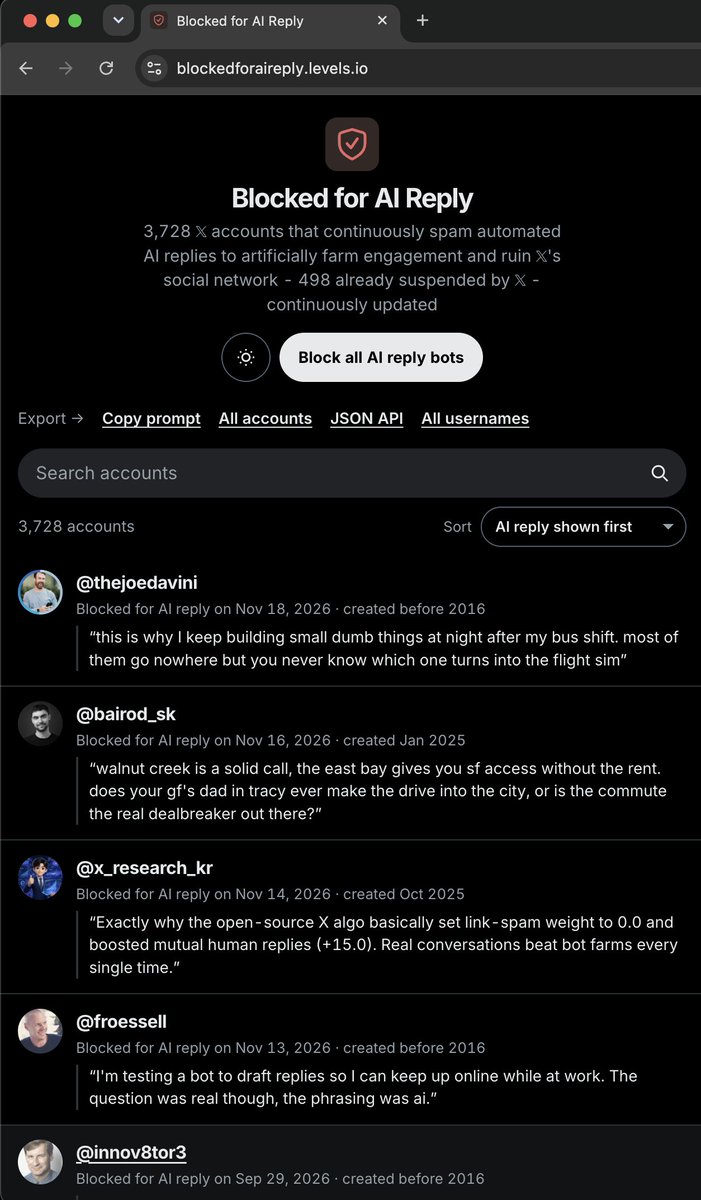
It took a while but as promised here it is...
"THE 𝕏 SPAMMERS LIST"
🛡️ Blocked for AI reply
https://t.co/0kzHNGpOrr
3,728 𝕏 accounts that continuously spam automated AI replies to artificially farm engagement and ruin 𝕏's social network - 498 already suspended by 𝕏 - continuously updated
✅ Evidence for every blocked account
✅ One-click block all button
✅ Continuously updated JSON API
✅ Text-only username list
Based on @ryanvogel's original Clankwall and @dillon_mulroy's X list
I hope everyone uses this and keeps using it, so my account becomes a honeypot for AI replies, once I block them they're blocked by the entire network and they stop being able to reply to anyone
+ It'd be cool to add more "scouts" like @ThePrimeagen and @JackEllis and sync their block list continuously too cause they and many others have the same issue
I've also submitted this list to @X's CEO @petersellis to train their spam models on
Again it'll be continously updated!
Enjoy a spam free 𝕏 experience! 😊🙏
Veo arquitecturas de enjambres de agentes y me recuerdan a la época de los microservicios: el diagrama siempre era la parte fácil. El papel lo aguanta todo.
Me llama la atención que la gente se sorprenda con los temas de que se están resolviendo los problemas tipo Riemman. Supongo que así se sintió la gente que empezó a usar ordenadores.
La cosa es que entonces no había twitter ni era algo con tanto acceso para todo el mundo.
Los bots de orca son justamente lo que necesitaba. He migrado lo que tenia en Hermes ahi.
Ya se que es un poco lo de todos los huevos en la misma cesta pero...
OpenAI's GPT-6.2 intro is such an uninspiring and sad vision of the future
your reward for AGI: a 9 to 5 desk job in a cubicle
meanwhile Anthropic: the future is out there, go do something great
I have a major result to share.
I’ve found conclusive forensic evidence that the top 4 Chinese AI labs—DeepSeek, Moonshot, MiniMax and Ant Group—have built their newest models on NVIDIA’s most advanced Blackwell chips, which are barred from export to China.
This sounds insane, but I discovered that almost every AI model carries a hidden signature of the GPU that trained it. When a model is first set up, the starting values of its weights are laid out in a pattern that depends on the exact GPU. Each combination of GPU and seed number produces a unique pattern—a sort of fingerprint of the hardware used to create the model. Traces of that pattern survive training into the published model.
Again, this evidence isn’t based on any insider information or leaking. It’s based on a forensic analysis of the model weights released by the companies themselves.
I searched more than six trillion combinations of chip layout and seed number and matched them to open-weights models. In doing so, I found conclusive evidence that six Chinese AI models—including DeepSeek-V4-Pro, Kimi K3, and MiniMax-M3—were initialized on NVIDIA Blackwell systems. Four of the models match Grace Blackwell, the GB200 and GB300 parts in NVIDIA’s flagship liquid-cooled rack-scale systems.
I then verified these results on real hardware. Running unmodified PyTorch with the seeds I’d recovered, a Blackwell B300 reproduced DeepSeek-V4-Flash’s untouched starting weights bit for bit, and a rented GB200 reproduced Kimi K3’s to a correlation of 0.999995. A Hopper H100 reproduced none of DeepSeek-V4-Flash’s, and changing the seed by one broke the match. (DeepSeek’s seed is 953049583 by the way.) The method also was verified to match 24 known open-weights models to the hardware that developers said they used.
It is exceedingly unlikely that these results are a coincidence. Across six trillion combinations, the best accidental match should reach only about 8 sigma (i.e., eight standard deviations above what random chance would produce). The real matches range from 49 to 1,385 sigma, and even the weakest single test hits 20.
These were data-center-scale training runs. With some analysis of release schedules and model details, I estimate that the largest, Kimi K3 and DeepSeek-V4-Pro, used 2,000 to 3,000 Blackwell GPUs each. Clusters of this size cost on the order of $150 to $200 million each to buy, and across these labs alone would add up to more than half a billion dollars of export-controlled GPUs, not counting experimental compute or otherwise. It’s quite likely that we see multi-billion dollar expenditure on export-controlled GPUs.
I am highly confident in this result, and it has been independently verified by senior researchers at OpenAI and Anthropic. You can read the full report at https://t.co/YOtzND0Jqk.
There is much more I’ve identified about these models through other forms of checkpoint forensics like this, and will have more to share soon.
@alvarombt El dique que empiezo a ver es que la gente “normal” no está acostumbrada a automatizar todo. La gente con la mentalidad adecuada de automatizar absolutamente todo le irá bien.