7/ If you're building agents, automation or onchain tools, AVM gives you the missing execution layer:
☄️run code
☄️manage wallets
☄️automate onchain actions
☄️operate outside the prompt
Build agents that actually do things 👉https://t.co/Zj9fzQEUWv
6/ What’s coming next:
➡️Agents operating directly on the crypto platforms people already use
➡️More persistent environments for long-running agents
➡️x402-native flows where agents can pay, get paid, and access services autonomously
The goal is simple: make web3 agents actually usable.
4/ Under the hood, AVM already includes:
🟠Wallet integrations and execution flows
🟠Sandbox lifecycle management
🟠Terminal and filesystem access
🟠Agent configuration layers
🟠Compute usage metering
And we're beginning to connect agents directly to payments and trading rails.
3/ Today, developers using AVM can:
1️⃣Run agents in isolated sandbox environments
2️⃣Attach wallets and perform onchain actions
3️⃣Access terminals and filesystems
4️⃣Configure agents and trigger them through webhooks
In other words: agents stop being chat assistants and start behaving like software.
2/ AVM is infrastructure for crypto-native agents.
Instead of limiting agents to prompt interfaces, developers can run them inside real execution environments where they can write code, execute tasks and interact with crypto systems.
1/ Most AI agents in crypto can talk. But they can’t actually operate.
They live inside prompts instead of real environments where they can run code, access wallets, and interact with the ecosystem.
That’s the gap we built $AVM to solve.
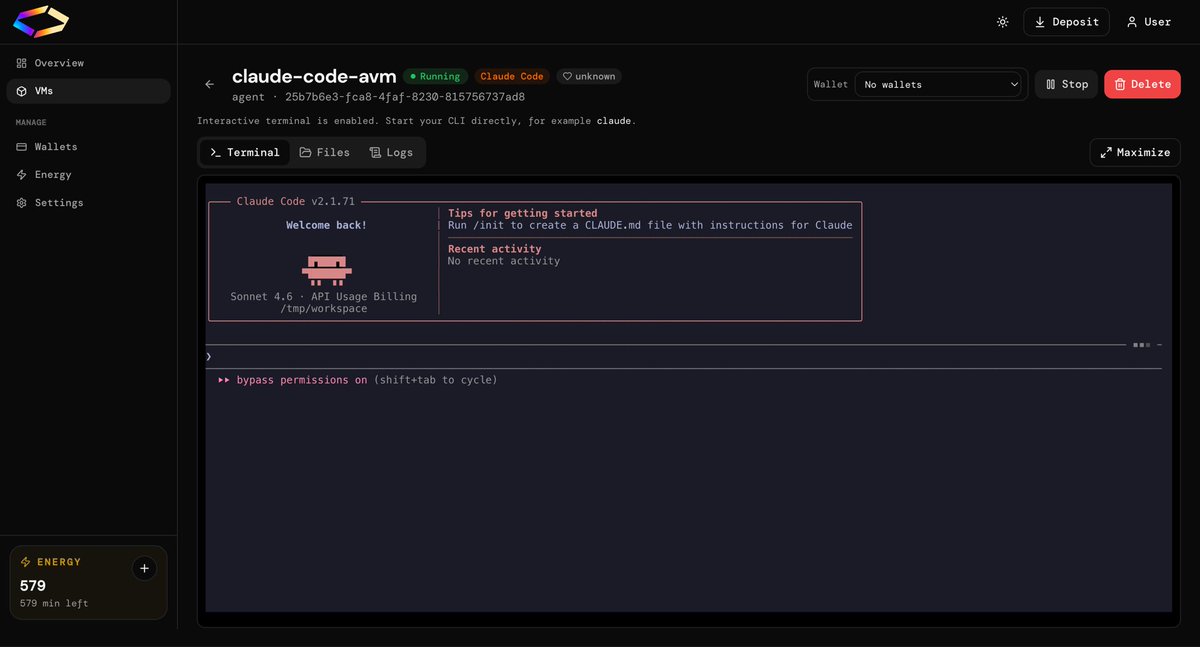
Run Claude Code in the terminal with your own API.
Spin up multiple Claude Code instances. Orchestrate them across isolated sandboxes.
This is the future AVM is building.