PSA:
Think about what you do in a grocery store. You're inundated by brands and the opportunity for brainless consumption is all around you. Do what you want, but be intentional about it.
Read more
https://t.co/PDHFqMh5D0
hosting a grocery rave at foodstories in bangalore next week! 🍇🍞🎧
drop by if ya’ll enjoy food tasting, grocery shopping, grooving in supermarkets and the like
link in comments
Had a Jane Street interview in 2013 that still bothers me.
It was my 6th round. Final interview. The guy walks in carrying no laptop, no notebook, just a cold brew and what I later realized was a single IKEA tea candle.
He writes on the whiteboard:
food: $200
rent: $800
utilities: $150
candles: $3,600
family: dying
Then he turns around and says, “Optimize.”
I laughed because I thought it was a culture-fit bit. He did not laugh.
So I said, “Well, obviously you spend less on candles.”
He says, “Assume candles are non-discretionary.”
Okay.
I start building a model. Basic constraint satisfaction. Family survival as a soft penalty. Candles as a state variable. Maybe there’s an arbitrage where you buy wholesale paraffin and convert the $3,600 line item into inventory.
He stops me.
“You’re thinking like a consultant.”
That’s when I knew I was in trouble.
He says, “Give me a bid-ask on family dying.”
I say, “What?”
He says, “You’re long candles, short family. Where do you make markets?”
I try to recover. I say the real issue is liquidity: rent and utilities are fixed, food is elastic, candles are emotionally inelastic. Therefore the optimal strategy is to securitize future candle enjoyment and borrow against it.
He nods for the first time.
Then he asks, “What time do you sell the candles?”
I say, “Whenever the market is liquid?”
He says, “Be more specific.”
I say, “Uh… 10 a.m. Eastern?”
For the first time, he smiles.
He goes, “Every day?”
I say, “Every day.”
He says, “In size?”
I say, “In size.”
He says, “And what do we call that?”
I say, “Market manipulation?”
The room gets very quiet.
He looks disappointed and writes something down.
“No. We call it providing liquidity to candle ETFs during the U.S. cash open.”
I try to save it. “Right. Of course. The family isn’t dying because we underfunded them. They’re just experiencing temporary price discovery.”
He nods again.
Then he points back at the board.
I had missed it. The utility bill was $150, but candles provide light. You can zero out utilities.
I update the budget:
food: $200
rent: $800
utilities: $0
candles: $3,750
family: still dying, but now in a more capital-efficient way
He says, “How confident are you?”
I say, “0.95.”
He smiles and circles candles.
“0.95 huh?”
Then he asks me to estimate how many leveraged longs get liquidated if we dump $3,750 of candles at 10:00:01 every morning for 90 consecutive trading days.
Needless to say I did not get the offer.
@AshwiniVaishnaw@INCIndia@kharge And honestly stop branding India or it's citizens with Modi. Stop being so stupid about this.
INDIA IS NOT MODI
MODI IS NOT INDIA
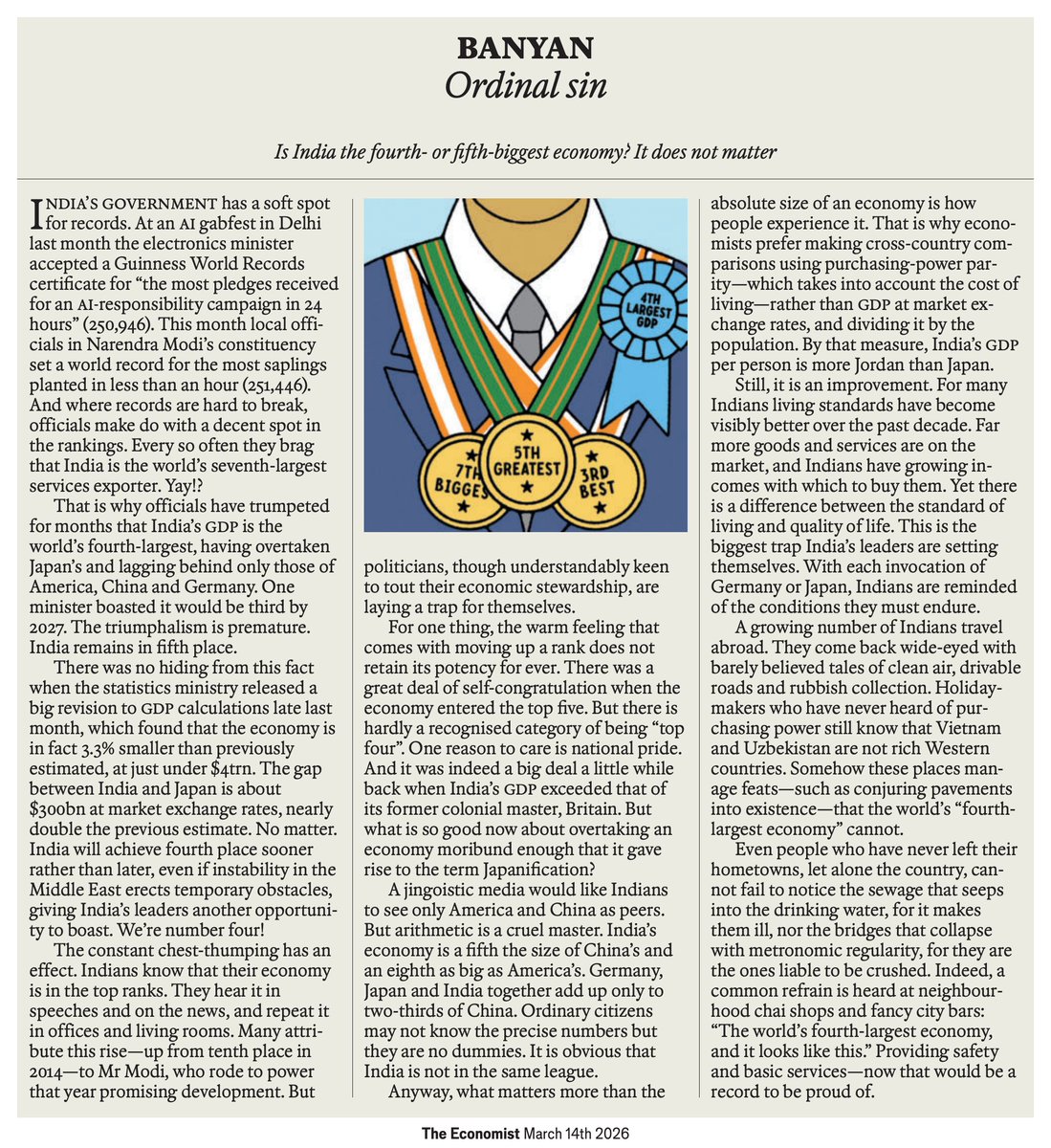
"A growing number of Indians travel abroad. They come back wide-eyed with barely believed tales of clean air, drivable roads and rubbish collection. Holidaymakers who have never heard of purchasing power still know that Vietnam and Uzbekistan are not rich Western countries. Somehow these places manage feats—such as conjuring pavements into existence—that the world’s “fourthlargest economy” cannot."
Just want to remind everyone of my favorite cartoon ever. You aren't *in* the universe, you are a literal part of it, you are made of it, like a knot in a rope. When you read these words, it's the universe reading it's own writing.
In work emails, I often speak in plural and people assume that I mean me and the organisation. Wrong. I mean me and my symbiote. We will get on it. We will keep you updated. We are Venom.
@NarasimhaKan When the revolution comes - remember that we’re the rich in “eat the rich”
You may not feel like it with the taxes you pay - but you’re the tiny minority actually capable of paying taxes.