I agree with you that the boats and asylum costs need dealing with, but they're completely different problems, and in terms of the public finances, the State Pension is vastly bigger.
Asylum support cost about £4bn in 2024/25. The State Pension alone is forecast to cost £146.1bn in 2025/26.
So even if you somehow reduced asylum support to £0 tomorrow, you haven’t remotely solved the long-term pension problem.
And the “45 years of contributions” point keeps getting misunderstood. Those contributions weren’t saved in a personal pension pot. They funded government spending, including the pensioners of that time. Today’s £12,500 State Pension is being funded by today’s taxpayers.
That’s why its future cost matters.
I can agree that illegal migration needs tackling while also recognising that guaranteeing pensions to rise faster than earnings indefinitely is financially unsustainable. They aren’t mutually exclusive arguments.
Yep, agree.
It just exposes how we’ve built huge parts of the economy around systems that are politically painful to unwind. Universities, welfare, pensions, housing. Everyone agrees reform is needed until the reform costs them something.
That’s the political trap. We keep kicking unsustainable systems down the road because nobody wants to be the generation that takes the hit.
My worry is that Millennials, Gen Z and those after us will end up taking the hit anyway, except we’ll be paying for decades of avoiding the problem first.
Personally, I’m not planning my retirement on the assumption that I’ll receive the same State Pension settlement my parents or grandparents did. I think younger people would be wise to prepare for a future where those benefits are less generous, start later, or are more targeted than they are today.
And I wouldn’t be surprised if higher-rate tax relief on private pension contributions gets chipped away at next.
That’s fair. My concern is exactly why I’d want any means test designed properly, with a generous threshold and a gradual taper.
I wouldn’t support dragging ordinary pensioners on modest incomes into it just to save a few quid. The target should be people with genuinely substantial retirement income and wealth, not someone being taxed £3.40 a month.
There’s a sensible middle ground between “give it to absolutely everyone” and “hammer anyone with a small private pension”.
Yes, they did.
But they did so under a very different deal.
There was no Triple Lock for most of their working lives. Housing was far cheaper relative to earnings. Many had access to better defined-benefit workplace pensions, lower university costs, and could expect to retire earlier.
Today’s workers are being asked to fund a more generous pension guarantee while dealing with much higher housing costs, weaker pensions and a later State Pension age themselves.
So “we paid for pensioners too” isn’t the end of the argument.
The question is whether today’s settlement is still fair and affordable for the people being asked to fund it.
Because a wage is what someone earns for working full-time. The State Pension is a retirement benefit. Of course the wage is higher.
You’re comparing someone’s entire earned income with one part of a pensioner’s retirement income.
The actual question is much simpler: why should the State Pension be guaranteed to rise faster than the wages of the people funding it?
“Workers earn more than pensioners” doesn’t answer that.
Jesus christ.
It isn’t about one pensioner living for 40 years.
It’s about the State Pension system carrying on for 40 years.
Every year, new people retire. If pensions keep rising faster than wages, the cost keeps growing faster than the incomes of the people paying for it.
That’s the point.
“Whoopy do” rather misses how compounding works.
Take a simple example. If wages grew by 3% a year and the State Pension grew by 3.53%, then after:
20 years, pensions would be about 11% higher relative to wages
30 years, about 17% higher
40 years, about 23% higher
50 years, about 29% higher
Start both at £100 for illustration. After 40 years:
Wage-linked: £100 * 1.03⁴⁰ = £326
Triple-Lock-style growth: £100 * 1.0353⁴⁰ = £401
That tiny-looking 0.53 percentage-point gap has turned into a 23% difference.
That is why the OBR cares about it. Public finances tend to operate for slightly longer than one year.
I’d use a tapered means test, not some cliff edge where you earn £1 too much and lose the lot. Personally, I’d start looking at it around the higher-rate tax threshold and reduce it progressively for genuinely wealthy retirees.
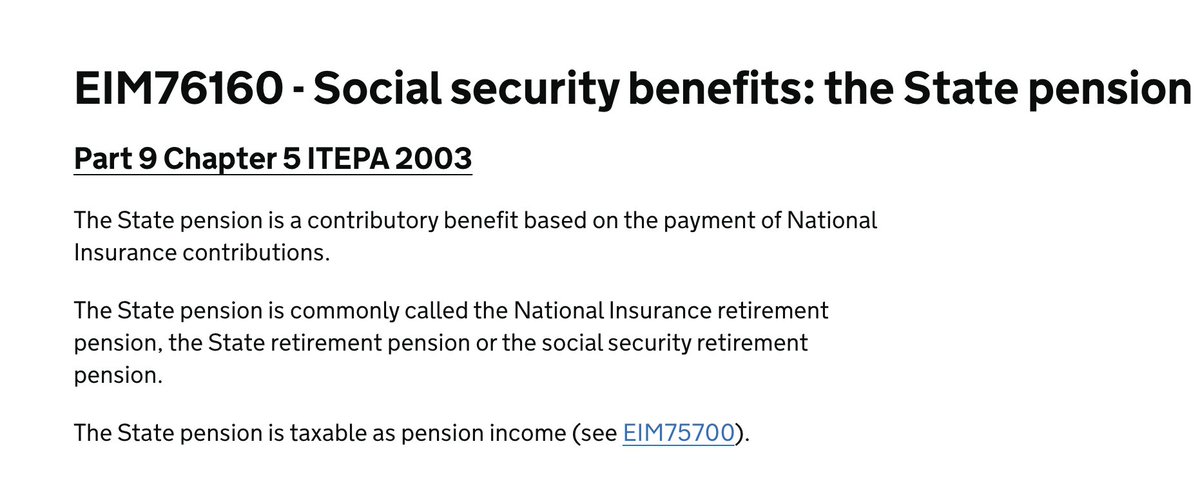
Also, the State Pension is already taxable income. Some other benefits are taxable too, although Universal Credit and PIP aren’t.
And that 13% tax between £5,000 and £12,570 isn’t government policy. It’s a proposal from a think tank. The current Personal Allowance remains £12,570.
My point is simply that if someone has substantial retirement income and wealth, I don’t see why taxpayers should still give them exactly the same State Pension as someone who genuinely depends on it.
They quite literally are. That’s one of the fundamental problems with the Triple Lock.
The OBR projects that it will increase the State Pension by an average of 0.53 percentage points above earnings growth over the long term.
And yes, pensioners paid NI. But they didn’t pay into a personal State Pension pot. Their contributions funded the pensioners and benefits of the time, just as today’s workers fund today’s pensioners.
That’s how a pay-as-you-go system works.
“I paid in” gives you an entitlement under the system's rules. It doesn’t mean your contributions were saved for you, and it certainly doesn’t guarantee above-earnings pension growth that's financially sustainable forever.
https://t.co/N7r0CAi8hv
@BenJoRS2017@magicpanny It needs demolishing - it's unsustainable.
You can't have pensions increasing faster than the wages of those funding them.
The Triple Lock needs scrapping at a minimum; the State Pension needs means-testing at a maximum.
I agree.
The welfare state has expanded far beyond what is sustainable, and we should be much more willing to ask who genuinely needs taxpayer support.
But that principle has to apply to pensioners too.
The State Pension alone cost around £146bn last year. It is the single biggest benefit in the welfare system. Yet we’re apparently not even allowed to discuss whether someone with substantial private pensions, investments and wealth actually needs it.
We’re increasingly telling younger generations they must pay more tax, work longer and expect less in retirement, all to honour a supposed “contract” they never signed.
If the welfare state is unfit for purpose, protecting its largest universal payment from reform makes absolutely no sense.
@JohnBuckland02@MattHarperUK@GBNEWS “Such ignorance…”
Excellent argument, John.
Now identify specifically what I’ve said that is incorrect and explain why.
Yes, because apparently the only possible “peaceful retirement” is one where taxpayers continue handing money to people who are already wealthy enough not to need it.
Nobody is suggesting taking support away from pensioners who rely on it.
I’m suggesting targeting public money at people who actually need public money. Apparently that is now an outrageous concept.
You’ve just described the entire welfare state and then decided the State Pension should somehow be exempt from the same logic.
High earners pay more tax than they receive back throughout their lives. That is not “robbery”, it is progressive taxation.
And saying “the pension isn’t means-tested” isn’t an argument against means-testing it. That is literally the policy I’m proposing.
As for this supposed deal with government, future taxpayers were never parties to a contract promising every wealthy retiree an unconditional payment regardless of need.
That’s generally how progressive taxation works.
People who earn more pay more into the system. It doesn’t therefore follow that they must personally receive every penny back in benefits.
Otherwise we’d better start giving Universal Credit to millionaires too, just so they “get something back”.
The State Pension is a taxpayer-funded social security benefit, not a personal savings account.
Amazing how confidently you can call someone stupid while getting the basic fact wrong.
The State Pension is literally a benefit. NI contributions do not go into a personal pension pot with your name on it. They fund current expenditure, including today’s pensioners, while your NI record determines your future entitlement.
And I never said poor pensioners should get nothing. I said wealthy pensioners should be means-tested.
But apparently “use your own wealth before demanding taxpayers’ money” is communism now. Very capitalist of you lads.
Learn to read buddy.