Why Traders Fail: The Solution-Seeking Trap !
Most people fail at trading not because of poor math or lack of information — but because they bring the wrong mindset entirely.
From an early age, we are trained to find answers. One plus two equals three. Solve for X. Identify the cause, apply the remedy. By the time we reach our mid-twenties, after two decades of education, we are deeply conditioned to believe that every problem has a correct solution — and that our job is to find it.
⚡️Trading doesn't work that way.
Markets are not static problems with discoverable answers. Navigating them is like entering a maze where the walls rapidly shift and change. Because the environment is dynamic and evolving, the "right" move shifts constantly based on hidden or incomplete variables. A path that led to a solution moments ago may suddenly lead nowhere.
Even the most brilliant analytical minds struggle here, because they keep reaching for a verdict — right or wrong, good or bad — they keep following tried and tested paths, not realizing that the path is no longer a viable route.
In this world, intellectual intelligence struggles; what trading actually demands is Adaptive Intelligence: the ability to make sound decisions under uncertainty, revise them in real time, and detach your ego from the outcome. - Learning these skills is almost entirely absent from formal education.
Which is why, when a friend recently asked what course might best prepare their child for a trading career, my tongue-in-cheek answer was: open them a poker account.
I was joking — but only partly.
♣️Poker Mindset
Poker is arguably the best training ground for a trading mindset. Not because of any surface similarity, but because it develops the precise cognitive skills markets require; it helps a person think ‘Adaptively’! — This includes:
🤔Probabilistic Thinking — Weighing risk against incomplete and hidden information, rather than seeking certainty.
👀Considering Pay-offs — Viewing maximizing gains on winning hands as a deliberate, technical edge.
↩️Dynamic Pivoting — Abandoning plans as new information emerges and conditions shift.
🖱️Focusing on Process over Outcome — Evaluation of decisions on their logic, not their results.
🧘♂️Learning to Regulate Emotions — Maintaining clear thinking under pressure, recognizing tilt, and recovering from it.
👨🍼Reading the Room — Sensing intentions, context, and shifting dynamics in real time.
Crucially, poker teaches these things ”experientially.”
Entering the Maze and being aware that it will shift requires a very different mindset and approach than entering a static maze.
The solution-seeking mindset serves us well in most of life. In trading, it is the very thing that often holds us back.
BOOK GIVEAWAY 🚨
Want to know how strong your tournament game really is?
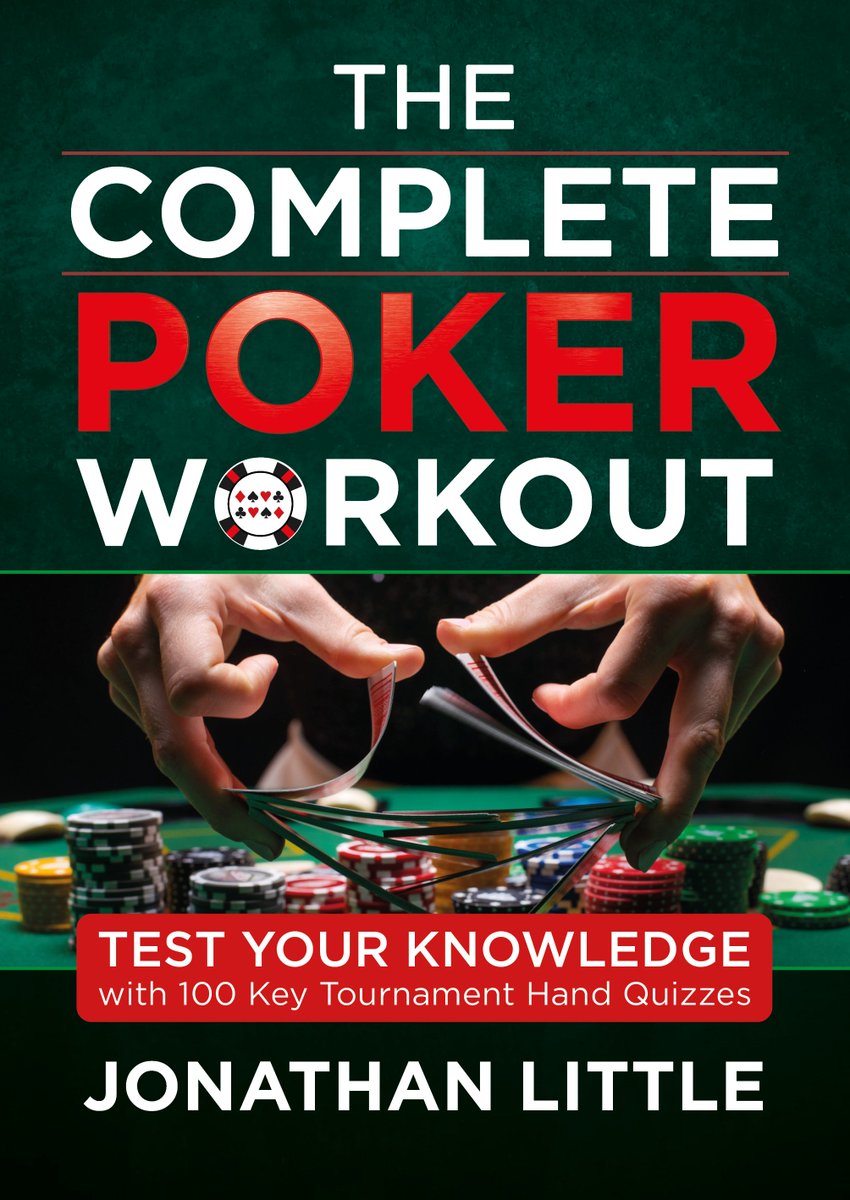
I've released my brand-new book, The Complete Poker Workout, and I’m giving away 1 FREE copy 📘
To enter:
✅ Like
🔁 Retweet
Winner drawn in 1 week. Good luck 🔥🔥🔥
The last 24 hours are a textbook case of narratives attempting to chase price, a ton of threads and articles on what causes this Bitcoin move and who is to blame. A phenomenon behavioral economists call the "narrative fallacy." The human brain is wired to construct coherent stories from chaotic data, desperate to assign clear cause-and-effect relationships to market movements. We need something or someone to blame, a single catalyst that explains everything.
But market reality operates more like continental drift than a light switch. While there's often a visible trigger, the earthquake that finally releases the tension, the structural stress had been building beneath the surface for weeks. The 2-month range we dropped from was packed with fresh positioning, confident spot buyers who got ran over. When it broke, it didn't just trap them underwater, it triggered a cascading liquidation event where fear compounds geometrically, not arithmetically.
Think of it like a forest fire: the news will report "a discarded cigarette caused the blaze," but the real story is months of drought, dry underbrush, and favorable wind conditions. The cigarette was just the spark. The market was already weak, evidenced by deteriorating breadth, declining volume and aggression at resistance, and the inability to reclaim key technical levels despite multiple attempts.
The narrative merchants will always scramble to attribute moves like this to one thing or another: regulation, macro data, a single liquidation, a large player under stress, some geopolitical event, etc. But markets rarely collapse because of news, they collapse because they were structurally vulnerable, and news simply provided permission for participants to acknowledge what price was already telling them.
I’d say a big part of me, personally, being profitable, is I couldn’t give a shit whether I trade or not on a particular day.
If you want to trade, you tend to try harder to actively find trades and I always found that to be counterproductive to my performance.
You usually know this is your problem if you review your performance and end up thinking “what did I take that trade for?!”
I know there will be a few clear, high probability opportunities each week and they’re usually remarkably obvious and you know exactly why you did them and don’t regret them, even if they go wrong.
Many people ask how I do it when instead they should be asking what I don’t do..
The simple answer is that I don’t fade momentum. Number 1 rule.
What is momentum? It is a force that keeps an object moving or an event developing after it has started. In other words, the increase in a process's development rate is called momentum. It is one of the essential concepts of physics that is also associated with your daily life.
Majority of traders prefer to be the hero and aim to buy bottoms and sell tops. It’s good for clout points. Terrible for your PnL. The only time you should be doing such a thing is when momentum is slowing down.
When momentum is in full swing, you go with. It is the thing that will take you from your entry (starting point) to your take profit (finishing point) the quickest. You are putting yourself on the right side of probability. You are letting the force be with you. You wouldn’t step in front a car rolling down a hill would you?
Instead of trying to buy bottoms/sell tops and continuing to get ran over let momentum slow down, turn in the opposite direction and jump on board. I guarantee you’ll see better results by doing so.
🚨 HUGE GIVEAWAY ALERT 🚨
We’re giving away 2× 1-YEAR memberships to @PokerCoaching_ Premium + @peakgto to celebrate our Black Friday Sale!
How to enter:
1️⃣ Follow @PeakGTO
2️⃣ Retweet this post
3️⃣ Comment “Black Friday”
🎁 Winners announced November 18th.