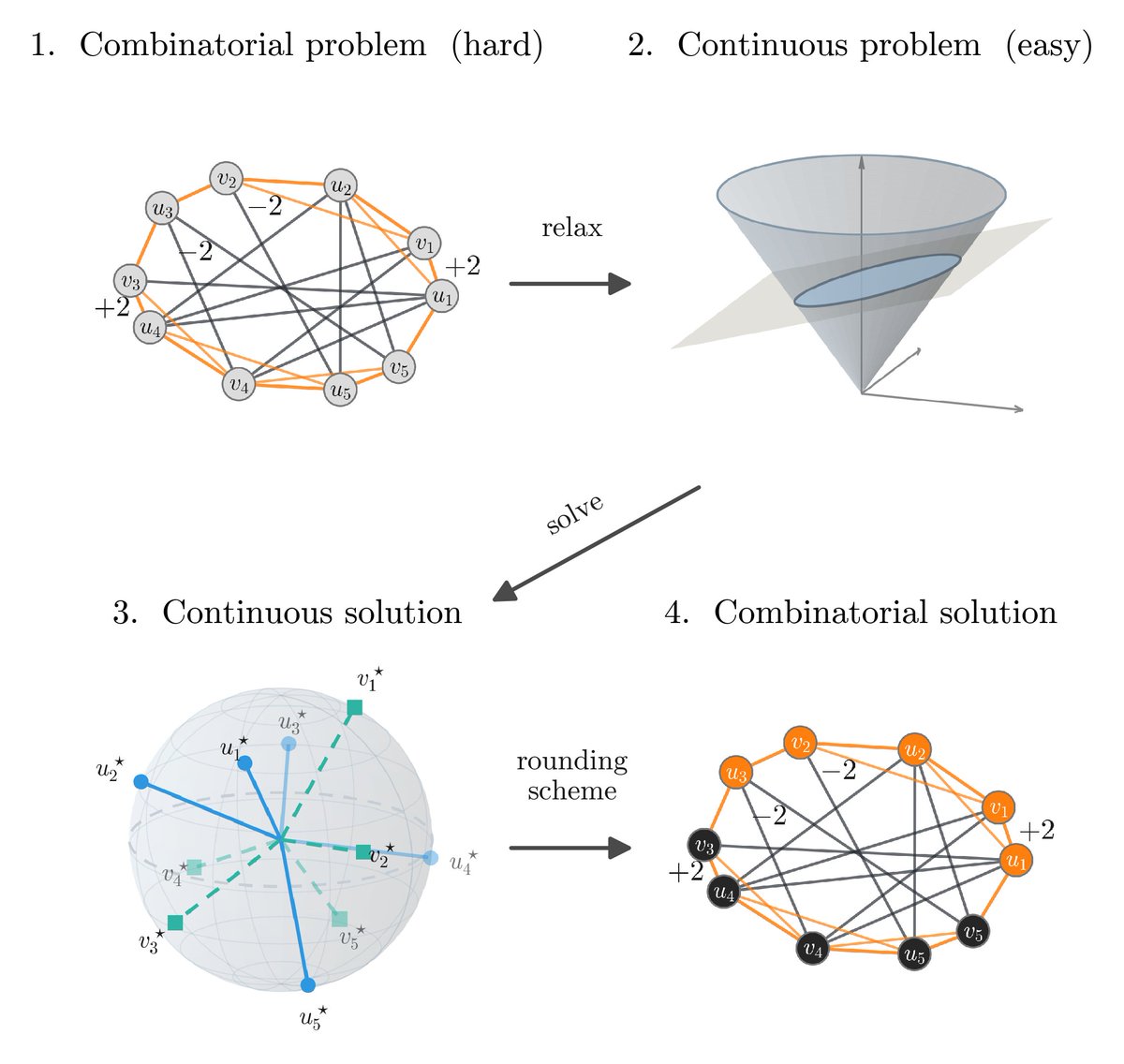
@DocOctagonical Yes! The lower bound has not been significantly improved in 40 years, and more importantly the bigger headline that doesn't fit into a tweet is the novel approaches discovered in analyzing higher dimensional algorithms for these problems.
The Grothendieck constant is 1.7...!
We are excited to share this breakthrough on a 70 year-old problem discovered through a year-long human-AI collaboration.
We publish both the math and AI setup because academics should shape AI-assisted research to keep it fundamentally human.
Deeply grateful to all my collaborators who have worked hard on this problem over the last year:@ByAlanLi@AntonXue@swarat@praveshkkothari, Raghu Meka, and Adam Klivans.
We also want to acknowledge the important concurrent work of Steven Heilman, Chris Jones, Giulio Malavolta, and others who have recently pushed the bounds on (K_G). It has been exciting to see so much progress on this old problem at once.
Our papers:
Grothendieck bounds:
https://t.co/Klm58GZzJU
AI for long-horizon mathematical research:
https://t.co/zgJ7WSg514
Would love to hear any thoughts on the math or the research process; don’t hesitate to reach out.