@arun260284@Airtel_Presence@airtelindia Yes, they mentioned that some power issue in box hence the flactuation. Though ping value is high 325-500 ms. Able to load
@Airtel_Presence@airtelindia Hey Airtel, facing serious issues with Airtel Broadband (Xstream Fiber). Unable to reach AWS services — connections are either not going through or extremely slow and keep timing out. This is affecting work badly.
Dos ingenieros de Anthropic pasaron 24 minutos exponiendo cada función de Claude Code que no sabías que existía y gratis.
La mayoría de las personas pasarán de largo este contenido
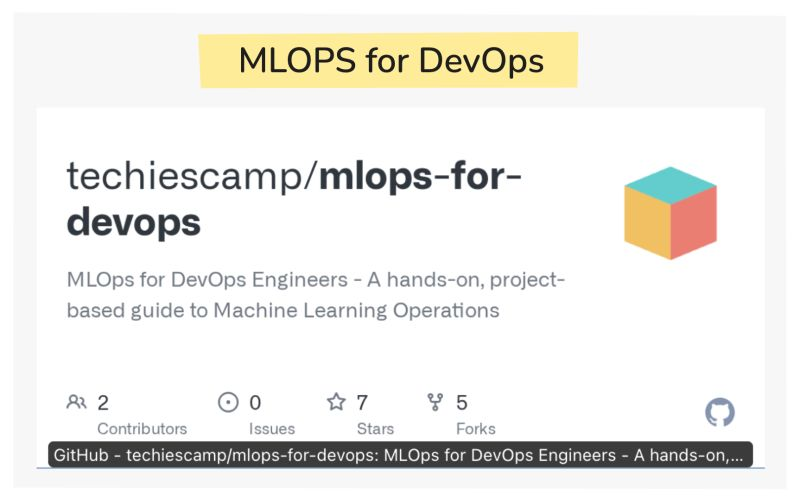
We created a GitHub repository to help DevOps engineers learn MLOps.
𝗚𝗶𝘁𝗛𝘂𝗯 𝗥𝗲𝗽𝗼𝘀𝗶𝘁𝗼𝗿𝘆: https://t.co/bWermJeKNM
Here is the thing.
Most MLOps resources assume you already know machine learning.
But what if you are coming from a DevOps background?
That is exactly who we built this for.
The repository focuses on ML operations using cloud-native tools on top of Kubernetes.
So you are learning ML concepts while working with infrastructure you already understand.
This approach lets you gain MLOps knowledge using your existing DevOps skills, or develop new ones along the way.
The repo follows our MLOps newsletter series.
We have already published three editions that are part of the repository.
The latest edition is hands-on, where you perform data preparation using Python scripts.
If you have any feedback on how the content is organized, please raise an issue in the repository. We can discuss it there.
♻️ PS: Repost and share this with DevOps engineers who want to expand into MLOps.
#mlopsfordevops
From Day 1 of marriage, Saurabh started sending ₹25,000 every month to his parents.
No excuses. No delays.
Parents lived in a small town. Simple life. No demands.
8 years passed.
₹24 lakh sent.
Saurabh always thought,
“At least they are comfortable.”
In 2024, his father passed away suddenly.
While arranging documents, his mother handed him a bank passbook.
Balance: ₹29.5 lakh.
Every rupee Saurabh sent… was saved.
Plus FD interest.
Inside the passbook, there was a small folded note:
“For your children’s future. – Papa”
Saurabh thought he was supporting them.
They were silently building his safety net.
Moral:
Parents never stop being parents.
Even when you think you are the provider. ❤️
The client requests won't even reach the servers which causes 𝗦𝗣𝗢𝗙 -> Single Point Of Failure in your system and a complete outage ⚠️
How do you solve this ?
A Load Balancer is designed to handle server failure, but who handles Load Balancer failure? If your architecture relies on a single Nginx or HAProxy instance entry point, you are one crash away from a total outage. Here is how we can fix it :
1. 𝗗𝗶𝘀𝘁𝗿𝗶𝗯𝘂𝘁𝗲𝗱 𝗟𝗼𝗮𝗱 𝗯𝗮𝗹𝗮𝗻𝗰𝗲𝗿 :
Instead of one load balancer, you run two or more load balancers in parallel.
Clients do not point directly to a single LB IP.
They point to something above the load balancers which is a LB for LBs.
𝟮. 𝗗𝗡𝗦 𝗯𝗮𝘀𝗲𝗱 𝗟𝗼𝗮𝗱 𝗕𝗮𝗹𝗮𝗻𝗰𝗲𝗿 𝗿𝗼𝘂𝘁𝗶𝗻𝗴 :
DNS returns multiple IPs for the same domain.
ex : https://t.co/fJfo0L6KsP -> 192.168.1.10 , 192.168.1.11
Client randomly picks one.
if LB 1 is unhealthy, DNS removes it.
𝟯. 𝗔𝗻𝘆𝗰𝗮𝘀𝘁 𝗜𝗣 :
Anycast is a networking technique that allows for multiple machines to share the same IP address. Based on the location of the user request, the routers send it to the machine in the network that is closest.
It reduces latency and increases redundancy.
If a particular data center were to go offline, an anycasted IP would choose the best path for users and automatically redirect them to the next closest data center.
Before you learn Kubernetes, understand why to learn Kubernetes. Or should you?
25 years back, if you wanted to run an application, you bought a $50,000 physical server. You did the cabling. Installed an OS. Configured everything. Then run your app.
Need another app? Buy another $50,000 machine.
Only banks and big companies could afford this. It was expensive and painful.
Then came virtualization. You could take 10 physical servers and split them into 50 or 100 virtual machines. Better, but you still had to buy and maintain all that hardware.
Around 2005, Amazon had a brilliant idea. They had data centers worldwide but weren't using full capacity. So they decided to rent it out.
For startups, this changed everything. Launch without buying a single server. Pay only for what you use. Scale when you grow.
Netflix was one of the first to jump on this.
But this solved only the server problem.
But "How do people build applications?" was still broken.
In the early days, companies built one big application that did everything. Netflix had user accounts, video player, recommendations, and payments all in one codebase.
Simple to build. Easy to deploy. But it didn't scale well.
In 2008, Netflix had a major outage. They realized if they were getting downtime with just US users, how would they scale worldwide?
So they broke their monolith into hundreds of smaller services. User accounts, separate. Video player, separate. Recommendations, separate.
They called it microservices.
Other companies started copying this approach. Even when they didn't really need it.
But microservices created a massive headache. Every service needed different dependencies. Python version 2.7 for one service. Python 3.6 for another. Different libraries. Different configs.
Setting up a new developer's machine took days. Install this database version. That Python version. These specific libraries. Configure environment variables.
And then came the most frustrating phrase in software development: "But it works on my machine."
A developer would test their code locally. Everything worked perfectly. They'd deploy to staging. Boom. Application crashed. Why? Different OS version. Missing dependency. Wrong configuration.
Teams spent hours debugging environment issues instead of building features.
Then Docker came along in 2012.
Google had been using containers for years with their Borg system. But only top Google engineers could use it, too complex for normal developers.
Docker made containers accessible to everyone. Package your app with all dependencies in one container. The exact Python version. The exact libraries. The exact configuration.
Run it on your laptop. Works. Run it on staging. Works. Run it in production. Still works.
No more "works on my machine" problems. No more spending days setting up environments.
By 2014, millions of developers were running Docker containers.
But running one container is easy. Running 10,000 containers? That's a nightmare.
Microservices meant managing 50+ services manually. Services kept crashing with no auto-restart. Scaling was difficult. Services couldn't find each other when IPs changed.
People used custom shell scripts. It was error-prone and painful. Everyone struggled with the same problems. Auto-restart, auto-scaling, service discovery, load balancing.
AWS launched ECS to help. But managing 100+ microservices at scale was still a pain.
This is exactly what Kubernetes solved.
Google saw an opportunity. They were already running millions of containers using Borg. In 2014, they rebuilt it as Kubernetes and open-sourced it.
But here's the smart move. They also launched GKE, a managed service that made running Kubernetes so easy that companies started choosing Google Cloud just for it.
AWS and Azure panicked. They quickly built EKS and AKS. People jumped ship, moving from running k8s clusters on-prem to managed kubernetes on the cloud.
12 years later, Kubernetes runs 90% of production infrastructure. Netflix, Uber, OpenAI, Medium, they all run on it.
Now advanced Kubernetes skills pay big bucks.
Why did Kubernetes win?
Perfect timing.
Docker has made containers popular. Netflix made microservices popular. Millions of people needed a solution to manage these complex microservices at scale.
Kubernetes solved that exact problem.
It handles everything. Deploying services, auto-healing when things crash, auto-scaling based on traffic, service discovery, health monitoring, and load balancing.
Then AI happened. And Kubernetes became even more critical.
AI startups need to run thousands of ML training jobs simultaneously. They need GPU scheduling. They need to scale inference workloads based on demand.
Companies like OpenAI, Hugging Face, and Anthropic run their AI infrastructure on Kubernetes. Training models, running inference APIs, orchestrating AI agents, all on K8s.
The AI boom made Kubernetes essential. Not just for traditional web apps, but for all AI/ML workloads.
Understanding this story is more important than memorizing kubectl commands.
Now go learn Kubernetes already.
Don't take people who write "Kubernetes is dead" articles are just doing it for views/clicks. They might have never used k8s.
For people looking to learn AI 🤖 & Claude - Spend 30 minutes this weekend watching this video…
Way better than watching reels and shorts 👍
If you bookmark, do share that someone can benefit 🫶