One week out: the Get Started with Palantir Foundry series begins Friday the 17th, 4 PM SGT.
A live, hands-on build for developers. No prior experience needed, each session stands alone, and recordings go to everyone who registers.
If it's been on your maybe list, now's the time. Register: https://t.co/Ycn1DrHXoT
#Palantir #AIP #Vanyar
Why do enterprise AI projects stall even as models get better every quarter?
This week Palantir and NVIDIA shipped an engine that lets US agencies own Nemotron open models and post-train them on their own data. The brain, owned outright, and it's a fair bet enterprise versions follow.
It still won't be enough on its own. A brain in a jar can't run a supply chain. Give a model your raw tables and it guesses which join is right, then presents the guess fluently. A better model just guesses more eloquently.
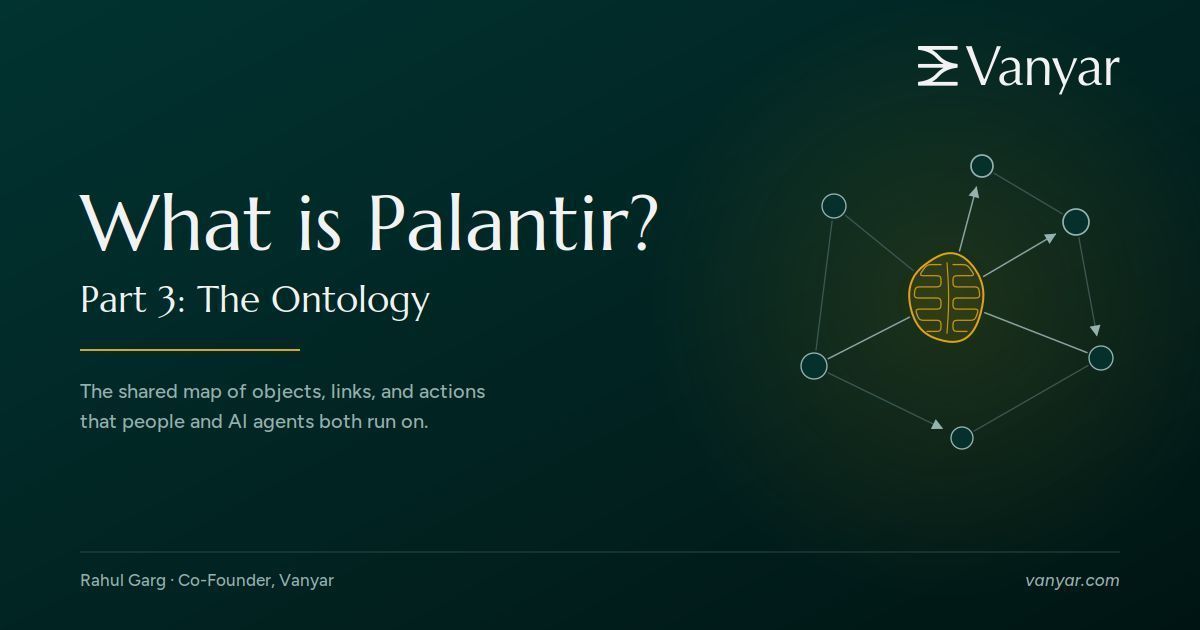
The model needs senses, hands, and memory. That's the ontology, and it's the subject of Part 3 of my "What is Palantir" series: https://t.co/0i0CCZND0h
#palantir #nvidia #foundry #ontology #enterpriseai
"Forward Deployed CEO" gets thrown around as a buzzword. The Mixology Clothing Company story is what makes it real.
Palantir built its name on Forward Deployed Engineers: elite people parachuted into a company's hardest problems. The catch was that only the biggest companies could afford to rent that talent.
Jordan Edwards flipped it. A 17-year family fashion business, no engineering team, a budget that ran out fast. His first Palantir Boot Camp failed and he didn't walk away. He sat at the keyboard, used ChatGPT and Gemini to explain things to him like he was five, and learned to configure the platform himself. He calls it "bleeding on the keyboard." Integrations and pipelines that should have taken months took hours, and a small clothing brand ended up on stage at AIPCon.
That's the real shift. Founders shipping next to customers is old. The new part is that the tools finally let a non-technical CEO do what used to need a team of FDEs.
The value still shows up where you deploy, not where you sell. Mixology just proved the deployment can be a team of one, and that one can be the CEO.
https://t.co/OeQE1FjMfg
#Palantir #AIP #Vanyar
Two weeks out: the Get Started with Palantir Foundry series kicks off Friday July 17, 4 PM SGT.
A hands-on build for developers, no prior experience needed. Each session stands alone so you can drop in anytime, and recordings go to everyone who signs up.
Register for the first session: https://t.co/Ycn1DrHXoT
#Palantir #AIP #Vanyar
Palantir CEO Alex Karp on what customers actually want, the real business of frontier labs, and the importance of open source models:
“What the technical customers want is control over their compute, their models, their data stack, and their alpha. They want to know they own the means of production, and it's not being transferred to someone else.”
"Who owns the data? Are the prompts secure? Is this being transferred to you?"
"If it was so valuable, and I can make you a billion dollars, wouldn't I say I'll make you a billion dollars and I want 30%? Why are they charging for tokens if it's so valuable?"
Our thoughts on the importance of AI sovereignty.
1. Your AI sovereignty dictates your institution’s future. Sovereignty is the precondition for choice. Relinquishing sovereignty transfers the future choices of your institution to others, who are likely to exploit it for their gain and your loss.
2. Data retention is your treasure. Transfer it at your own peril. Your ability to win is dictated by your ability to recognize and use your unique edges, and you keep winning by compounding the underlying data to generate new insights. Transferring that data hands over access to your pre-existing winning plays and yields the means of production for new ones.
3. Tokenmaxxing hijacks your value orientation and decreases your institutional fortitude and intelligence. The pursuit of high token usage incentivizes disposable scripts over robust software — with the addictive feeling of false progress. There is a reason why those selling tokens refuse to charge based on value.
4. Controlling your weights is controlling your fate. Weights are the distilled form of hard-won, accumulated institutional knowledge. If you let others control your weights, you are allowing them to migrate the alpha of your business to theirs.
5. There is no contradiction between sovereignty and alpha. The architecture that maximally preserves sovereignty is one that enables institutions to own their tribal knowledge, and to compound it as alpha.
6. Politicizing the technical issues involving sovereignty is what your adversary wants. Techno-politicization is the wellspring of false sovereignty. Techno-politicization drives decisions that seem to reduce dependency, but ultimately limit agency — especially on the battlefield in the West.
7. Real expertise is existential. Allowing politics or favoritism to determine your technical decisions rewards whoever is best at politics, not whoever is right. Listen to those closest to the problems, not those speaking most compellingly about them.
8. Learn from institutions that are winning or that have consistently delivered. Institutions facing existential threats do not have the luxury of making technical decisions based on political preferences.
9. Only listen to institutions, countries, and people who have a proven record of being right. A track record of correctness is the best and only signal for future correctness. Judging something as right or wrong based on who you like is exceedingly misguided.
The sharpest framing of enterprise software I've read sits in the Palantir S-1.
The argument: most software makes companies more alike, not more different. It encodes shared best practices, so it gets you level with the market. They call that beta. The value that actually separates a company, alpha, needs software that bends to what's unique about you, not what's standard.
It's why buy-versus-build is usually a false choice. Off-the-shelf gets you beta. A platform you model your own operation on is how you reach for alpha.
That's the whole reason I bet on Foundry.
#Palantir #Vanyar
The thing that makes Palantir Foundry click isn't the dashboards or the AI. It's the Ontology.
Most systems store data in tables and leave the meaning in people's heads. The Ontology puts the meaning into the platform: this is a customer, this is an order, this customer placed that order. Once the software knows what things are and how they connect, the apps, the logic and the AI agents all build on the same shared model instead of each reinventing it.
That's why a good Foundry app and a Foundry agent feel like they actually understand the business. They're reading the same map.
We build one from scratch in the series, starting July 17.
https://t.co/Ycn1DrHXoT
#Palantir #Foundry #Vanyar