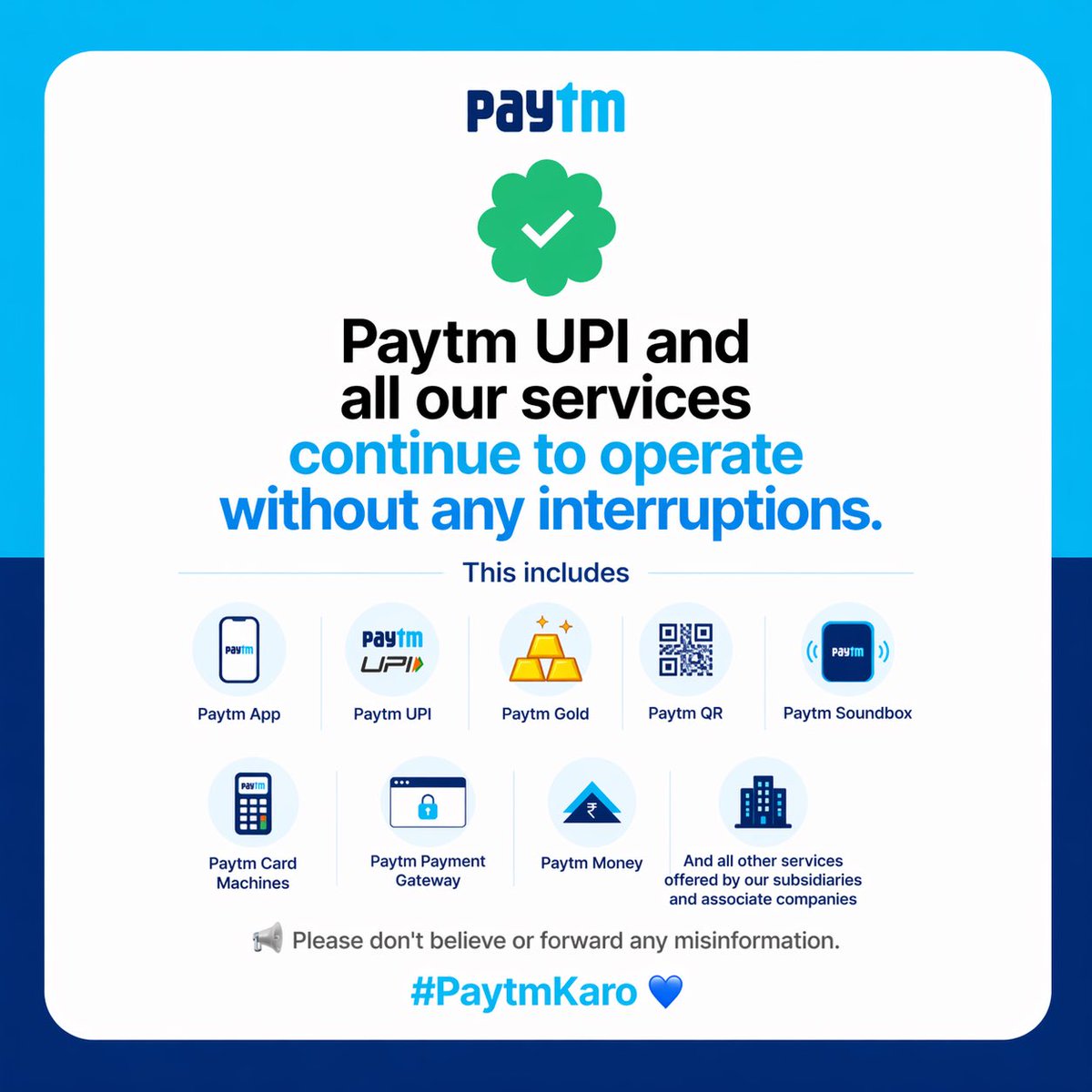
Paytm UPI and all our services continue to operate without any interruptions
This includes the Paytm App, Paytm UPI, Paytm Gold, Paytm QR, Paytm Soundbox, Paytm Card Machines, Paytm Payment Gateway, Paytm Money and all other services offered by our subsidiaries and associate companies
#PaytmKaro
.@elonmusk: “We are in the singularity.”
“I think we’ll hit AGI in 2026.”
“You’re at the top of the rollercoaster about to go down.”
“Don’t worry about squirreling money away for retirement. It won’t matter.”
“I don’t just have courtside seats— I’m on the court. It still blows my mind multiple times a week.”
Via @PeterDiamandis
We are at the India AI Impact Summit at Bharat Mandapam, Delhi today.
Join us for a live demonstration of our Agentic AI tax filing platform, and meet the team building it.
#IndiaAIImpactSummit2026
Beautiful. Fast. Effortless. And potentially shallow.
Now Figma has announced that you can send AI-generated UI straight into the design canvas as editable layers.
On the surface, it’s smart. You build with AI, refine in Figma, move back to code.
But step back for a second.
Why now?
For years, Figma was the center of product creation. Everything started there.
Today, many builders are starting in a prompt box. Or in a terminal. Or inside AI coding tools.
Design is no longer the starting point.
Execution is.
Is this integration innovation?
Or is it Figma trying to pull builders back into its ecosystem?
Because if AI can generate screens directly into code, why would anyone open a design tool at all?
Unless design becomes something more than drawing screens.
Here’s the uncomfortable part.
When screens become easy to generate, we stop questioning them.
The first output becomes the direction.
Momentum becomes strategy.
Polished becomes “good enough.”
That is how design becomes shallow.
Earlier, creating something required effort. Effort forced thinking.
Now creation is instant. Thinking is optional.
And that is dangerous.
Because AI can give you a beautiful layout, But it cannot tell you If the feature should exist or If the journey makes sense. If the product is solving the right problem.
It predicts patterns, It does not carry intent. So maybe this is the real shift. Design is no longer about making screens.
It is about making choices.
If AI can generate twenty versions in seconds, the real skill is deciding which one deserves to live — and which nineteen to kill.
Maybe Figma understands this.
Maybe this move is not about features.
Maybe it’s about survival.
Because if design becomes automated,
the only moat left is judgment.
@Paytm UX & UI evolution need to be studied. Recently, I have shifted from @getsupermoney and it has been delighted experience!
Earlier @Paytm had too much cluttered screens but now it has minimal & clean UI. Takes very less time to do payments & omg UX is really top notch.
I review portfolios often.
One pattern that quietly signals inexperience:
Skill meters.
Design isn’t a percentage.
It’s judgment under constraint.
I’d rather see:
• A messy problem made simple
• A metric moved
• A system scaled
• A failed experiment dissected
The strongest designers barely talk about tools.
Because tools change.
Thinking compounds.
If you’re building a portfolio:
Remove the bars.
Add depth.
This was probably 2003–2004 when I created this website for Tarun Tahiliani. This was the second version of the site, completely coded in Flash ActionScript.
Once you see it, you can’t unsee it.
Fear patterns in design:
• Over-explaining decisions
• Excessive user quotes
• Endless iterations
• Pixel perfection as a shield
Most “design rigor” is fear disguised as better typography.