🔥 Welcome to Kernel Hell — where progress burns hot and roads are earned the hard way.
In Road Craft: Kernel, every turn tests patience, grit, and strategy.
📺 https://t.co/887FuHNEDc
#RoadCraft#gaming#walkthrough#simulation#challenge
🌅 Goodbye PARADISE map… NEXT: a real CHALLENGE.
Paradise was calm, but greatness begins where comfort ends.
Time to test strategy, patience, and grit.
📺 https://t.co/WSJq9ZFOYu
#RoadCraft#gaming#walkthrough#challenge#simulation
🔥 Maintenance Mini-Event!
Guess the 5 Ultra Rare heroes!
How to join:
• RT + Like
• Tag 2 friends
• Comment your answers
🎁 The first 5 correct answers will receive 1 Genesis Pass.
⏳ Event ends in 48 hours.
Hint below ⏬
@multiplifi The “50,000 crystals” drop doesn’t look like a token launch — crystals = reward points, so it’s likely a new rewards campaign, a vault update, or a fresh early-access feature getting unlocked.
Smart hype beats blind hype. Let’s see what they’re cooking. 🔥🔍
#multipli#Airdrops
🔭 New observations of 3I/ATLAS
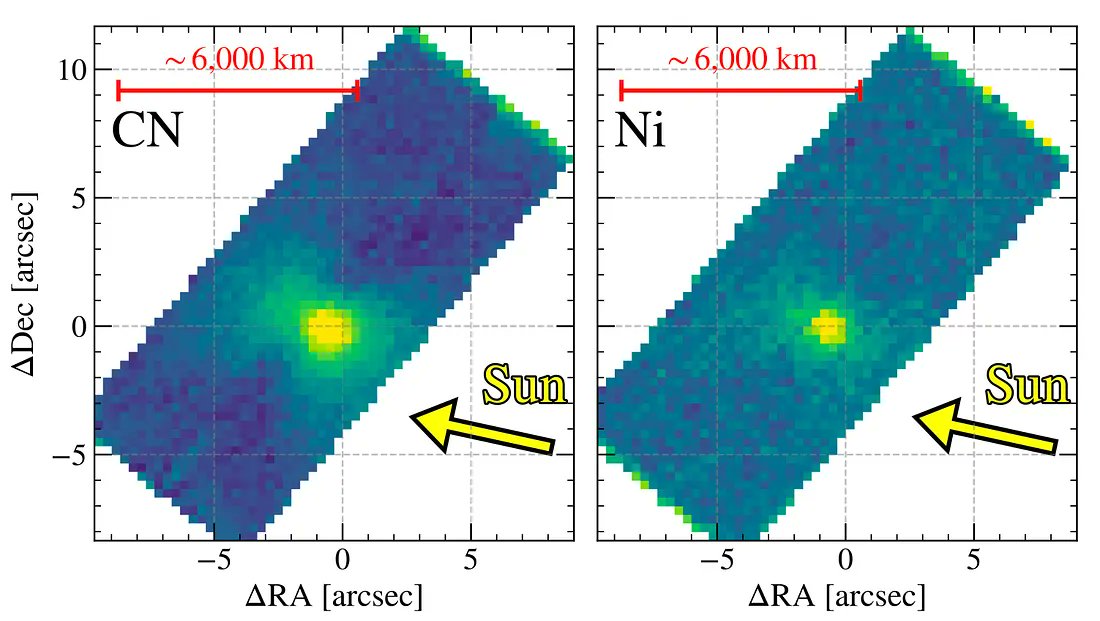
On August 24, 2025, the Keck II telescope (via the Keck Cosmic Web Imager, KCWI) captured images of 3I/ATLAS in visible/near-UV wavelengths (0.3425–0.55 µm).
The images show a puzzling anti-tail (i.e. extension toward the Sun) — not typical for most comets.
🧪 Unusual chemical signature
The gas emission around 3I/ATLAS reveals strong nickel (Ni) emission but no iron — unusual compared to known comets.
The authors propose a carbonyl chemical pathway occurring near the nucleus, forming nickel tetracarbonyl (Ni(CO)₄) naturally. This mechanism would concentrate nickel near the nucleus.
Narrow-band imaging in Ni (0.3865–0.3885 µm) and cyanide (CN) (0.3605–0.3625 µm) shows a tighter core of nickel relative to cyanide; Ni emission falls off over ~600 km, CN over ~840 km.
📈 Comparative anomalies & implications
The Ni/CN production ratio is much higher than in comet 2I/Borisov and far above the median seen in solar-system comets.
The emission profiles are asymmetric, extending both sunward and anti-sunward, confirming the anti-tail structure.
In visible (“white light”) imaging, there is no obvious dust tail as one would expect from typical cometary dust being pushed away by solar radiation.
These new data add to prior anomalies about 3I/ATLAS. Loeb maintains its placement as rank 4 on his “Loeb scale” of outliers.
📸 Upcoming & supporting missions
The release of HiRISE images (from Mars Reconnaissance Orbiter) is awaited. These will provide a side-view of the glow when 3I/ATLAS passed ~30 million km from Mars, with ~30 km pixel resolution.
Spacecraft that may contribute further data: JUICE (Nov 2025) and Juno (Mar 2026).
Source : https://t.co/fxmdeBFgUX
#3IATLAS #AviLoeb #InterstellarObject #KeckObservatory #CometResearch #AstroNews #SpaceScience
🚨 The silence from China is deafening.
While NASA and ESA have gone quiet about 3I/ATLAS, China’s total blackout is sparking even more speculation.
If Tianwen-1 captured images of the object during its close pass by Mars, it would’ve been the perfect moment for China to flex its space power. Instead — nothing. No photos. No data. No statements.
All four Mars orbiters — from NASA, ESA, UAE, and China — were in position to observe 3I/ATLAS. Yet the only trace we’ve seen is a faint “smudge” from Perseverance.
China’s silence stands out. In a world where every discovery is a chance for prestige, why stay quiet—unless what they saw wasn’t easy to explain? 👁️
#3IATLAS #SpaceMystery #China #Tianwen1